
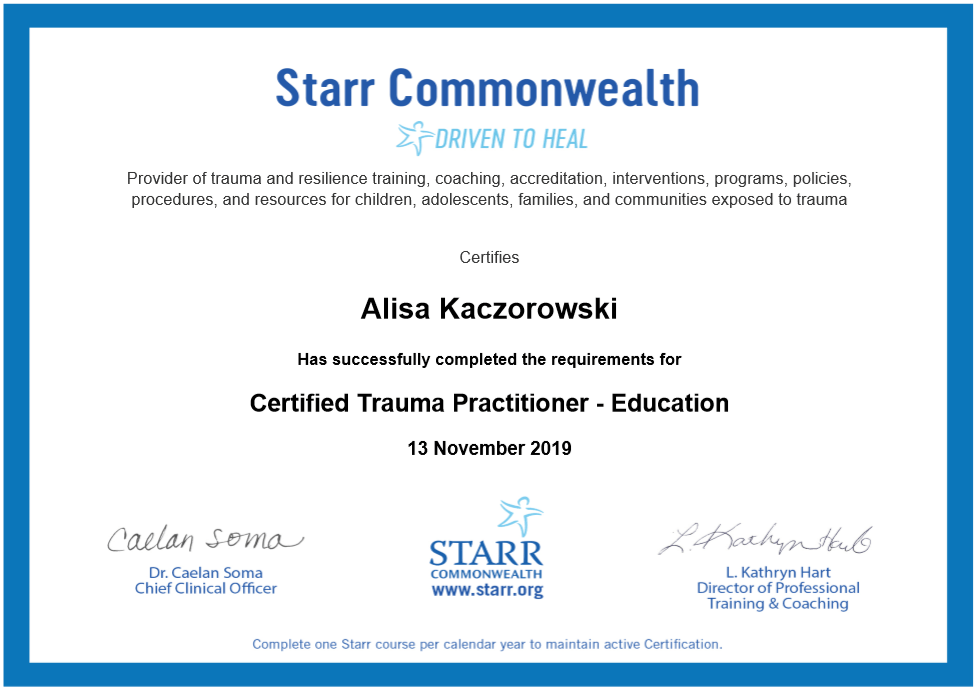
I’m excited to announce that this past week I completed my certification as a Certified Trauma Practitioner – Education (CPT-E) through Starr Commonwealth. This means I have completed 30+ hours of coursework on research-based, trauma-informed and resilience-focused strategies for educators and schools.
So what does this really mean? It means that in the coming weeks I will be using my knowledge and experience to create content for schools to help them put trauma-informed practices in place. These practices are not only useful to schools with large populations of students experiencing the trauma of poverty, domestic violence, neglect, etc. but can be used to help ANY student be more successful in school.
Practices such as relationship and community building, de-escalation strategies, anger management tips and self-care strategies for teachers can all help educators be more successful in managing their classroom and addressing the needs of struggling students.
These practices can be implemented school-wide in any school to improve upon the culture in the building, as well as raise academic achievement levels. Students whose brains are stressed simply cannot learn. It’s not until educators and schools begin to meet the basic needs of these students that discipline referrals will decrease and student engagement and achievement will increase.
There is so much research and science behind trauma-informed care and resilience strategies, and I look forward to sharing practical, easy-to-implement tips to help educators and schools get on track to better meeting the needs of at-risk students.
 akeducationalconsulting.com