
I did it. I started a Substack and will be doing a lot more of my writing and longer posts over there. I’d love for you to check it out and subscribe!
I did it. I started a Substack and will be doing a lot more of my writing and longer posts over there. I’d love for you to check it out and subscribe!
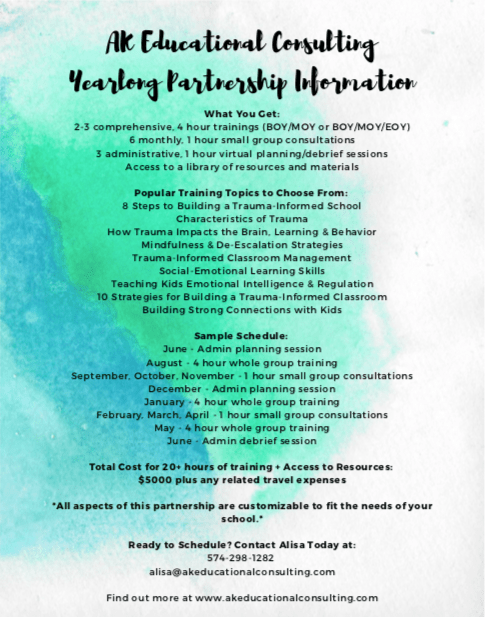
Every spring, I open up 5 yearlong partnership opportunities for the following school year.
This is a fantastic opportunity to begin, or build on, your journey toward becoming a more trauma-informed school or district.
This partnership also allows teachers to take in and process new information in smaller chunks, apply it to their classrooms and evaluate what works and what doesn’t alongside their colleagues and me.
Are you ready to commit to more than a one-and-done training for your staff? Email me to secure your spot!


I’m thrilled to announce a brand new parent workshop that focuses on the impact of social media and technology on kids and families! There are two versions of this workshop – one geared toward Catholic schools and includes content related to Blessed Carlo Acutis and one geared toward public and other private schools that does not.
Are your families expressing concerns over their children’s use of technology and social media? Are they wondering how to encourage a more unplugged childhood? Do they want to build a community of other like-minded parents? If so, my newest parent workshop will address all this and more AND in an engaging, hands-on way!
What will you learn during this training?
What else will you get from this training?
Our children are growing up in a society that values technology and instant gratification over most everything else. This has resulted in less praying and playing and more staying on screens for many of our kids. If your families are looking to empower themselves and their children to take back their childhoods, this workshop will do just that!
This training is designed for parents and caregivers. It can be done as a stand-alone 1-3 hour workshop.
If you’re ready to join the thousands of educators (and parents!) who have benefited from my trainings and expertise, send me an email at alisa@akeducationalconsulting.com. Let me help you build a happier and healthier school community!
I’m thrilled to announce a brand new training that focuses on educator well-being!
If your school is looking for ways to better support the wellness of staff members, address and increase teacher satisfaction and retention or transform the culture of the building so that students and staff are happier, my newest training may be perfect for you!
A few things you will learn during this training include:
This training is designed for teachers and other school staff. It can be done as a stand-alone 2, 4 or 6 hour professional development.
If you’re ready to join the thousands of educators (and parents!) who have benefited from my trainings and expertise, send me an email at alisa@akeducationalconsulting.com. Let me help you build a happier and healthier school!
I’ve been reviewing the Missouri Model for Trauma-Informed Schools guidance document, and I LOVE this breakdown of stages to becoming trauma-informed.
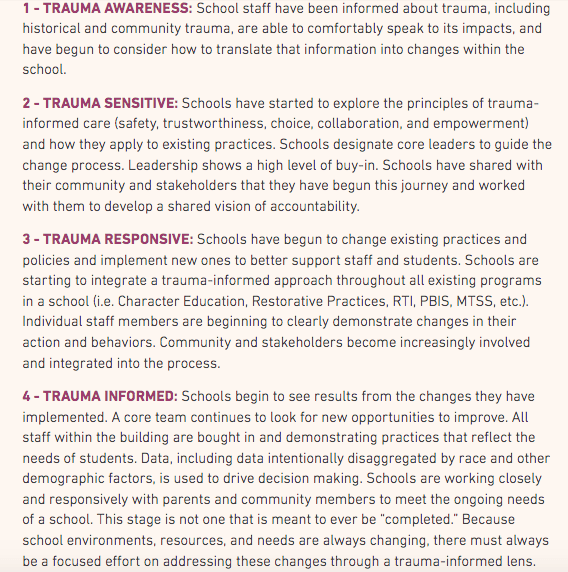
I often say that I hate the term “trauma-informed” because it’s so overused and seldom actually understood.
This is such great insight into how most schools are actually only in stage 1 – trauma awareness. Until you begin to research and implement change at the building level, and see the results of those changes, you can’t leave the first stage.
Being informed about trauma does not make you TRAUMA-INFORMED.
Well, it’s early August in Indiana which means…back to school. I know, I know…it feels WAY too early to go back to school. I agree! I don’t make the rules, though, so back they all go.
If you are one of the lucky ones who still have a lot of summering left to do, enjoy it! Your time is coming!
As we prepare for a fantastic 2024-2025 school year, though, let’s take some time to consider the culture we are building in our classrooms and schools. Is it one of safety, love and belonging or is it one of fear, submission and alienation?
I am passionate about building schools where children feel safe and loved, where behavior management is logical, intentional and appropriate, where communication and interactions are respectful and thoughtful and where feelings and emotions are welcomed and embraced.
If this is your wish for your school, let’s work together to make it happen! I believe we can change the landscape of education in this country, one school at a time.
Looking for picture books to support a lesson or discussion on resilience or perseverance? Check out one of these great titles!


What other books about resilience and perseverance do you love?
This week, I talked all about the importance of connecting, and building relationships, with kids over on YouTube. One of the strategies I discussed was relationship mapping. I found this excellent tool for use by any teacher/school looking to do a more formal relationship mapping of their students.
I realize that this might be a difficult task to undertake for educators working in larger schools, but if you’re in a smaller school or up to the challenge, this tool really is fantastic and well worth the time it would take to complete.
I’d love to hear from you, if your school has done any kind of relationship mapping! How did you do it? What were the take-aways?
***Trigger Warning: This blog post contains references to gun violence.***
Today, I’m going to digress from my typical content and tell a more personal story that highlights the importance of connection and community in building resilience in kids.
Allow me to begin by laying the foundation. My family lives in the city, in a fairly gentrified neighborhood that is surrounded by both up-and-coming areas and not-so-great areas. The police station, fire station, library and my kid’s school are all within a half mile of our house. It’s a front porch community, a walking neighborhood and, despite the violence that Indianapolis regularly experiences (and that we can often hear from our house in the form of gunshots), we feel very safe.
Our block, in particular, is a cozy, insulated city block with 20+ houses and 20+ kids. While the kids range in age from toddler to high school age, they all get along well and are outside constantly. They play soccer, race RC cars, ride bikes, draw with chalk, make up games, play with dolls, hang out on porches and just generally act like kids. I like to say that the kids on our block are living their best 1980’s childhoods.
Most of the older kids have free range of the block. Our families are all close, and we all watch out for one another. I know that if I don’t have eyes on my kids, another adult does. We all feel comfortable redirecting and correcting each others’ kids, and the kids feel comfortable talking to, and engaging with, all the grown-ups.
I realize how fortunate we are to live this life. I am grateful everyday for our neighbors, my kids’ friends and the community we’ve built on this block. I know that even just a street or two over from where we live, this is not the reality. I know that many people who live in the city don’t feel comfortable allowing their kids to run freely because they don’t know their neighbors or it just doesn’t feel safe.
That said, two weeks ago, we had a random incident of gun violence on our block, less than an hour before the kids would begin arriving home from school. Thanks to several quick calls to 911, police arrived quickly and fatally shot the gunman. However, because it was an officer-involved shooting, our block was shut down and crawling with police officers, detectives, forensics and others well into the evening hours.
In our family, my husband and I are very transparent with our kids and aren’t afraid to have tough conversations and answer hard questions, in an age-appropriate manner. Our kids feel very comfortable talking to us about just about anything (and they do, much to our chagrin sometimes!).
That day, we picked them up from school so that we could discuss what happened with them and allow them to ask questions, prior to them seeing all the action on the block where they live. As we walked and talked, we reinforced that the neighbors on our block are part of our community and that it’s our job to always look out for one another and do all that we can to keep everyone safe.
Later that evening, several parents from our block had a conversation via our block’s text thread about how to truthfully and appropriately communicate what happened to our kids to avoid them becoming fearful. In discussing how different families had approached, or were planning to approach, the subject with their children, something became so clear to me. Our kids were going to be ok.
Why was I so certain about this? Because the kids on our block are resilient, and that is because the adults around them have thoughtfully built a community of individuals who intentionally connect with one another, cultivate a sense of belonging and believe in empowering kids by allowing them to problem-solve, resolve conflict, build upon friendship and social skills and so much more, all in a safe environment.
It was entirely coincidental that all of this happened just as I had introduced the May social-emotional learning theme of resilience and perseverance. I knew right away, though, that I wanted to share this story during the month to highlight just how important connection and community are to building resilience.
When I speak in schools or at conferences about resilience (or SEL or trauma-informed care, for that matter), the one point that I always stress is this – connection matters. More than anything, in fact.
According to a study done at Harvard University’s Center on the Developing Child, “the single most common factor for children who develop resilience is at least one stable and committed relationship with a supportive parent, caregiver, or other adult.”
Many of us are fortunate enough that our kids have this many times over, in the form of parents, family members, neighbors, teachers, coaches, youth group leaders, etc.
What about the kids who don’t, though?
As a mom who also does double (quintuple???) duty as a teacher, coach, mentor, volunteer, etc., I always walk around with this question in the back of my mind.
When I’m serving as the dugout coach for my 7 year old’s baseball team or when I’m going on a field trip with my 10 year old’s class, I think about ways that I can intentionally connect with the kids around me so that maybe, just maybe, one day they will view me as one of their “people.”
It’s such a simple thing, but it’s so important. Although I truly hope not, perhaps one day, your student or child will be in a situation where resilience is the difference between them living in fear vs. processing through an event, choosing a healthy coping mechanism vs. an unhealthy one or talking to a trusted adult vs. keeping a dangerous or harmful secret.
Let’s work now to set them up for success later. It truly begins with a simple connection to build a beautiful community like the one in which I am so fortunate to live.
Do me a favor – I want you to think about how you can intentionally and meaningfully connect with another person whose path you cross today. And then, do it again tomorrow and the next day and the day after that.
Whenever I hear the word “resilience,” my mind immediately starts to think of certain sets of student siblings or family members that I’ve had over the years. I’ve always been intrigued by the question, “What causes one sibling to be on an uphill trajectory in life while another sibling makes worrisome choices?”
While we know that the answer is resilience, what does that mean really? How does one build resilience? What traits must they possess to become resilient?
These are just a few of the questions I will address over the course of this month, as we dive into our monthly SEL theme of resilience and perseverance.
First, we know that there are a plethora of traits associated with resilience building, including the following:
We also know that we can help people build resilience in a variety of ways.
The 7 Cs model of resilience building was first published by the American Academy of Pediatrics in 2006. This model provides us with a roadmap for building resilience. By identifying aligned activities and implementing them in our classrooms or homes, we can set our children up to have the ability to bounce back from challenges and roadblocks.

Over the next few weeks, I am going to spend time here and over on my YouTube channel, breaking down each of the 7 Cs. Additionally, I am going to give you actionable activities to help grow resilient learners. I hope you’ll join me!

