
5 Strategies for Building Self-Management Skills in kids

If you’ve been following along with the blog and my YouTube channel for the past several weeks, you’ve probably noticed that I’ve been spending a lot of time talking about social-emotional learning and its many components. A few weeks ago on the blog, I wrote an overview of the CASEL framework.

Last week, I began a deeper dive into each competency within the CASEL framework, beginning with self-awareness. Self-management is the second competency within the social-emotional learning framework, and it is also a critical component of building emotional intelligence, as it goes hand in hand with self-awareness. As a reminder, the Institute for Health and Human Potential states, emotional intelligence is “the ability to recognize, understand and manage our own emotions” and “recognize, understand and influence the emotions of others.” 

Self-awareness is all about knowing how you feel, understanding how your emotions impact the people around you, knowing your strengths and weaknesses and having humility. You can review even more characteristics of self-awareness by reading here.

Self-management is the ability to manage and express emotions in a constructive manner. Think of it this way – self-awareness is laying the groundwork and giving kids the tools while self-management is actually using and applying those tools in real life. Let’s look at 5 strategies that we can use to help foster self-management skills in kids.

  1. Teach and practice calm down techniques.
  2. Use “I feel…” statements.
  3. Set up a calm down space.
  4. Follow through on commitments.
  5. Set a short-term goal and create an action plan.

Teach and practice calm down techniques.

If our ultimate goal is to teach kids to self-regulate (and that IS the ultimate goal), we need to begin by explicitly teaching kids the strategies they can use to calm down. We do this by introducing a wide variety of strategies to kids so that they can begin to decide which ones feel right to them. It’s also important to help kids understand that not all strategies work for all people and that’s ok.

Think about your own go-to calm down strategies. Maybe you do yoga, listen to music or work on a puzzle. As an adult, you’ve probably figured out which activities help you the most. On the flip side, you can probably think of one or two strategies that would be stress-inducing for you rather than relaxing. Maybe dancing, running or being in nature aren’t your jam. That’s totally fine! We are all different, and thus respond in different ways to different strategies.

One thing to keep in mind when introducing calm down strategies to kids is that it takes practice, practice, practice. Kids need consistent reminders of the strategies they’ve learned and to actually use those strategies. Be patient with them; building self-regulation skills is a process.

Use “I feel…” statements.

“I feel…” statements are a great tool to teach kids to use. They are great during a disagreement and as a simple way for kids to verbalize their feelings.

Think about the last time you were in a disagreement with your partner, a friend or co-worker. Oftentimes, the words we use escalate the disagreement and put the other person on the defensive. For example, we may say something like, “You never listen to me!” This immediately makes the other person feel attacked and doesn’t really get to the root of the problem. Alternately, if we say, “I feel frustrated when you don’t look at me when I’m speaking,” the other person isn’t so quick to feel put down by the statement.

That’s the great thing about “I feel…” statements – they don’t place blame on any one person and it’s hard to argue with someone about how they feel. By using this type of statement, you are better able to keep the disagreement on track and get to the problem solving portion more quickly.

Set up a calm down space.

Remember how important it is to teach kids calm down strategies? It’s equally important to provide them with a space to practice those strategies. It might be in the library area of the classroom, an extra desk you have lying around or a corner of the dining room at home. It really doesn’t matter where you set it up, as long as there’s a dedicated space available with a few key tools.

The purpose of a calm down space is to provide kids with a quiet area to go to process through whatever it is they’re feeling. You can include comfortable seating options, low lighting, sensory tools, visual reminders of strategies they’ve been taught, music, drawing materials…the list goes on and on.

The most important thing here is that kids understand that this is not a “time-out” space in a punitive sense but a quiet, calming space with tools to help them self-regulate.
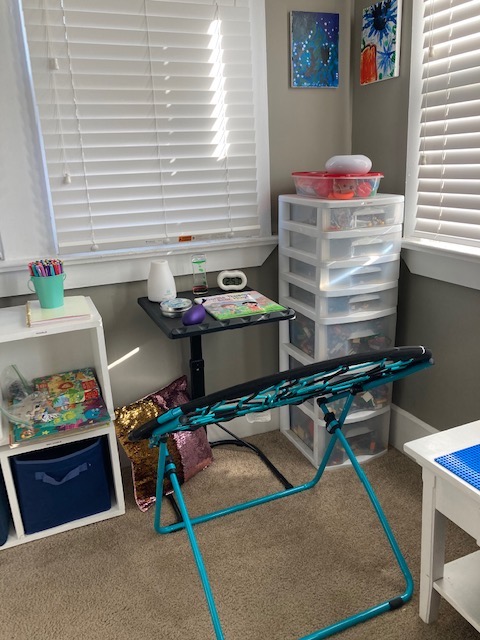
Our calm down space in my kid’s playroom

follow through on commitments.

Teaching kids to honor their commitments is a critical component of self-management. The concepts of perseverance and “stick-to-it-iveness” are ones that our kids are really struggling with, in light of the events of the past two years. However, that does not mean sending the message to kids that they should continue to do things that are unsafe or no longer serve them. This is more about teaching our kids to reflect upon whether or not they really want to join that team, club or activity. Will it fit into their schedule? Is it something they feel passionate about doing or trying? Do they understand what the commitment entails? Does it feel true to who they really are? These are the questions we want our kids to be able to reflect on to push them toward the higher-level goal of making responsible choices for themselves.

set a short-term goal and create an action plan.

If you remember, we’ve seen this strategy before! Goal setting is critical to building both self-awareness and self-management because it helps kids identify something they really want to accomplish and make and carry out a plan for doing it. Before diving into a large or long-term goal, encourage kids to start small. Help them to identify a smaller, short-term goal they would like to meet and teach them to create an action plan for how they will accomplish that goal. Don’t forget to celebrate the small wins along the way to reinforce the progress that is being made, build self-confidence and remind them that they are one step closer to their end goal.

Feel free to share other thoughts, ideas and strategies for building self-management in the comments!
5 Strategies for building self-awareness in kids

If you’ve been following along with the blog and my YouTube channel for the past several weeks, you’ve probably noticed that I’ve been spending a lot of time talking about social-emotional learning and its many components. Last week on the blog, I wrote an overview of the CASEL framework, and today I want to dig deeper into the section of self-awareness.

Self-awareness is the first competency within the social-emotional learning framework, and it is also a critical component of building emotional intelligence. According to the Institute for Health and Human Potential, emotional intelligence is “the ability to recognize, understand and manage our own emotions” and “recognize, understand and influence the emotions of others.”

Having high emotional intelligence (EQ) is very important for a variety of reasons. According to one survey, 71% of employers reported valuing EQ over IQ. Additionally, there are both short-term and long-term benefits to having a high EQ, including better grades, being less likely to drop out of school and contributing more to your community over time.

So what is self-awareness exactly and how do we go about building it in kids? Self-awareness is all about knowing how you feel, understanding how your emotions impact the people around you, knowing your strengths and weaknesses and having humility. You can review even more characteristics of self-awareness by reading last week’s blog post here.

Self-awareness is truly the foundation for social-emotional learning and building emotional intelligence. Let’s look at 5 strategies that we can use to help foster self-awareness in kids.

  1. Make feeling the feelings the norm.
  2. Teach emotional vocabulary.
  3. Celebrate strengths.
  4. Help kids set and track goals.
  5. Teach strategies for responding to compliments, feedback and criticism.

Make Feelings the Norm.

We have to start normalizing the discussion of feelings in our society. Feelings are meant to be felt! That’s why we have them. Start by modeling and discussing your feelings (i.e. I am feeling frustrated right now because many students are talking over me.). Once that feels more familiar, encourage kids to discuss their feelings (i.e. How did that make you feel? How are you feeling right now?). Expect that this will take some time.

As you encourage a more open dialogue around feelings, be sure to not minimize kids’ feelings. Help them to understand the purpose of their feelings and how we can respond to them appropriately.

Teach Emotional Vocabulary.

In order for the first strategy to be really effective, it’s critical that you provide kids with the appropriate vocabulary words to use to express themselves. Often, kids use the same words (good, fine, bad) repeatedly to describe their feelings and these words are just not incredibly descriptive or helpful. Help them branch out by exposing them to a wide variety of feelings words like the ones found on this list. Post them around the house or classroom. Use posters with emoticons to help them “read” facial expressions. Practice describing the feelings of other people or characters in books and the clues we use to help us know how they are feeling. Model the vocabulary words when you discuss your own feelings.

Celebrate strengths.

Help kids understand their many strengths and celebrate them. An important component of self-awareness is knowing what we are good at and how we can use our strengths to help others. Have kids create a list of their strengths, compare and contrast them with others and brainstorm ways to use their skills at home or in the classroom. Another important piece of this is teaching the concept of growth mindset, the idea that we all have things we are not so great at…YET. That’s why it’s important to help kids see how they can use their strengths to help others learn and grow.

Help Kids set and track goals.

Goal setting is critical to building self-awareness because it helps kids identify something they really want to accomplish and make a plan for doing it. Whether the goal is learning a new skill, honing a skill they already have or something else entirely, they are taking a good look at themselves when deciding what goal is important to them. Encourage them to break the goal down into smaller steps and set a timeline for achieving the goal. Then, be sure to celebrate the small wins they have as they work toward reaching the larger goal. Celebrating small wins reinforces that progress is being made, builds self-confidence and reminds them that they are one step closer to their end goal.

Teach strategies for responding to compliments, feedback and criticism.

Having humility is an important piece of building self-awareness. This is especially important when receiving compliments, feedback or criticism. Begin by helping kids to understand why compliments, feedback and criticism are necessary and how they help us grow as individuals. Brainstorm different responses with kids so they know how to respond when faced with different scenarios. Reinforce the concepts using the 2 stars and a wish peer feedback strategy. For example, when sharing their writing with the class, choose three peers to provide feedback – two provide stars, or compliments, and one provides a wish, or constructive feedback. Model how they might provide and respond to each classmate’s feedback.

Feel free to share other thoughts, ideas and strategies for building self-awareness in the comments!

New YouTube Series on coping skills

Check out my brand new 6 part series on coping skills over on YouTube! If you’ve ever felt angry, anxious or overwhelmed (and who hasn’t?!?), this topic is for you!

In Part 1, you will learn what coping skills are, why they are important and who might benefit from them (hint: EVERYONE!). You will also learn about the 5 categories that coping skills fall into.

In Parts 2-6, we will dive deeper into each of the 5 categories and identify specific skills within each one and when they might be beneficial to use.

Videos will drop on Tuesdays and Thursdays so be sure to follow my channel to get notifications! I hope you enjoy this series!

Summer Survival Tips for Parents

Photo by Julia Kuzenkov on Pexels.com

If you’re anything like me, you are currently feeling a healthy dose of nerves and fear as the kids are excitedly counting down the days to summer break (and dreaming of the picture above). No? Just me? I hope I’m not alone here!

While I love my kids (obviously), they are a lot of work. They need a lot of things…everyday. Things like breakfast, snacks, lunch, more snacks, attention, entertainment, another snack (why do they eat SO much??). I knew this when I signed up for motherhood, but geesh!

These past 15 months have been a whirlwind of fear, transition and emotional ups and downs. Every time we get settled into a routine, it’s back to virtual learning…or in-person learning…or winter break. This would be fine if I had no other responsibilities in life, but I do (along with every other parent in the universe). I have this little thing called a job, and summer and fall happen to be my busiest times of the year.

So…I’m just a *little* nervous about having 3 kids at home with me and trying to figure out how to juggle ALL THE THINGS. Anyone with me here?

In order to prevent a full-blown panic attack, I decided to sit down and plan out our summer as best I could. I listed out my needs (work-related and personal) and mapped out all the vacation and camp weeks. My kids and I also made a summer bucket list. This is something we do each spring. Basically, it’s a list of things they’d like to do or places they’d like to go. We keep it fairly simple. This year’s list is full of parks, the library’s summer reading program, picnic dates with friends and pool time.

Then, my husband and I sit down and figure out the carpool situation and how to break up the work day so that I can actually accomplish the things on my to-do list. I also brainstormed a few other ways to ensure we all come out of this summer unscathed. Here they are:

  1. Map Out a Daily Routine…and Stick with It!

Our kids crave consistency. If there’s one thing that’s been missing during this pandemic, that would be it. Map out a daily schedule that works for your family and stick with it. I don’t mean plan out every minute of every day, but do have a rough plan for each day. Factor in breakfast, lunch and snack times and time for chores, reading and other activities. Be specific about if and when screen time will be allowed. Use timers on your smart devices to hold your kids (and yourself!) accountable.

2. Have a Daily Quiet Period

Perhaps your kiddos are still little and take naps. Hooray! Unfortunately, we are past that stage at my house. However, I am instituting a quiet hour each day this summer. The kids and I have chosen 4 separate locations in our house (bedroom, playroom, living room and porch) where we will spend one hour everyday. This is time for me to work and them to do a quiet activity such as reading, puzzles, rest or quiet play. I have discussed my expectations for this time so they know what they may and may not do, as well as the purpose of this time being to rest and recharge (them) and work (me). This is also a great time for kids to practice mindfulness activities which will help with emotional regulation. There are tons of great resources out there such as yoga cards, mindfulness picture books, etc. that you can tap into.

3. Schedule One-on-One Time with Each Child

I have one child who is really struggling with reading. She is getting a lot of extra help at school and does tutoring 2 afternoons a week. It will be critical for her to continue being exposed to books and practicing reading every single day over the summer. Since my kids typically play really well in pairs (not as much in 3s), I decided to set aside time each day for me to spend one-on-one with each of my kids. During this time, the other 2 will occupy each other outside or in another room. This way, I can work on reading with one kiddo, emotional regulation strategies with another and basic preschool skills with the third. Everyone gets what they need and gets bonus time with mom! It’s a win-win!

4. Plan Your Weekly Activities/Outings

Remember how I mentioned the summer bucket list? This is where those activities come into play. Each week, we will choose the activities we are going to do, based on the weather, what camps or other commitments we have, etc. I typically have my kids take turns choosing the activities so that everyone’s choices are honored. Our rule is, if you whine and complain about someone else’s choices, you lose your next opportunity to choose. We do not do one activity or outing everyday. Some days, I cave and let them have screen time. Other days, they are having a blast playing outside with neighbors, and I’m not about to interrupt that! It is nice to have something to look forward to each week, though!

5. Take Time for Yourself

Be sure to schedule in time for YOU! You know those things that just help you feel like the best version of yourself? Make sure those things are on the calendar! Whether it’s exercise, time to read, get a massage or veg out with Netflix, it’s imperative you MAKE the time to do them. It’s for your own sanity. You will a better parent if you’re taking care of yourself as well!

6. Give Yourself Grace When Everything Blows Up in Your Face 🙂

It’s going to happen. I know and you know it. On the days that it inevitably happens, give yourself grace, bust out the iPads (or sprinklers, or popsicles, or whatever will help you get through the day) and remind yourself that tomorrow will be better!

Hopefully, you’ve gotten some good tips for surviving the summer and you’re ready to tackle the challenge! Have a tip that wasn’t mentioned? Share it with us!