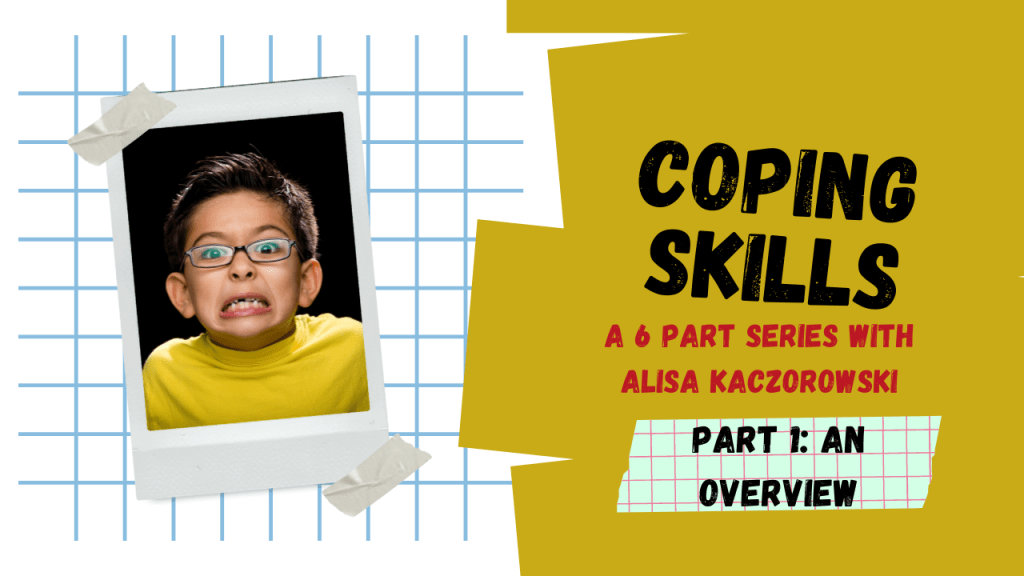
New YouTube Series on coping skills

Check out my brand new 6 part series on coping skills over on YouTube! If you’ve ever felt angry, anxious or overwhelmed (and who hasn’t?!?), this topic is for you!

In Part 1, you will learn what coping skills are, why they are important and who might benefit from them (hint: EVERYONE!). You will also learn about the 5 categories that coping skills fall into.

In Parts 2-6, we will dive deeper into each of the 5 categories and identify specific skills within each one and when they might be beneficial to use.

Videos will drop on Tuesdays and Thursdays so be sure to follow my channel to get notifications! I hope you enjoy this series!

App Review: Headspace

Let’s talk about a new-to-me app called Headspace. I know this one is very popular with many people, but I hadn’t tried it out until a few weeks ago. Thank goodness I did because now I’m obsessed with it!

Not only are there a ton of meditations and breathing exercises of varying lengths (most are 2-10 minutes), there are targeted meditation courses, sleep meditations and music, focus playlists and workouts! Plus, everything is categorized so it’s easy to find exactly what you’re looking for. Want a breathing exercise to jumpstart your day? Check! How about a meditation to help you feel more hopeful and less anxious? Check! There is even a whole category of meditations for kids!

So maybe you’re wondering what all the hype around mindfulness is about. Well, in her book, Mindful Parenting, Dr. Kristen Race discusses how even 5 MINUTES of daily mindfulness practice can work to strengthen the neural pathways in the brain, resulting in more reflective responses vs. impulsive responses. I don’t know about you, but the deeper into this pandemic we’ve gone, the more impulsive my responses to my husband, my children and myself have become. It’s something I’m actively working to improve, and practicing mindfulness each day is one action step I’m taking toward thinking before speaking or acting.

Perhaps you’ve noticed your interactions becoming more reactive as well. Or perhaps you have a kiddo who flies off the handle when told no or when they don’t get their way. Mindfulness practice is a great place to begin course correction. Plus, if we want our kids to grow their emotional intelligence and learn self-regulation techniques, they must be able to filter and vet their words and actions first. This means they need to actively practice slowing down and taking charge of their brain at times.

Mindfulness isn’t easy for most of us, but like many other things in life, the more we practice, the better we become. The good news is that Headspace makes the practice part easy. See my overall review below and check out this awesome app, if you haven’t already!

PROSCONS
Great for all ages and levelsCostly (~$70 per year)
So many options for meditating, breathing, moving and focusingThe many options can feel a bit overwhelming for beginners.
Well-organizedYou still have to make the time…the app won’t do that part for you!
Easily set reminders to make mindfulness a daily practice

Creating a Calm Down Corner for Kids

Yesterday, I had the opportunity to sit down (virtually, of course) and talk with my friend, Casey VanPutten, a Certified EFT Practitioner and leader extraordinaire of the Mothering Freely Facebook group. We chatted about the importance of calm down corners and how to create one in your home or classroom. Plus, as a bonus at the end, we talk about tapping with kids, a topic that is close to both of our hearts! Enjoy!

**I will be adding this topic as a Parent Workshop in January! Shoot me an email for more details!

Video #2: De-Escalation Strategies

The second video that I recorded in collaboration with Indy Direct Docs has dropped over on their website! You can view the entire video here.

Just a reminder that these strategies, as well as TONS of others, will be included in the new virtual parent workshop that is coming very soon! If you’re interested in more information about that, reach out to me at akedconsult@gmail.com.

My Favorite De-Escalation Strategy

Oftentimes, as adults, it can be very difficult for us to step back and think logically when our students or our own children are angry. Some of us may feel ourselves escalating. Others may feel the need to “fix” the situation for the child. Still others may think that ignoring the behavior will help the child to calm down. While there is nothing inherently “bad” about any of these reactions, there is a better way.

Most often, when kids are activated, they need us to remain calm and present for them, and they need us to help them through, not around, the situation. How do we do this?

First, we validate the feelings, but not the behavior, of the child. This may sound something like, “It is ok for you to feel angry right now, but it’s not ok to hit your friend.” This lets the child know that feeling big emotions is not only ok but perfectly normal! Once they know that it is ok to feel the way they do, but that you do not condone making poor choices, you can move onto the next step.

Start by ingraining this phrase (or another similar phrase) into your brain, “In this moment, what can I do to help you?” Asking this of the child puts the ball in their court and teaches them important problem solving and communication skills. Now it is not you, the adult, fixing the situation but the child communicating their needs to you which is the ultimate goal.

I have found that, by using this strategy with my own children, they are initially surprised by this question. I think so many adults (myself included!) spend so much time trying to “control” the thoughts, words and actions of children, they are not accustomed to being asked about their needs. Once the phrase becomes more commonplace in your classroom or home, though, you may be amazed at what your students or children are able to communicate to you.

Perhaps they really want someone to listen to them or maybe they need a quiet place to sit for a few minutes. I’ve even gotten the response, “A granola bar…I’m just hangry!” Sometimes the solution to the problem is simpler than we might think.