The third video in my collaborative series with Indy Direct Docs is now up on their website! You can view it here. I sat down with Dr. Holliday to discuss how to share difficult news and current events with children. This is such a timely topic right now, as parents and educators navigate the tricky waters of appropriately informing kids of current events while being mindful of their age and emotional well-being.
Interested in learning more about topics like this? Check out the other videos in the series here and here or shoot me an email at akedconsult@gmail.com. You can also find out more about Indy Direct Docs at their website.
As I’ve been traveling to schools around the Midwest to train teachers, I’ve had the opportunity to reflect upon some of the obstacles that I have encountered as a “teacher.” Over the next week or two, I am going to post about a few of them, as I think they are valuable information for all teachers to consider as they return to school in-person.
Until you have to stand in front of a group of people (whether adults or children) and talk all day long, you probably underestimate the power of reading facial expressions and their impact on your teaching. This became abundantly clear to me in the first hour of my first training this summer.
Being able to see only eyes and foreheads makes it nearly impossible to read a person’s expression which is often a direct reflection of their interest in, and understanding of, a topic. If I’m presenting confusing information…I see eyes staring at me. If I’m telling a funny story to highlight some information I taught…I see (possibly slightly squinty) eyes staring at me. If I’m asking if anyone has questions…I see eyes staring at me. As a seasoned teacher, I was not anticipating how heavily I (apparently) rely on looking at people’s faces and reading their expressions to drive my instruction.
Fortunately, since I’ve realized this, I’ve been able to work it into my trainings. Why? Because this highlights the importance of teaching our students to recognize and name their emotions, skills that were already important pre-pandemic.
If students are wearing a mask all day, as teachers, we are going to need to rely on students to gauge their feelings and understanding of content. Some of you may be thinking, “Yeah right!” to yourselves right now, and I feel you. Our kids are notoriously BAD at recognizing and naming their emotions, for a lot of reasons.
Like so many other things that fall into the laps of teachers, though, we need to help our students recognize the different emotions they may feel and give them the vocabulary to name them. Not only is this going to be critical information teachers need, but these are skills that students need to hone anyways. Recognizing and naming emotions is the foundation for learning de-escalation and self-regulation strategies. We can’t expect kids to be able to self-regulate if they cannot even recognize what they are feeling in a given moment.
So how do we teach these skills to kids? The first step is helping them be aware of WHY this is a problem. This could be done through role playing or the simple act of making different faces under your mask and having students try to guess how you’re feeling. We did this at one of schools I visited and let me tell you how impossible it is to figure out what face a person is making (it’s also kind of hysterical!).
Once kids understand why it is important for them to learn this new skill, you can begin giving them the necessary vocabulary. Make an anchor chart of common feelings (sad, tired, frustrated, excited, etc.) and some of the ways we FEEL these feelings in our bodies. This will help students learn the words they need to verbalize their emotions but also give them clues to look for when they are trying to decipher how they’re feeling in a given moment.
The final step is constant practice through modeling. Feeling frustrated with technology? Talk through it aloud so students can hear you verbalizing your emotions. It might sound something like this:
“Oh, boys and girls, this website doesn’t seem to want to work right now. That is making me feel very frustrated. I really wanted to show you this video that aligns to what we are learning in science. I don’t really like how tense my body feels when I’m frustrated, though, so I think we will just need to be flexible and perhaps come back to this video later. I know many of you are feeling disappointed right now and that’s ok, but we can’t control technology that doesn’t want to work, can we?”
Peppering your instruction with this type of modeling throughout the day will help students feel more comfortable expressing their emotions verbally. You will also likely need to talk students through the process of recognizing and naming their emotions many, many times before they will be able to master it. Rest assured, though, that even if the pandemic is long over by the time some of them do master this skill, it is one that will serve them well for the rest of their lives.
We are all feeling it. The cabin fever has set in. Our emotions swing like a pendulum, constantly in motion, veering from gratitude to anger, contentment to hopelessness. As adults, we are struggling to maintain a positive attitude, a calming presence. Just imagine how difficult this emotional regulation must be for a child, even a seemingly well-adjusted one. Now imagine what it must be like for a child who struggles with anxiety, depression or ADHD.
Regardless of how well-adjusted a child is, these uncertain times have thrown everyone for a loop. I have no doubt that most kids are struggling, in some way, at some time. This turning upside-down of lives is traumatic, and many children may not be equipped to process what they’re feeling.
The good news, though, is that there are things we can do to help.
Maintain Relationships
As teachers, we know that relationships are key to having a successful school year. Although, it’s difficult to build relationships in our current situation, we can most definitely be proactive in maintaining the relationships we spent the first half of the school year building. In fact, our students are counting on this.
It doesn’t have to be extravagant or expensive or full of fanfare (despite what some Facebook posts may be making you think). Sending your students a quick note, calling to check in on them (aside from planned virtual class meetings) or sending them a silly picture of something you’ve done can go a long way.
I know these are the things my own children have thrived on. One received a handwritten note and activity book on the porch one day. It made her entire day! The other got happy birthday messages from both his current and former teachers that made him feel so special. Such simple acts can make a profound impact on kids during uncertain times and serve as a reminder of their lives before quarantine.
2. Consistency is Key
Kids crave consistency, and that’s a hard thing to come by during a global pandemic when it seems everyday new information pushes us further away from our former reality. During this time, thanks to the nature of virtual learning, there’s only so much consistency teachers can provide. And as for parents, it’s difficult to provide the structure and consistency to which kids are accustomed with so many competing items on the daily to-do list.
Think about a typical school day, though, where kids are busy for 6-7 hours per day. It would be impossible to replicate this at home (nor should you), but figuring out a schedule or structure that will work for your family is key. Kids need to know what to expect during each part of their day. It will provide them with the structure and (kind of, sort of) sense of normalcy they need.
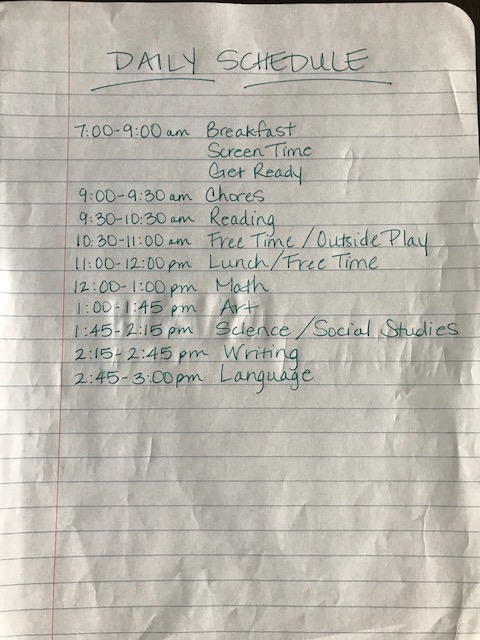
At my house, we have a schedule taped to the table where we complete our homeschooling (see below). It’s nothing fancy, and we’ve revised it about 3 times already, but it gets the job done. It helps my kids know what the day will look like and provides them a visual reminder of what they need to complete. The days I have allowed my kids to stray from the schedule have been some of the most difficult days we’ve experienced.
3. Acknowledge and Validate Feelings
This one can be difficult to do, but it is so important. Acknowledging and validating kids’ feelings is critical to helping them understand that they are not alone in how they are feeling. If your house is anything like mine, the emotions change from happiness to boredom to anger and back to happiness faster than I can keep up.
When kids are feeling emotional, it’s important to help them recognize and name their emotions. They cannot regulate their emotions, if they don’t recognize what they are feeling. “I feel” statements are so useful for helping kids identify and voice their feelings. For instance, when my oldest is exhibiting “big feelings,” I always start by asking him what is going on (sometimes I already know and other times I’m completely in the dark). Once he is able to verbalize and identify how he is feeling (“I feel mad because I have so much schoolwork to do and it’s nice outside”), we can begin to brainstorm an action plan of regulation strategies.
Emotional regulation strategies are important for even the most well-adjusted kids because even they are going to have days when they just feel down. My very chill middle child is a perfect example of this. She doesn’t typically exhibit “big feelings,” but lately, she’s been occasionally off, and I just know the quarantine is getting to her. Typically, if I ask her what is wrong, she will tell me she misses school, her friends or her teacher. On these days, I usually just let her be, and she typically spends more time playing alone in her bedroom or quietly doing crafts. Social distancing has been her go-to regulation strategy since long before this pandemic made it the cool thing to do…ha!
4. Teach Tools for Self-Regulation
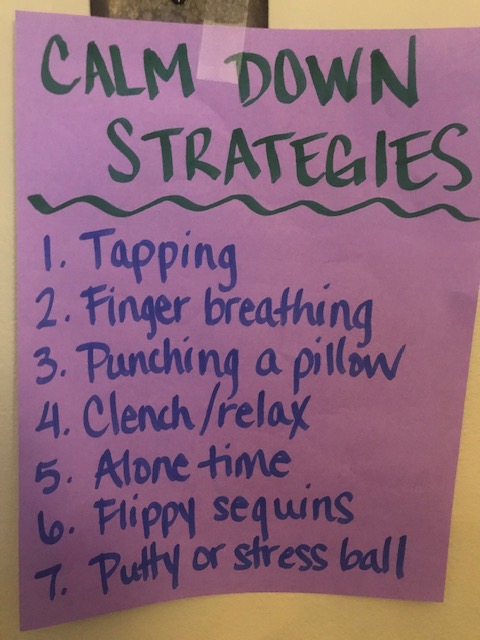
Once kids are able to recognize and identify their feelings, they’re ready to begin learning strategies for emotional regulation, or calm down strategies, as we call them in my house.
Last week was a very tough week at my house so I did an activity with my kids to help them better understand some of the “big feelings” they’ve been experiencing lately. First, we talked about how we can physically feel our emotions throughout our bodies (sweaty palms, racing heart, butterflies in our belly), and we each gave examples of how our bodies feel when we are feeling nervous, shy or sad. Then, I explained how our “feeling brain” takes over our “thinking brain” when we are experiencing strong emotions and that we need to help our “thinking brain” get back in control. I asked them to think of different things they could do to help calm their “feeling brain.” The list below is what they came up with. Now, keep in mind that we use a lot of calm-down strategies in our house so all the ideas they came up with are ones with which they are familiar. My goal in doing this activity was not to teach them new strategies so much as it was to remind them of the strategies they already know (sneaky, I know!).
5. Be Transparent about the Future
This one can be scary to think about, but it’s so important that we encourage open and honest conversations with our kids. Whether you’re a teacher conducting a virtual class meeting or a parent, your kids are going to ask questions about the current state of affairs. Be prepared for these questions. How can you provide kids the reassurance they need to feel safe, loved and cared for while also not hiding things from them? Obviously, the age of the kids should be taken into account when determining what to tell them.
From the very beginning of this pandemic, I have worked to prepare my kids for possibilities…the possibility of school being cancelled for the remainder of the year, the possibility of pools not opening this summer, and most recently, the possibility of not returning to school in a normal fashion next fall. I like to pose these possibilities as questions to my kids initially. For instance, I asked my oldest today, “How would you feel if you weren’t able to go back to school in August?” His answer was, “A little sad because I miss my friends but happy because we don’t have to do as much work at home and I get to be with you.” This provided an opening for me to discuss this as a real possibility with him in a non-scary manner. I’ve done the same thing with my middle child but tailored the conversation to fit her age and personality.
You know your students/children best. You know what each of them can handle. Prepare yourself with responses that address their questions in a positive, hopeful manner. The goal is to be transparent in an age-appropriate way.
Hopefully, by incorporating these strategies into your virtual or homeschool classroom, you can help provide your kiddos with the reassurance and validation they need to realize that this too shall pass.
As educators, we have a big enough job ahead of us when students return to school with inevitable achievement gaps. There’s no reason they should have to return with mental baggage as well.



 akeducationalconsulting.com