My Favorite De-Escalation Strategy

Oftentimes, as adults, it can be very difficult for us to step back and think logically when our students or our own children are angry. Some of us may feel ourselves escalating. Others may feel the need to “fix” the situation for the child. Still others may think that ignoring the behavior will help the child to calm down. While there is nothing inherently “bad” about any of these reactions, there is a better way.

Most often, when kids are activated, they need us to remain calm and present for them, and they need us to help them through, not around, the situation. How do we do this?

First, we validate the feelings, but not the behavior, of the child. This may sound something like, “It is ok for you to feel angry right now, but it’s not ok to hit your friend.” This lets the child know that feeling big emotions is not only ok but perfectly normal! Once they know that it is ok to feel the way they do, but that you do not condone making poor choices, you can move onto the next step.

Start by ingraining this phrase (or another similar phrase) into your brain, “In this moment, what can I do to help you?” Asking this of the child puts the ball in their court and teaches them important problem solving and communication skills. Now it is not you, the adult, fixing the situation but the child communicating their needs to you which is the ultimate goal.

I have found that, by using this strategy with my own children, they are initially surprised by this question. I think so many adults (myself included!) spend so much time trying to “control” the thoughts, words and actions of children, they are not accustomed to being asked about their needs. Once the phrase becomes more commonplace in your classroom or home, though, you may be amazed at what your students or children are able to communicate to you.

Perhaps they really want someone to listen to them or maybe they need a quiet place to sit for a few minutes. I’ve even gotten the response, “A granola bar…I’m just hangry!” Sometimes the solution to the problem is simpler than we might think.

New Resource & Training

With so many schools making the decision to begin the year 100% virtually, many educators are feeling overwhelmed and anxious about the start of the school year. How will they build relationships with students? How will they meet the needs of all their students virtually? How will they prevent at-risk students from slipping through the cracks?

During this time, it’s critical for teachers to build trauma-informed VIRTUAL classrooms. Arguably, trauma-informed practices are just as important for virtual classrooms as they are for traditional classrooms.

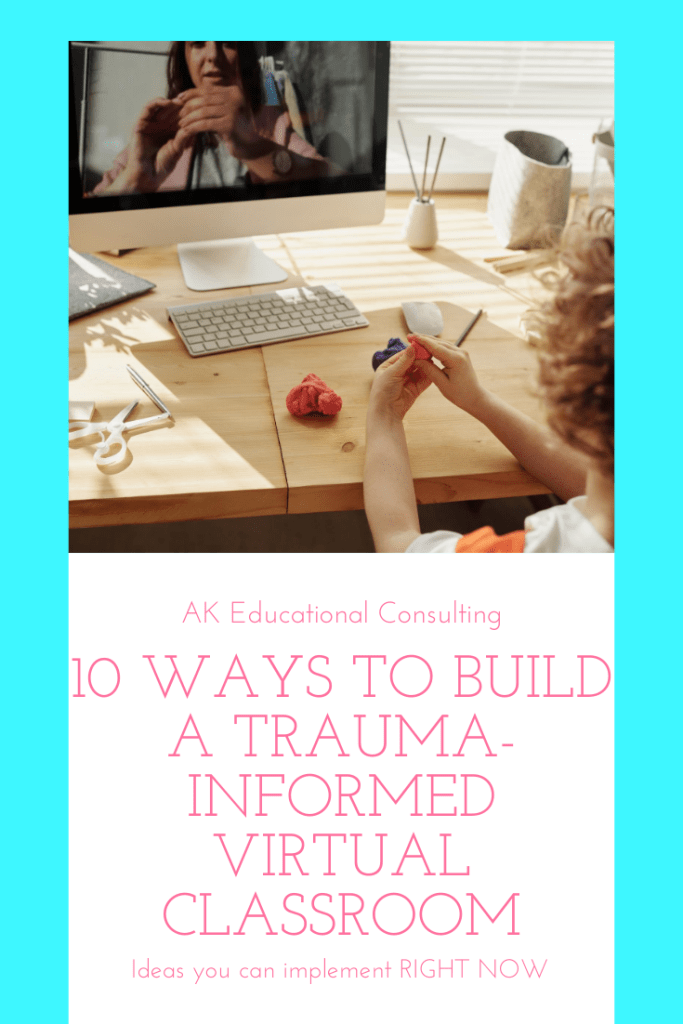
Need a jumpstart? Check out my new infographic here for 10 easy-to-implement strategies!

Want to go even deeper? Contact me to learn more about a NEW training that will help educators build a trauma-informed virtual classroom.

Minimizing Traumatic Feelings in Kids During Uncertain Times

We are all feeling it. The cabin fever has set in. Our emotions swing like a pendulum, constantly in motion, veering from gratitude to anger, contentment to hopelessness. As adults, we are struggling to maintain a positive attitude, a calming presence. Just imagine how difficult this emotional regulation must be for a child, even a seemingly well-adjusted one. Now imagine what it must be like for a child who struggles with anxiety, depression or ADHD.

Regardless of how well-adjusted a child is, these uncertain times have thrown everyone for a loop. I have no doubt that most kids are struggling, in some way, at some time. This turning upside-down of lives is traumatic, and many children may not be equipped to process what they’re feeling.

The good news, though, is that there are things we can do to help.

  1. Maintain Relationships

As teachers, we know that relationships are key to having a successful school year. Although, it’s difficult to build relationships in our current situation, we can most definitely be proactive in maintaining the relationships we spent the first half of the school year building. In fact, our students are counting on this.

It doesn’t have to be extravagant or expensive or full of fanfare (despite what some Facebook posts may be making you think). Sending your students a quick note, calling to check in on them (aside from planned virtual class meetings) or sending them a silly picture of something you’ve done can go a long way.

I know these are the things my own children have thrived on. One received a handwritten note and activity book on the porch one day. It made her entire day! The other got happy birthday messages from both his current and former teachers that made him feel so special. Such simple acts can make a profound impact on kids during uncertain times and serve as a reminder of their lives before quarantine.

2. Consistency is Key

Kids crave consistency, and that’s a hard thing to come by during a global pandemic when it seems everyday new information pushes us further away from our former reality. During this time, thanks to the nature of virtual learning, there’s only so much consistency teachers can provide. And as for parents, it’s difficult to provide the structure and consistency to which kids are accustomed with so many competing items on the daily to-do list.

Think about a typical school day, though, where kids are busy for 6-7 hours per day. It would be impossible to replicate this at home (nor should you), but figuring out a schedule or structure that will work for your family is key. Kids need to know what to expect during each part of their day. It will provide them with the structure and (kind of, sort of) sense of normalcy they need.

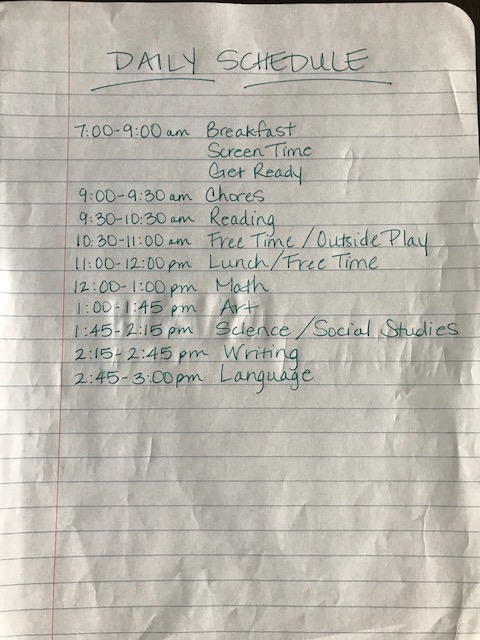
At my house, we have a schedule taped to the table where we complete our homeschooling (see below). It’s nothing fancy, and we’ve revised it about 3 times already, but it gets the job done. It helps my kids know what the day will look like and provides them a visual reminder of what they need to complete. The days I have allowed my kids to stray from the schedule have been some of the most difficult days we’ve experienced.

3. Acknowledge and Validate Feelings

This one can be difficult to do, but it is so important. Acknowledging and validating kids’ feelings is critical to helping them understand that they are not alone in how they are feeling. If your house is anything like mine, the emotions change from happiness to boredom to anger and back to happiness faster than I can keep up.

When kids are feeling emotional, it’s important to help them recognize and name their emotions. They cannot regulate their emotions, if they don’t recognize what they are feeling. “I feel” statements are so useful for helping kids identify and voice their feelings. For instance, when my oldest is exhibiting “big feelings,” I always start by asking him what is going on (sometimes I already know and other times I’m completely in the dark). Once he is able to verbalize and identify how he is feeling (“I feel mad because I have so much schoolwork to do and it’s nice outside”), we can begin to brainstorm an action plan of regulation strategies.

Emotional regulation strategies are important for even the most well-adjusted kids because even they are going to have days when they just feel down. My very chill middle child is a perfect example of this. She doesn’t typically exhibit “big feelings,” but lately, she’s been occasionally off, and I just know the quarantine is getting to her. Typically, if I ask her what is wrong, she will tell me she misses school, her friends or her teacher. On these days, I usually just let her be, and she typically spends more time playing alone in her bedroom or quietly doing crafts. Social distancing has been her go-to regulation strategy since long before this pandemic made it the cool thing to do…ha!

4. Teach Tools for Self-Regulation

Once kids are able to recognize and identify their feelings, they’re ready to begin learning strategies for emotional regulation, or calm down strategies, as we call them in my house.

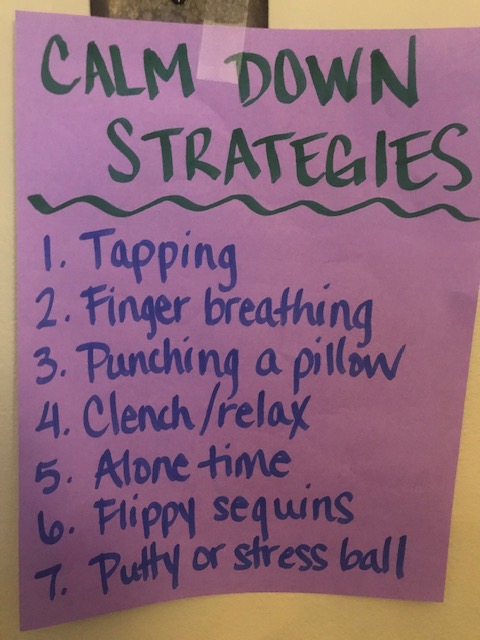
Last week was a very tough week at my house so I did an activity with my kids to help them better understand some of the “big feelings” they’ve been experiencing lately. First, we talked about how we can physically feel our emotions throughout our bodies (sweaty palms, racing heart, butterflies in our belly), and we each gave examples of how our bodies feel when we are feeling nervous, shy or sad. Then, I explained how our “feeling brain” takes over our “thinking brain” when we are experiencing strong emotions and that we need to help our “thinking brain” get back in control. I asked them to think of different things they could do to help calm their “feeling brain.” The list below is what they came up with. Now, keep in mind that we use a lot of calm-down strategies in our house so all the ideas they came up with are ones with which they are familiar. My goal in doing this activity was not to teach them new strategies so much as it was to remind them of the strategies they already know (sneaky, I know!).

5. Be Transparent about the Future

This one can be scary to think about, but it’s so important that we encourage open and honest conversations with our kids. Whether you’re a teacher conducting a virtual class meeting or a parent, your kids are going to ask questions about the current state of affairs. Be prepared for these questions. How can you provide kids the reassurance they need to feel safe, loved and cared for while also not hiding things from them? Obviously, the age of the kids should be taken into account when determining what to tell them.

From the very beginning of this pandemic, I have worked to prepare my kids for possibilities…the possibility of school being cancelled for the remainder of the year, the possibility of pools not opening this summer, and most recently, the possibility of not returning to school in a normal fashion next fall. I like to pose these possibilities as questions to my kids initially. For instance, I asked my oldest today, “How would you feel if you weren’t able to go back to school in August?” His answer was, “A little sad because I miss my friends but happy because we don’t have to do as much work at home and I get to be with you.” This provided an opening for me to discuss this as a real possibility with him in a non-scary manner. I’ve done the same thing with my middle child but tailored the conversation to fit her age and personality.

You know your students/children best. You know what each of them can handle. Prepare yourself with responses that address their questions in a positive, hopeful manner. The goal is to be transparent in an age-appropriate way.

Hopefully, by incorporating these strategies into your virtual or homeschool classroom, you can help provide your kiddos with the reassurance and validation they need to realize that this too shall pass.

As educators, we have a big enough job ahead of us when students return to school with inevitable achievement gaps. There’s no reason they should have to return with mental baggage as well.

Stay well, my friends.

Trauma-Informed Practices & COVID-19: A Roadmap for Educators

Over the past few weeks, for a variety of reasons, I’ve struggled with putting pen to paper here on this blog. Life has come to a standstill, it seems, but in an odd juxtaposition, a standstill in which time is in short supply.

With two school-aged children, as well as a toddler at home, my life (just like many of yours) has been thrown a curveball. Instead of meetings with administrators, planning professional development sessions and speaking at conferences, I am homeschooling a kindergartener and third grader while also trying to entertain a three year old…and work…and cook meals…and keep a house clean…and the list goes on and on.

While all that is challenging, I feel grateful everyday that I am an educator, equipped to continue providing my children with high-quality instruction based on their needs. Most parents aren’t afforded that luxury. In fact, most parents cannot just put their work on hold to attend to their family’s needs. They rely on their paycheck to survive, and that paycheck may now be much smaller or altogether non-existent. They may have just gone from being worried about buying groceries last week to being downright panicked this week.

So many of our students were living in deplorable conditions or in frightening home environments just mere weeks ago. And now? Well, now their homes may just be unimaginable. Neglect. Abuse. Food insecurity. Domestic violence. All of these things are on the rise and only worsening around the world, as this pandemic stretches from weeks into months.

How do we cope with this as educators? What do we do to help care for our students from afar?

If you thought I was a proponent of trauma-informed practices prior to this pandemic, just wait until you see me once it’s over. I will be singing their praises from the rooftops! The good news, though, is that we don’t have to wait until it’s over. We can start right now.

I came across this article this evening that is so concisely written and full of specific ideas for incorporating trauma-informed practices into e-learning. I urge you to take a few minutes to read it and reflect on how you can implement some of the strategies mentioned into your own distance learning plan.

The cornerstone of trauma-informed education is relationship-building, and there are still plenty of ways to maintain and grow the relationships you have with students during this time. In fact, it’s even more critical to do so now. We have an uphill battle ahead of us in the weeks and months to come. But I know that if anyone is up to the challenge, it’s educators.

Exciting News!

I am super excited to announce that I have been selected to present a breakout session at the 2020 Southeastern School Behavioral Health Community Annual Conference next month in Myrtle Beach! I will be presenting “10 Strategies for Building a More Trauma-Informed Classroom Right Now.” I’m looking forward to connecting with educators, school leaders and mental health professionals in the Southeast region. Stay tuned for more information and more BIG news!

Children’s Books and Social-Emotional Learning

I love picture books. No, I mean I really LOVE picture books. I check out picture books from the library like most adults check out, you know…books for adults. I believe they can be used as mentor texts for just about any topic – math, science, music, art, even social-emotional learning. Especially social-emotional learning. That’s why I’m working on creating a GIANT list of mentor texts that can be used to address every SEL topic I can think of. I want educators and parents alike to have a resource to go to when looking for a book to read to their child on say, bullying or acceptance of others.

The list is going to be a living document, meaning it will never be “done.” I will just keep adding to it as long as children’s books are published. Know of a great book I haven’t included (I mean…I know a LOT of picture books but not ALL of them)? Let me know about it! Shoot me an email, share it on Facebook, leave it in the comments here.

Just to get started, here are three of my favorites…

You all know of my love for tapping. This is a great picture book to introduce children to tapping and help them to remember the meridian points in a fun and interactive manner.

I love, love, LOVE every book by Jory John. This one is great, though, because of the underlying message that not every seed starts off as a “bad” seed. It’s great for helping children understand the idea that life events can affect a person’s behavior and actions.

Of course, we all know and love the chapter book Wonder, but I happen to think it was a brilliant idea to turn the storyline into a picture book. The message is perfect and now it’s accessible to a younger audience. What’s not to love about that?

All right…now it’s your turn! What are some of your favorite picture books to support social-emotional learning topics? Share them in the comments below!

A TED Talk on Trauma

Anyone who knows me well knows that I LOVE a good TED Talk. As an instructional coach and school administrator, I used them regularly in my Professional Learning Communities (PLCs) to inspire and spark dialogue. In fact, one of my goals in life is to present a TED Talk!

I came across this particular TED Talk this morning, as I was doing research for some professional development content I’m creating. The presenter is Dr. Meredith Fox, a long-time public educator and current deputy superintendent in New York State. The personal experience she brings to her talk is both inspiring and eye-opening, making it a must-see for educators. Do yourself a favor and take 15 minutes out of your day to watch it here.

After you watch it, I hope you’ll ask yourself, “Have I created a space where my students can unload their backpack?”

Experiencing Emotional Freedom Technique (EFT)

Last week, I had a unique opportunity arise to experience and learn more about something that I have been interested in for a year or two. Emotional Freedom Technique (or EFT), more commonly known as tapping is a method of tapping specific points on the face and upper body to reduce stress, anxiety and depression, among other things.

I first heard about tapping about two years ago when a special education teacher at my school sent out information to the staff about the technique. At that time, we were working hard to incorporate trauma-informed practices and become the first trauma certified school in our state. Tapping fit right in with many of the strategies we were learning about and introducing to students. I had never heard of tapping, but the more I read about it, the more interested I became. 

Coincidentally, at that same time, one of my own children was struggling with anxiety, depression and outbursts of anger. I was excited to learn that there was a technique that could be used to help not only my child, but also many of the students at school. I dove into several books and articles to learn more and eventually introduced tapping to my son. We began to use tapping to help him regulate his emotions and de-escalate when he felt angry, and it seemed to work. We continued to practice tapping at home, as needed, for the next several months. Eventually, like many routines in life, we fell out of the habit. 

Fast forward a year or two…Here I am, busy starting my consulting business and tapping is the last thing on my mind. Then, one day a few weeks ago, a fellow “Mompreneur” posted in a Facebook group that I am part of, that she was looking for a few people to experience a free session of EFT with her and write a blog post about it. On a whim, I commented that I would be interested, and we began messaging with one another. As it turns out, she has built a business around tapping, practicing the technique with clients out of her office in suburban Indianapolis while also trying to build more of a following with schools. 

The more we “talked,” the more excited I became to meet her. Initially, I was interested in the session because of my interest in tapping and how it relates to the content I am currently developing for schools around trauma-informed practices. After our conversation, though, I was looking forward to learning more about the work she has already done in schools, as well as how she would like to take it to the next level and reach more students. Of course, my “school leader brain” was already flipping through the many benefits of bringing tapping directly to students in schools. Unfortunately, I also know that my former school and colleagues were much more unconventional, outside-the-box thinkers than the typical educator is allowed to be.

The day arrived, and I met Casey VanPutten in a beautiful, industrial chic office building in downtown Fishers. Entering her office, I really had no expectations. She invited me to sit in a comfortable chair where a bottle of water and pen and paper were waiting for me on a side table. Essential oils were diffusing, the lighting was low…it was definitely my kind of place! 

We began by talking about our backgrounds (she was a school counselor, I was a school administrator), the current educational landscape, the politics of schools, our businesses and the goals we have for growing them. We probably could have just sat and talked for hours! Sadly, though, that is not why I was there. 

She began giving me some background on EFT and the differences between people who are trained in the technique (like her) and the information that is readily available on the internet (in other words, the stuff I had researched). It was fascinating and made so much sense to me!

We started with a quick demonstration. She asked me to stand up, bend over and touch my toes. After I did that, she took me through a series of tapping and repeating phrases after her. After a couple of minutes, she asked me to touch my toes again, and wouldn’t you know it, I was able to stretch much further the second time around.

After the initial demonstration, we sat back down, and Casey began asking me questions to pinpoint our focus for the session. Eventually we settled on the anxiety I have around starting a business. It’s been a giant leap of faith for my family, but one we feel very strongly about. That being said…mom guilt. It will get you every time.

To better understand my anxiety levels, Casey asked questions regarding the intensity level of my anxiety, where I feel the anxiety in my body, what it feels like, the specific thoughts I have about it, etc. Then, she began taking me through a series of tapping and repeating phrases once again. 

The tapping itself focuses on 8 points on your body. These points are believed to be areas of the body through which energy flows. The idea is that blocks or imbalances in your energy flow can result in issues such as anxiety, depression, PTSD, chronic pain, stress, weight loss issues, etc., but that balance can be regained by tapping on the 8 meridian points (think acupuncture or acupressure). The phrases that you repeat while tapping are meant to help you accept and acknowledge the problem so that you can gain power over it. 

After each series of tapping, we would return to the feelings, emotions and thoughts around my anxiety to gauge whether they had increased, stayed the same or decreased. With each series, my anxiety level decreased, the somatic symptoms slowly began to disappear, and my thoughts became much more positive and realistic. For instance, rather than feeling mom guilt over limiting my children’s activities and “extras” during this season of life, I finally realized (and said aloud) that they are just fine. They are not missing out on anything. They are cared for, happy, well-adjusted kids. By the end of the session, my anxiety had all but disappeared and I felt a mental clarity that I haven’t felt in a long time. 

While I know that techniques such as EFT can often be met with skepticism (I get it, really, I do), I also have experienced and can attest to the difference it has made for my kiddo and for me (in only one session). There is still room for a lot more research on the technique, but the research that is out there is pretty incredible. From veterans suffering from PTSD to students struggling with depression, in each study significant reductions in symptoms were observed. 

I think this technique holds a lot of promise and hope to see more research done to study its effects. I also hope that, as the educational landscape continues to evolve, educational leaders see the value in incorporating practices such as EFT, yoga, mindfulness or other trauma-informed strategies into the school day. 

Our society is broken. Many of our children are broken. Although I wish all of these problems didn’t fall solely on the shoulders of educators, I am confident that educators are the ones who can make the real difference in addressing these issues. 

If you are a forward-thinking educator (or just an awesome person) who wants to learn more about tapping, I would encourage you to reach out to Casey. Visit her website for more information. 

Common Myths About Trauma-Informed Practices

As the words “trauma-informed” have become more of an educational buzzword, several myths have come to the surface regarding the types of schools and students that need these strategies. Unfortunately, by buying into these beliefs, many schools are missing out on a golden opportunity to reach more of their students, cut down on discipline referrals, improve student academic achievement levels and change the culture of the building.

That’s right…when implemented consistently and correctly, trauma-informed practices can impact all of those things in a school. I promise, it’s not magic…it’s just common sense. Let’s take a look at a few of the biggest myths out there:

Myth #1: Trauma-informed practices are only useful in schools with low-income, high-poverty populations.

That’s like saying no one in the middle or upper class faces mental health issues. Let’s face it…everybody has baggage. You do, I do. It’s no different for kids. Whether they are living in poverty and exposed to domestic violence, drugs and gangs or living a suburban life in a home with two parents, every child faces their own issues and struggles. Just look at all of the middle- to upper-class communities facing epidemics of student drug use or suicide recently. The trauma that children experience does not necessarily have to be of a violent and epic nature for trauma-informed strategies to be useful. They are just as helpful for kids struggling with anxiety, depression, bullying and ADD/ADHD, among many others.

Myth #2: Trauma-informed practices are only for counselors to use.

Unfortunately, in schools today, it’s more common for the School Counselor to be found completing administrative/clerical tasks, proctoring tests or doing lunch or recess duty than it is for them to be meeting with small groups of students to target specific skills. In a perfect world, yes, counselors would be a critical component in the implementation of trauma-informed practices in a school. However, they can’t be the only one teaching and demonstrating these skills. If that were the case, how would kids practice applying the skills during the other 95% of their school day? Besides, as mentioned above, trauma-informed practices need to be implemented on a school-wide, consistent basis to really make an impact. So who should be trained and using these strategies? Everyone on staff, from the front office to the cafeteria workers to the bus drivers, teachers and administrators. As with most things in life, consistency is key.

Myth #3: Trauma-informed practices will not impact student learning.

There’s a common saying in schools, “You can’t teach if you can’t manage.” In other words, if the kids are running around the room, throwing chairs or just constantly talking, very little learning is taking place.

These are the types of behaviors that result in phone calls to the office, discipline referrals and students sitting in the hallway. So often, it’s easier for educators to remove the few for the benefit of the many, and sometimes, that is absolutely necessary. But how often do we stop and ask ourselves, “Why is this student acting in this way?” Well, there’s a really good chance that there is a reason behind the behavior. Perhaps it’s attention-seeking or maybe it’s their go-to defense mechanism. Whatever it is, we need to ask ourselves “Why?” more often to get to the root of the issue because that is where real change occurs.

Trauma-informed practices CAN and WILL impact student learning because when kids feel heard and understood, safe and loved and trust the adults around them, they are less likely to act out and are able to regulate and return to class more quickly. Fewer behavioral distractions translates into more time for teaching and learning and that WILL impact student achievement levels.

Myth #4: Incorporating trauma-informed practices is expensive and time-consuming.

Can it be expensive and time-consuming for teachers? Of course. Does it have to be? Absolutely not. Although the goal may be to transform the culture of an entire school, it’s wise to start small and build toward that goal incrementally.

Perhaps begin by asking yourself a few questions: How do we better understand the connection between trauma/stress and learning? Why do our students behave the way they do? What are the critical needs of the teachers and students? What strategies can be implemented in classrooms easily and immediately? What small changes can be made to what we’re already doing? That’s where you begin.

Trauma-informed practices are here to stay…and for good reason. They just make sense. Our society is facing epidemics of drugs, gun violence, gangs and teen suicide. All of these affect the mental health of our children AND our teachers. Something has to be done, and in this case, it’s a deeper understanding of how these stressors affect the brain, learning and development of our students and how we, as educators, can help them to overcome these obstacles and give them the tools they need to break the cycle.

Trauma in Schools

I’m excited to announce that this past week I completed my certification as a Certified Trauma Practitioner – Education (CPT-E) through Starr Commonwealth. This means I have completed 30+ hours of coursework on research-based, trauma-informed and resilience-focused strategies for educators and schools.

So what does this really mean? It means that in the coming weeks I will be using my knowledge and experience to create content for schools to help them put trauma-informed practices in place. These practices are not only useful to schools with large populations of students experiencing the trauma of poverty, domestic violence, neglect, etc. but can be used to help ANY student be more successful in school.

Practices such as relationship and community building, de-escalation strategies, anger management tips and self-care strategies for teachers can all help educators be more successful in managing their classroom and addressing the needs of struggling students.

These practices can be implemented school-wide in any school to improve upon the culture in the building, as well as raise academic achievement levels. Students whose brains are stressed simply cannot learn. It’s not until educators and schools begin to meet the basic needs of these students that discipline referrals will decrease and student engagement and achievement will increase.

There is so much research and science behind trauma-informed care and resilience strategies, and I look forward to sharing practical, easy-to-implement tips to help educators and schools get on track to better meeting the needs of at-risk students.