Blog

New Training Announcement! 6 Strategies for building strong connections with kids

I’m so excited to announce my newest training – 6 Strategies for Building Strong Connections with Kids. As I talk about in all my other trainings, building strong relationships is really the foundation for all trauma-informed care, particularly in schools.

We cannot expect to get anywhere with the students or kids we work with without first building a relationship based on mutual trust, respect and compassion. This relationship becomes the basis for digging deeper into a child’s past experiences to better understand their words, actions and behaviors. By doing this, we can then provide them with the supports they need most and set them up for success in their school and home environments.

This professional development will cover the benefits of strong relationships for both children and adults and 6 key strategies that can be used to build, strengthen and maintain strong relationships with kids. This training is applicable to just about anyone who works with kids, from teachers and social workers to school counselors and childcare workers.

The strategies that are covered (in much greater detail) are:

  1. Know Their Story
  2. Be Human
  3. We are Family
  4. Build Them Up
  5. Thoughtfully Interact
  6. Be an Advocate

Interested in learning more? Send me an email at akedconsult@gmail.com.

5 Strategies for Building decision making skills in kids

Over the past several blog posts, we’ve focused on each of the individual competencies within the CASEL social-emotional learning framework. So far, we have talked about the first four competencies – self-awareness, self-management, social awareness and relationship skills. Today, we will dig into the final competency – responsible decision making.

I think we can all agree that the skills within this competency are probably the ones that keep most parents awake at night. How do we teach our kids to not only make decisions but make RESPONSIBLE decisions?

This skill is critical to a child’s safety and really sets the tone for the kind of person they will become. Making responsible decisions really encompasses so many different facets of a child’s life – behavior, personal safety, social interactions, their well-being and the well-being of those around them. The list goes on and on.

While there are so many different skills within this competency, there are a few key strategies we can teach kids to set a strong foundation for responsible decision making all the way through adulthood.

Teach kids to identify bullying and know what to do about it

Kids need to know what bullying is – what it looks like, what it sounds like and what they can do about it. Talk about the different types of bullying (physical, verbal, social and cyber). Help them to understand that bullying means repetitive, unwanted, aggressive and one-sided behaviors that target a specific person or group. Empower kids with the tools to recognize bullying, stand up for the person being bullied and seek help from an adult.

There are so many amazing tools online to help teach kids about bullying. This website is a great place to start and includes a wealth of information and resources to support you.

Teach kids to advocate for themselves

If we are going to give kids the tools to stand up for other people, we should probably also give them the tools to stand up and advocate for themselves. This is something that I have really been working on with my 2nd and 5th graders for the past year or so.

Begin by talking through social situations your child encounters after the fact. My children often come home from school upset about something that was said or done to them. In those situations, I always review with them what is ok for them to say and/or do. For example, if my preschooler mentions that someone hit him because they wanted the toy he was playing with, the conversation may go something like this:

Me: Did you tell him not to hit you, that you don’t like that?

Preschooler: No, I told on him.

Me: If someone is hurting you, it’s ok to say, “Don’t hit me. I do not like that.” You can stand up for yourself. Then, if he doesn’t stop, you can find an adult to help you.

This takes time and practice, but it’s so worth it. Not only am I modeling what is ok to say and do, I’m helping my kids understand that they don’t always have to rely on an adult to solve their problems.

With older children, the situation may involve an adult such as a teacher. Those are important conversations to model as well because you’re helping your child understand how to handle a situation in which they are likely uncomfortable and unsure of themselves.

Introduce kids to the decision making process

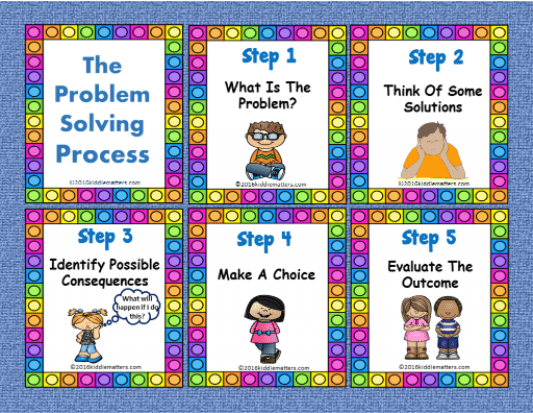
I really like this visual for teaching the decision making process from Kiddie Matters because it is simple to follow and fairly self-explanatory. Go over each step of the process, model what it might look like and practice by applying it to a variety of situations to give kids practice.

If we give kids the foundation for making responsible decisions when they are young, we can support them in applying it to more complex decisions as they get older.

Stop, Think, Act Strategy

This is a fantastic strategy for kids to have in their toolbox for a variety of situations. It can be used as a coping skill, a problem solving strategy or a way to make responsible decisions. The idea behind this strategy is that kids stop and take a moment to think through the situation, decision, problem, etc. before acting. This allows kids to be more reflective and proactive rather than impulsive and reactive. That’s never a bad thing!

Know the difference between above the line and below the line behaviors

You may remember this strategy from the post on relationship skills, and that’s ok! There is a lot of overlap within the competencies.

I don’t remember where I first heard that term, but it has stuck with me for years now. Above the line behaviors are positive and below the line behaviors are negative. Another way to think of it is above the line behaviors are characteristic of a healthy friendship or relationship while below the line behaviors are those reminiscent of an unhealthy relationship. Create an anchor chart of each type of behavior or the traits of a good friend. Read and discuss stories with examples of strong, healthy relationships, as well as ones where bullying or unhealthy relationships are happening. Help students understand that everyone is deserving of healthy relationships and, depending upon age, discuss ways to seek help if they are involved in an unhealthy relationship.

It’s helpful for kids to have a solid understanding of this, as it will (hopefully!) inform their own decision making regarding their behavior, personal safety, advocacy of others and relationships.

Have other ideas of great strategies for building decision making skills in kids? Share them with me!

Trauma-Informed School Partnership Opportunity

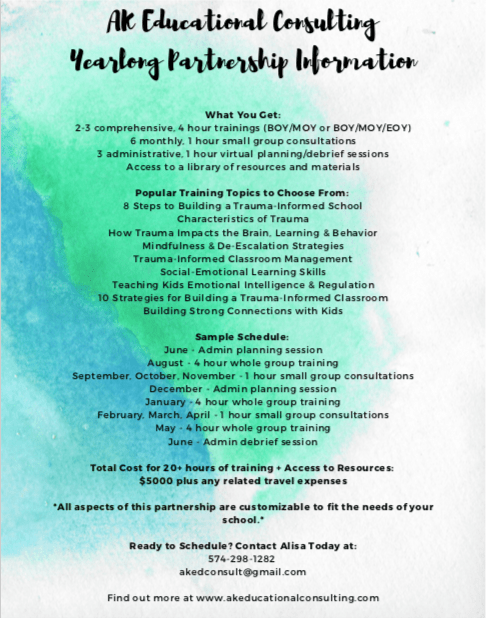
A few weeks ago, I rolled out a new training/consulting opportunity in my bi-weekly newsletter to schools. This is a fantastic opportunity for schools or districts to get a lot of bang for their buck and make tremendous headway toward building a trauma-informed culture in their building or district.

The informational flyer below outlines the details, but many aspects of this partnership are customizable to fit the needs of each particular school. I originally opened up 5 spots for the 2022-2023 school year, and I have 2 spots remaining.

Interested in learning more? Reach out to me at akedconsult@gmail.com.

5 Strategies for building relationship skills in Kids

Over the past month or so, we’ve been focusing on the individual competencies within the CASEL social-emotional learning framework. So far, we’ve talked in depth about self-awareness, self-management and social awareness. Today, we will dive into the next competency – relationship skills.

There’s certainly no denying the fact that our kids’ relationship and communication skills took a hit because of the pandemic. Think about it – kids were isolated from their peers, communicating primarily with the people they live with or via a screen, missing out on critical conflict resolution opportunities (i.e. recess, playdates, etc.). It’s no wonder so many teachers consider the lack of relationship and communication skills to be one of their biggest battles now that in-person school has resumed.

To further illustrate this point, let me tell a personal story. Toward the end of the initial COVID lockdown, my daughter and I were invited over to her best friend’s house for a “porch playdate.” The girls (1st graders at the time) were going to play together on the porch while the moms chatted. This was the first time the girls were going to be together in person in several months. They were both so excited!

That morning, we walked over to their house. Her best friend had pulled out a wide variety of toys they could play with. They sat down on the ground, and her mom and I got to chatting. After several minutes, I realized that neither of the girls were talking to one another. They were both quietly playing with the flip sequins on my daughter’s backpack. I made a joke about how they were allowed to talk to one another and returned to chatting with her mom.

A few more minutes passed, and suddenly her dad popped his head out the front door. He seemed surprised to find us on the porch. He said it seemed so quiet outside, he thought we had gone for a walk. I laughed and said that I had just made a similar comment.

As time went on, the girls seemed to warm up and began to play. As my daughter and I were walking home, I asked her why she seemed so hesitant to talk and play with her best friend, but she didn’t really have an answer.

For the rest of the day, I kept thinking about the playdate, and it finally hit me! The girls had (in a sense) forgotten how to communicate! They had spent so many months in isolation, with just their parents and siblings, they were unsure of how to go about resuming “normal” play.

While it took me awhile to come to this conclusion, it’s since become clear that this is a widespread problem. As I travel to schools all over the country, I’ve had teacher after teacher verbalize this very same issue…even 2 years into the pandemic!

Our kids spent a long time being isolated from their peers and missing out on learning and practicing some pretty critical communication skills. It’s really no wonder this has become such a problem. The question becomes…What can we do about it?

Read on for 5 strategies to help our kids rebuild or strengthen their relationship and communication skills.

practice cooperative learning skills.

With students spending so much time doing virtual learning, hundreds of opportunities to build cooperative learning skills were missed. We need to provide those opportunities now. Allow students to work in partners, trios or larger groups as often as possible. Review, model and practice the skills necessary for successful cooperative learning – listening, encouraging, compromising, coming to a consensus, etc. Give kids the time and space to flex those muscles once again, and it will eventually all come back to them.

Teach kids how to communicate their wants and needs.

A huge component of building healthy relationships is having the ability to advocate for yourself when necessary. This is a skill that most kids are not well versed in. We can help them with this, though, by discussing the difference between needs and wants, listing out possible needs and wants and helping them to understand why it’s so important to be able to communicate these to others. Talk about this concept within the context of different types of relationships – friendships, student/teacher, parent/child, etc.

Know the difference between above the line and below the line behaviors.

I don’t remember where I first heard that term, but it has stuck with me for years now. Above the line behaviors are positive and below the line behaviors are negative. Another way to think of it is above the line behaviors are characteristic of a healthy friendship or relationship while below the line behaviors are those reminiscent of an unhealthy relationship. Create an anchor chart of each type of behavior or the traits of a good friend. Read and discuss stories with examples of strong, healthy relationships, as well as ones where bullying or unhealthy relationships are happening. Help students understand that everyone is deserving of healthy relationships and, depending upon age, discuss ways to seek help if they are involved in an unhealthy relationship.

Teach respectful disagreement strategies.

I know, I know…this same strategy was included in the social awareness post. I feel so strongly about this one, though, I’m including it again. You can read about it more here.

Arm kids with conflict resolution strategies.

Conflict is going to happen. We can’t avoid it, but we can provide kids with a wide variety of conflict resolution strategies so they are ready when it happens. Kids will not learn how to solve conflicts through osmosis. We have to explicitly teach the strategies and model, model, model. Then, we have to walk them through the conflict resolution process over and over again until they feel ready to independently tackle the problem. This is not a quick strategy, but it will pay off in the long run when we have kids who can independently resolve their conflicts and not rely on us to solve every little problem they run into. That’s worth it, in my opinion!

What other strategies would you include on this list?

5 Strategies for Building Social Awareness In Kids

If you’ve been following along with the blog and my YouTube channel recently, you may remember a month or so ago I wrote an overview of the CASEL framework.

In the weeks following, I began a deeper dive into each competency within the CASEL framework, beginning with self-awareness and then self-management. Today we will dig deeper into the third competency – social awareness.

Social awareness is all about being aware of those around you, understanding that your words and actions impact others, knowing how to respect the differences among people and being a socially responsible and active participant in society.

While a wide variety of skills fall into this competency, we will focus on the following five in this post:

  1. Understand social cues and how to read them.
  2. Teach respectful disagreement strategies.
  3. Know how to maintain personal boundaries and respect the boundaries of others.
  4. Identify ways to be helpful to others.
  5. Learn about and celebrate different cultures.

Understand social cues and how to read them.

Cl One critical component of social awareness is knowing how to “read the room,” or interpret the social cues of others. This is a skill that can be difficult for many kids and needs to be taught explicitly and practiced consistently. You can do this easily through role play and modeling. Point out the different facial expressions or body language cues being given by others in the classroom or school building. Ask kids to try to interpret what that person is thinking or feeling. Dig deeper by asking students how we might need to adjust our communication with that person, based on those cues.

For example, if you notice that many students seem really sleepy on a Monday morning during your math lesson, you may point this out to the class and suggest a movement break. You may say, “It seems like we are a group of very sleepy 3rd graders this morning which is probably making it hard to concentrate on this multiplication strategy. Why don’t we stand up and choose a movement break from our jar to get our bodies moving and our brains awake and ready to think.”

By adjusting your plan, you are sending the message that sometimes we need to be flexible in how we communicate to best fit the needs of our listeners. This is especially important for chatty kids who like to go on and on, despite no one actively listening.

One last thing to keep in mind is that wearing masks made this skill especially hard for kids so it’s very likely they will be out of practice. Have patience…they will get there!

Teach respectful disagreement strategies.

If you spend any time on social media, you know that we live in a society of adults who have no idea how to respectfully disagree with one another. If adults can’t seem to master this skill, how do we expect our students to? Admittedly, this skill is going to take time to develop in kids, but it’s a critical one. Think about all the grown-ups out there who have cut ties with a family member or friend over political beliefs, pandemic opinions, etc. rather than choosing to be ok with the fact that we are all different and disagreements are bound to occur.

The best way to teach this skill to kids is through modeling when disagreements do pop up. Whether it’s in the classroom, the cafeteria or on the playground, take the time to walk the students through the disagreement in an appropriate manner. Help them to understand that they do not have to see eye to eye with every other person, but that there are ways to be respectful of our differences in opinion.

Don’t shy away from discussion topics that are sure to be controversial among students. If they are never given the opportunity to debate, disagree and voice their opinion (especially within the context of a safe environment), they will be missing out on key opportunities to learn this critical skill.

Know how to maintain personal boundaries and respect the boundaries of others.

Talk to your students about boundaries! Whether in the context of space, personal belongings or their bodies, help them to understand that we all have different comfort levels.

Start by setting specific expectations for the entire class. Perhaps it’s a rule that students do not get into the desks of others without their permission or they ask prior to giving hugs.

Be open in discussing that it’s ok to set boundaries and request that others respect them while also recognizing that we must extend the same courtesy to those around us. This skill can be tied into the skill of reading social cues by helping students recognize that sometimes people give us facial or body language cues to let us know that we are not respecting a boundary they have set.

Identify Ways to be helpful to others.

As I mentioned in the introduction, part of social awareness is understanding that we are part of larger groups and communities (i.e. classroom, school, city, nation, etc.), and that, as a member of these groups, it is our responsibility to contribute in some way. There are usually a multitude of ways to do this.

Whenever my own kids complain about doing chores, I remind them that, as a member of our family, it is each person’s responsibility to help take care of our house, the dog, our belongings, etc. It wouldn’t be fair for all the work to be done by just one person. I also like to remind them that chores get done much more quickly when we work together as a team.

The same holds true for a classroom or school community or a neighborhood community. Expect students to follow through on their responsibilities within the classroom or school and help them to identify new ways they can be helpful, both as individuals and as a group. Be sure to place an emphasis on WHY they should be helpful and what the benefits are being helpful are.

Learn about and celebrate different cultures.

There’s no way I can do this one justice within just a few paragraphs, but I think you’ll get the point. In order to be truly socially aware, we need to break down the barriers (both literal and figurative) that exist between people or groups who are different from one another. This means respecting the dignity of all humans and understanding the concepts of stereotyping, discrimination and prejudice. It means working to combat these things when they are happening within the walls of our school building. It means not only learning about different cultures but CELEBRATING and RESPECTING our differences and how we can learn from one another.

5 Strategies for Building Self-Management Skills in kids

If you’ve been following along with the blog and my YouTube channel for the past several weeks, you’ve probably noticed that I’ve been spending a lot of time talking about social-emotional learning and its many components. A few weeks ago on the blog, I wrote an overview of the CASEL framework.

Last week, I began a deeper dive into each competency within the CASEL framework, beginning with self-awareness. Self-management is the second competency within the social-emotional learning framework, and it is also a critical component of building emotional intelligence, as it goes hand in hand with self-awareness. As a reminder, the Institute for Health and Human Potential states, emotional intelligence is “the ability to recognize, understand and manage our own emotions” and “recognize, understand and influence the emotions of others.” 

Self-awareness is all about knowing how you feel, understanding how your emotions impact the people around you, knowing your strengths and weaknesses and having humility. You can review even more characteristics of self-awareness by reading here.

Self-management is the ability to manage and express emotions in a constructive manner. Think of it this way – self-awareness is laying the groundwork and giving kids the tools while self-management is actually using and applying those tools in real life. Let’s look at 5 strategies that we can use to help foster self-management skills in kids.

  1. Teach and practice calm down techniques.
  2. Use “I feel…” statements.
  3. Set up a calm down space.
  4. Follow through on commitments.
  5. Set a short-term goal and create an action plan.

Teach and practice calm down techniques.

If our ultimate goal is to teach kids to self-regulate (and that IS the ultimate goal), we need to begin by explicitly teaching kids the strategies they can use to calm down. We do this by introducing a wide variety of strategies to kids so that they can begin to decide which ones feel right to them. It’s also important to help kids understand that not all strategies work for all people and that’s ok.

Think about your own go-to calm down strategies. Maybe you do yoga, listen to music or work on a puzzle. As an adult, you’ve probably figured out which activities help you the most. On the flip side, you can probably think of one or two strategies that would be stress-inducing for you rather than relaxing. Maybe dancing, running or being in nature aren’t your jam. That’s totally fine! We are all different, and thus respond in different ways to different strategies.

One thing to keep in mind when introducing calm down strategies to kids is that it takes practice, practice, practice. Kids need consistent reminders of the strategies they’ve learned and to actually use those strategies. Be patient with them; building self-regulation skills is a process.

Use “I feel…” statements.

“I feel…” statements are a great tool to teach kids to use. They are great during a disagreement and as a simple way for kids to verbalize their feelings.

Think about the last time you were in a disagreement with your partner, a friend or co-worker. Oftentimes, the words we use escalate the disagreement and put the other person on the defensive. For example, we may say something like, “You never listen to me!” This immediately makes the other person feel attacked and doesn’t really get to the root of the problem. Alternately, if we say, “I feel frustrated when you don’t look at me when I’m speaking,” the other person isn’t so quick to feel put down by the statement.

That’s the great thing about “I feel…” statements – they don’t place blame on any one person and it’s hard to argue with someone about how they feel. By using this type of statement, you are better able to keep the disagreement on track and get to the problem solving portion more quickly.

Set up a calm down space.

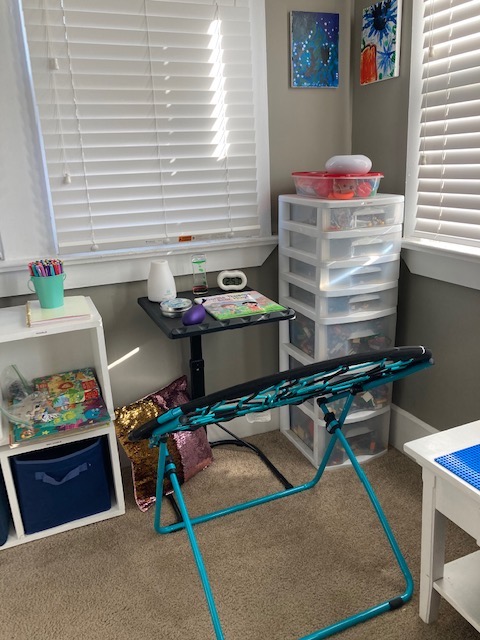
Remember how important it is to teach kids calm down strategies? It’s equally important to provide them with a space to practice those strategies. It might be in the library area of the classroom, an extra desk you have lying around or a corner of the dining room at home. It really doesn’t matter where you set it up, as long as there’s a dedicated space available with a few key tools.

The purpose of a calm down space is to provide kids with a quiet area to go to process through whatever it is they’re feeling. You can include comfortable seating options, low lighting, sensory tools, visual reminders of strategies they’ve been taught, music, drawing materials…the list goes on and on.

The most important thing here is that kids understand that this is not a “time-out” space in a punitive sense but a quiet, calming space with tools to help them self-regulate.

Our calm down space in my kid’s playroom

follow through on commitments.

Teaching kids to honor their commitments is a critical component of self-management. The concepts of perseverance and “stick-to-it-iveness” are ones that our kids are really struggling with, in light of the events of the past two years. However, that does not mean sending the message to kids that they should continue to do things that are unsafe or no longer serve them. This is more about teaching our kids to reflect upon whether or not they really want to join that team, club or activity. Will it fit into their schedule? Is it something they feel passionate about doing or trying? Do they understand what the commitment entails? Does it feel true to who they really are? These are the questions we want our kids to be able to reflect on to push them toward the higher-level goal of making responsible choices for themselves.

set a short-term goal and create an action plan.

If you remember, we’ve seen this strategy before! Goal setting is critical to building both self-awareness and self-management because it helps kids identify something they really want to accomplish and make and carry out a plan for doing it. Before diving into a large or long-term goal, encourage kids to start small. Help them to identify a smaller, short-term goal they would like to meet and teach them to create an action plan for how they will accomplish that goal. Don’t forget to celebrate the small wins along the way to reinforce the progress that is being made, build self-confidence and remind them that they are one step closer to their end goal.

Feel free to share other thoughts, ideas and strategies for building self-management in the comments!

5 Strategies for building self-awareness in kids

If you’ve been following along with the blog and my YouTube channel for the past several weeks, you’ve probably noticed that I’ve been spending a lot of time talking about social-emotional learning and its many components. Last week on the blog, I wrote an overview of the CASEL framework, and today I want to dig deeper into the section of self-awareness.

Self-awareness is the first competency within the social-emotional learning framework, and it is also a critical component of building emotional intelligence. According to the Institute for Health and Human Potential, emotional intelligence is “the ability to recognize, understand and manage our own emotions” and “recognize, understand and influence the emotions of others.”

Having high emotional intelligence (EQ) is very important for a variety of reasons. According to one survey, 71% of employers reported valuing EQ over IQ. Additionally, there are both short-term and long-term benefits to having a high EQ, including better grades, being less likely to drop out of school and contributing more to your community over time.

So what is self-awareness exactly and how do we go about building it in kids? Self-awareness is all about knowing how you feel, understanding how your emotions impact the people around you, knowing your strengths and weaknesses and having humility. You can review even more characteristics of self-awareness by reading last week’s blog post here.

Self-awareness is truly the foundation for social-emotional learning and building emotional intelligence. Let’s look at 5 strategies that we can use to help foster self-awareness in kids.

  1. Make feeling the feelings the norm.
  2. Teach emotional vocabulary.
  3. Celebrate strengths.
  4. Help kids set and track goals.
  5. Teach strategies for responding to compliments, feedback and criticism.

Make Feelings the Norm.

We have to start normalizing the discussion of feelings in our society. Feelings are meant to be felt! That’s why we have them. Start by modeling and discussing your feelings (i.e. I am feeling frustrated right now because many students are talking over me.). Once that feels more familiar, encourage kids to discuss their feelings (i.e. How did that make you feel? How are you feeling right now?). Expect that this will take some time.

As you encourage a more open dialogue around feelings, be sure to not minimize kids’ feelings. Help them to understand the purpose of their feelings and how we can respond to them appropriately.

Teach Emotional Vocabulary.

In order for the first strategy to be really effective, it’s critical that you provide kids with the appropriate vocabulary words to use to express themselves. Often, kids use the same words (good, fine, bad) repeatedly to describe their feelings and these words are just not incredibly descriptive or helpful. Help them branch out by exposing them to a wide variety of feelings words like the ones found on this list. Post them around the house or classroom. Use posters with emoticons to help them “read” facial expressions. Practice describing the feelings of other people or characters in books and the clues we use to help us know how they are feeling. Model the vocabulary words when you discuss your own feelings.

Celebrate strengths.

Help kids understand their many strengths and celebrate them. An important component of self-awareness is knowing what we are good at and how we can use our strengths to help others. Have kids create a list of their strengths, compare and contrast them with others and brainstorm ways to use their skills at home or in the classroom. Another important piece of this is teaching the concept of growth mindset, the idea that we all have things we are not so great at…YET. That’s why it’s important to help kids see how they can use their strengths to help others learn and grow.

Help Kids set and track goals.

Goal setting is critical to building self-awareness because it helps kids identify something they really want to accomplish and make a plan for doing it. Whether the goal is learning a new skill, honing a skill they already have or something else entirely, they are taking a good look at themselves when deciding what goal is important to them. Encourage them to break the goal down into smaller steps and set a timeline for achieving the goal. Then, be sure to celebrate the small wins they have as they work toward reaching the larger goal. Celebrating small wins reinforces that progress is being made, builds self-confidence and reminds them that they are one step closer to their end goal.

Teach strategies for responding to compliments, feedback and criticism.

Having humility is an important piece of building self-awareness. This is especially important when receiving compliments, feedback or criticism. Begin by helping kids to understand why compliments, feedback and criticism are necessary and how they help us grow as individuals. Brainstorm different responses with kids so they know how to respond when faced with different scenarios. Reinforce the concepts using the 2 stars and a wish peer feedback strategy. For example, when sharing their writing with the class, choose three peers to provide feedback – two provide stars, or compliments, and one provides a wish, or constructive feedback. Model how they might provide and respond to each classmate’s feedback.

Feel free to share other thoughts, ideas and strategies for building self-awareness in the comments!

Social-Emotional Learning: The CAsel 5

I’ve recently been working on a new project (details coming soon!) which has required me to really dive into the CASEL framework. If you’re not familiar, the framework is a set of five core social and emotional competencies that are the foundation of social-emotional learning. Additionally, the framework describes the four key settings in which kids spend most of their time and thus, should be learning social-emotional skills.

I thought it might be useful to give a brief synopsis of the CASEL wheel since I’ve spent so much time on social media, YouTube, etc. talking about social-emotional learning lately and not everyone lives and breathes it like I do.

The five core competencies that make up SEL are self-awareness, self-management, social awareness, relationship skills and responsible decision making. They are in that order specifically because the skills embedded into each competency build upon one another. In other words, you need to master the skills within self-awareness BEFORE you tackle the skills within self-management.

So what are the skills within each competency? I’ll briefly outline them below:

Self-Awareness: recognizing, labeling and describing our emotions, identifying our strengths/weaknesses and likes/dislikes, understanding the difference between static and dynamic traits, identifying safe adults and positive role models, understanding that there are positive and negative consequences for our actions, knowing how to care for our emotional selves

Self-Management: identifying and managing our emotions, managing frustration and addressing stress, moving to a calm down space, using strategies to calm ourselves, using self-monitoring strategies, expressing our emotions respectfully, accepting constructive feedback, demonstrating honesty and integrity, setting, monitoring and evaluating goals in life

Social Awareness: demonstrating awareness of other people’s emotions and perspectives, understanding how our own behavior affects the emotions of others, being considerate of others, positively contributing to our communities, demonstrating an awareness of, and respect for, different cultures, reading social cues and responding accordingly

Relationship Skills: effectively communicating with others, using attentive listening skills, working cooperatively with others, developing and maintaining positive relationships, understanding the difference between helpful and harmful behaviors in a relationship, using problem solving and conflict resolution skills

Responsible Decision Making: being positive and accepting of people from other cultures, showing empathy for others, being honest, respectful and compassionate, knowing the steps of effective decision making, having individual roles and responsibilities in a variety of settings

If you’ve been following along with my Social-Emotional Learning YouTube series, you may be wondering how the competencies I’m discussing over there fit into all of this. Each of those 11 skills (kindness, coping skills, social problem solving, etc.) align to one of the five competencies listed above. You can think of them as the subset of skills needed to successfully master each of the core competencies.

If you remember, I also mentioned that the CASEL Wheel identifies four key settings in which social-emotional learning skills are important. These are the classroom, school, home and community. It is important that any school-based social-emotional learning program take into account the external settings of home and community, in order to be as effective as possible.

Now that you (hopefully!) have a better understanding of the building blocks of social-emotional learning, you may be wondering where to even begin. That’s a very fair question since SEL is a term that encompasses a LOT of skills. Check out the list below of a few ideas of where to start:

-Read up on the CASEL Framework here

-Check out my SEL YouTube series here

-Do a little research on your state’s SEL standards (not every state has standards and some states have poor quality standards so you can check out the Michigan standards here to see what high quality SEL standards should look like)

-Follow me on Pinterest for loads of SEL ideas and strategies

-Check out all the resources in my TPT store

-Stay tuned for a BIG announcement that will be verrrryyyy helpful in getting social-emotional learning integrated into your classroom instruction!!!

Social-Emotional Learning

If you’ve been following along with the news recently, you’ve probably run across articles similar to this one, in which the benefits and necessity of addressing social-emotional learning (SEL) skills in schools are called into question. In my home state of Indiana, the debate has now reached the state legislature, where the Indiana General Assembly is currently hearing testimony on House Bill 1134 that states, in part, that schools must obtain written parental consent PRIOR to providing certain mental, social-emotional or psychological services to students. Who knows exactly what is meant by the vague language included in the bill, but one thing is certain – educators and other proponents of SEL are NOT happy.

Why? Because they know firsthand what the research has been saying for a long time – explicit instruction in SEL leads to improved academic performance, improved classroom behavior, increased ability to cope with stress and a more positive outlook on life. Additionally, the benefits are LONG-TERM, meaning the research shows a strong correlation between social-emotional learning and higher emotional intelligence later in life.

With most kids returning to in-person learning this school year, one thing is certain. All of our kids are struggling. I hear the same thing over and over again, from principals from California to Florida and everywhere in between. Students are struggling to focus, they are apathetic and giving up easily when the work gets tough, they are having a hard time appropriately communicating with their peers. The list goes on and on.

The good news (if we can call it that) is that the behaviors that kids are exhibiting are consistent. It doesn’t seem to matter where you live, what socio-economic group you belong to, etc. The social-emotional impacts of the COVID pandemic seem to be equal opportunity. Heck, even my own kids are seriously struggling in many ways…and they are living a much more ideal reality than many kids!

The question becomes…what do we do to help our kids? Well, the answer is simple and utterly complicated at the same time. The short answer is we start focusing on critical social-emotional learning skills and providing kids tools for their toolboxes. What do I mean by that? I mean that we dedicate time and planning to ensure that social-emotional learning skills are explicitly taught to kids. Of course, we all know that time is not something that teachers have an abundance of, and we certainly know that our teachers are already doing the job of 184 different people on any given day (this is the complicated part).

Here’s the good news, though…there are many SIMPLE things that we can begin doing in our classrooms and homes to better support the social-emotional health of our kids. Many of these things don’t take a lot of time or cost any money either. These are simple ideas, books and activities to springboard a conversation with kids about social-emotional learning skills such as friendship, social problem solving or self-esteem.

I’m currently sharing a series of videos on this very topic over on my YouTube channel, if you’re looking for some quick and easy ideas on how to get started at home or school.

Going forward, it is going to be critical for school administrators and parents to recognize the importance of supporting social-emotional learning at school. We are living in a world much different than any of us has ever experienced, and unfortunately, it has taken a serious toll on one of our most vulnerable populations – school-aged children. The sooner we accept this as our current reality, the sooner we can take steps toward changing this reality for the future.

**If you’re looking for resources on social-emotional learning, please check out my TPT store here or contact me at akedconsult@gmail.com to find out more about the professional development and consultation services I offer to schools.