5 Strategies for Building Social Awareness In Kids

If you’ve been following along with the blog and my YouTube channel recently, you may remember a month or so ago I wrote an overview of the CASEL framework.

In the weeks following, I began a deeper dive into each competency within the CASEL framework, beginning with self-awareness and then self-management. Today we will dig deeper into the third competency – social awareness.

Social awareness is all about being aware of those around you, understanding that your words and actions impact others, knowing how to respect the differences among people and being a socially responsible and active participant in society.

While a wide variety of skills fall into this competency, we will focus on the following five in this post:

  1. Understand social cues and how to read them.
  2. Teach respectful disagreement strategies.
  3. Know how to maintain personal boundaries and respect the boundaries of others.
  4. Identify ways to be helpful to others.
  5. Learn about and celebrate different cultures.

Understand social cues and how to read them.

Cl One critical component of social awareness is knowing how to “read the room,” or interpret the social cues of others. This is a skill that can be difficult for many kids and needs to be taught explicitly and practiced consistently. You can do this easily through role play and modeling. Point out the different facial expressions or body language cues being given by others in the classroom or school building. Ask kids to try to interpret what that person is thinking or feeling. Dig deeper by asking students how we might need to adjust our communication with that person, based on those cues.

For example, if you notice that many students seem really sleepy on a Monday morning during your math lesson, you may point this out to the class and suggest a movement break. You may say, “It seems like we are a group of very sleepy 3rd graders this morning which is probably making it hard to concentrate on this multiplication strategy. Why don’t we stand up and choose a movement break from our jar to get our bodies moving and our brains awake and ready to think.”

By adjusting your plan, you are sending the message that sometimes we need to be flexible in how we communicate to best fit the needs of our listeners. This is especially important for chatty kids who like to go on and on, despite no one actively listening.

One last thing to keep in mind is that wearing masks made this skill especially hard for kids so it’s very likely they will be out of practice. Have patience…they will get there!

Teach respectful disagreement strategies.

If you spend any time on social media, you know that we live in a society of adults who have no idea how to respectfully disagree with one another. If adults can’t seem to master this skill, how do we expect our students to? Admittedly, this skill is going to take time to develop in kids, but it’s a critical one. Think about all the grown-ups out there who have cut ties with a family member or friend over political beliefs, pandemic opinions, etc. rather than choosing to be ok with the fact that we are all different and disagreements are bound to occur.

The best way to teach this skill to kids is through modeling when disagreements do pop up. Whether it’s in the classroom, the cafeteria or on the playground, take the time to walk the students through the disagreement in an appropriate manner. Help them to understand that they do not have to see eye to eye with every other person, but that there are ways to be respectful of our differences in opinion.

Don’t shy away from discussion topics that are sure to be controversial among students. If they are never given the opportunity to debate, disagree and voice their opinion (especially within the context of a safe environment), they will be missing out on key opportunities to learn this critical skill.

Know how to maintain personal boundaries and respect the boundaries of others.

Talk to your students about boundaries! Whether in the context of space, personal belongings or their bodies, help them to understand that we all have different comfort levels.

Start by setting specific expectations for the entire class. Perhaps it’s a rule that students do not get into the desks of others without their permission or they ask prior to giving hugs.

Be open in discussing that it’s ok to set boundaries and request that others respect them while also recognizing that we must extend the same courtesy to those around us. This skill can be tied into the skill of reading social cues by helping students recognize that sometimes people give us facial or body language cues to let us know that we are not respecting a boundary they have set.

Identify Ways to be helpful to others.

As I mentioned in the introduction, part of social awareness is understanding that we are part of larger groups and communities (i.e. classroom, school, city, nation, etc.), and that, as a member of these groups, it is our responsibility to contribute in some way. There are usually a multitude of ways to do this.

Whenever my own kids complain about doing chores, I remind them that, as a member of our family, it is each person’s responsibility to help take care of our house, the dog, our belongings, etc. It wouldn’t be fair for all the work to be done by just one person. I also like to remind them that chores get done much more quickly when we work together as a team.

The same holds true for a classroom or school community or a neighborhood community. Expect students to follow through on their responsibilities within the classroom or school and help them to identify new ways they can be helpful, both as individuals and as a group. Be sure to place an emphasis on WHY they should be helpful and what the benefits are being helpful are.

Learn about and celebrate different cultures.

There’s no way I can do this one justice within just a few paragraphs, but I think you’ll get the point. In order to be truly socially aware, we need to break down the barriers (both literal and figurative) that exist between people or groups who are different from one another. This means respecting the dignity of all humans and understanding the concepts of stereotyping, discrimination and prejudice. It means working to combat these things when they are happening within the walls of our school building. It means not only learning about different cultures but CELEBRATING and RESPECTING our differences and how we can learn from one another.

5 Strategies for Building Self-Management Skills in kids

If you’ve been following along with the blog and my YouTube channel for the past several weeks, you’ve probably noticed that I’ve been spending a lot of time talking about social-emotional learning and its many components. A few weeks ago on the blog, I wrote an overview of the CASEL framework.

Last week, I began a deeper dive into each competency within the CASEL framework, beginning with self-awareness. Self-management is the second competency within the social-emotional learning framework, and it is also a critical component of building emotional intelligence, as it goes hand in hand with self-awareness. As a reminder, the Institute for Health and Human Potential states, emotional intelligence is “the ability to recognize, understand and manage our own emotions” and “recognize, understand and influence the emotions of others.” 

Self-awareness is all about knowing how you feel, understanding how your emotions impact the people around you, knowing your strengths and weaknesses and having humility. You can review even more characteristics of self-awareness by reading here.

Self-management is the ability to manage and express emotions in a constructive manner. Think of it this way – self-awareness is laying the groundwork and giving kids the tools while self-management is actually using and applying those tools in real life. Let’s look at 5 strategies that we can use to help foster self-management skills in kids.

  1. Teach and practice calm down techniques.
  2. Use “I feel…” statements.
  3. Set up a calm down space.
  4. Follow through on commitments.
  5. Set a short-term goal and create an action plan.

Teach and practice calm down techniques.

If our ultimate goal is to teach kids to self-regulate (and that IS the ultimate goal), we need to begin by explicitly teaching kids the strategies they can use to calm down. We do this by introducing a wide variety of strategies to kids so that they can begin to decide which ones feel right to them. It’s also important to help kids understand that not all strategies work for all people and that’s ok.

Think about your own go-to calm down strategies. Maybe you do yoga, listen to music or work on a puzzle. As an adult, you’ve probably figured out which activities help you the most. On the flip side, you can probably think of one or two strategies that would be stress-inducing for you rather than relaxing. Maybe dancing, running or being in nature aren’t your jam. That’s totally fine! We are all different, and thus respond in different ways to different strategies.

One thing to keep in mind when introducing calm down strategies to kids is that it takes practice, practice, practice. Kids need consistent reminders of the strategies they’ve learned and to actually use those strategies. Be patient with them; building self-regulation skills is a process.

Use “I feel…” statements.

“I feel…” statements are a great tool to teach kids to use. They are great during a disagreement and as a simple way for kids to verbalize their feelings.

Think about the last time you were in a disagreement with your partner, a friend or co-worker. Oftentimes, the words we use escalate the disagreement and put the other person on the defensive. For example, we may say something like, “You never listen to me!” This immediately makes the other person feel attacked and doesn’t really get to the root of the problem. Alternately, if we say, “I feel frustrated when you don’t look at me when I’m speaking,” the other person isn’t so quick to feel put down by the statement.

That’s the great thing about “I feel…” statements – they don’t place blame on any one person and it’s hard to argue with someone about how they feel. By using this type of statement, you are better able to keep the disagreement on track and get to the problem solving portion more quickly.

Set up a calm down space.

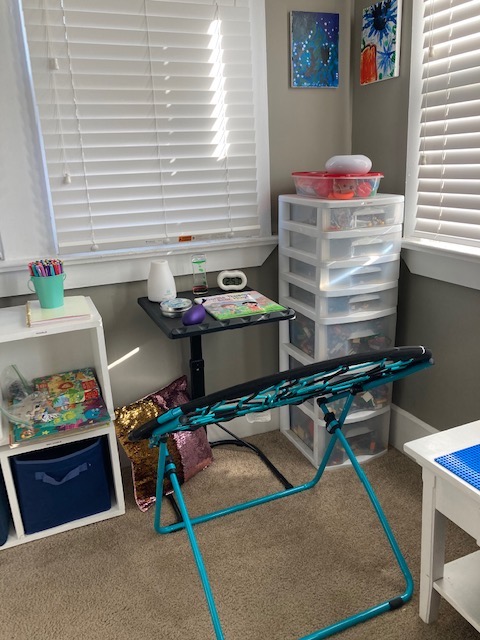
Remember how important it is to teach kids calm down strategies? It’s equally important to provide them with a space to practice those strategies. It might be in the library area of the classroom, an extra desk you have lying around or a corner of the dining room at home. It really doesn’t matter where you set it up, as long as there’s a dedicated space available with a few key tools.

The purpose of a calm down space is to provide kids with a quiet area to go to process through whatever it is they’re feeling. You can include comfortable seating options, low lighting, sensory tools, visual reminders of strategies they’ve been taught, music, drawing materials…the list goes on and on.

The most important thing here is that kids understand that this is not a “time-out” space in a punitive sense but a quiet, calming space with tools to help them self-regulate.

Our calm down space in my kid’s playroom

follow through on commitments.

Teaching kids to honor their commitments is a critical component of self-management. The concepts of perseverance and “stick-to-it-iveness” are ones that our kids are really struggling with, in light of the events of the past two years. However, that does not mean sending the message to kids that they should continue to do things that are unsafe or no longer serve them. This is more about teaching our kids to reflect upon whether or not they really want to join that team, club or activity. Will it fit into their schedule? Is it something they feel passionate about doing or trying? Do they understand what the commitment entails? Does it feel true to who they really are? These are the questions we want our kids to be able to reflect on to push them toward the higher-level goal of making responsible choices for themselves.

set a short-term goal and create an action plan.

If you remember, we’ve seen this strategy before! Goal setting is critical to building both self-awareness and self-management because it helps kids identify something they really want to accomplish and make and carry out a plan for doing it. Before diving into a large or long-term goal, encourage kids to start small. Help them to identify a smaller, short-term goal they would like to meet and teach them to create an action plan for how they will accomplish that goal. Don’t forget to celebrate the small wins along the way to reinforce the progress that is being made, build self-confidence and remind them that they are one step closer to their end goal.

Feel free to share other thoughts, ideas and strategies for building self-management in the comments!

Social-Emotional Learning: The CAsel 5

I’ve recently been working on a new project (details coming soon!) which has required me to really dive into the CASEL framework. If you’re not familiar, the framework is a set of five core social and emotional competencies that are the foundation of social-emotional learning. Additionally, the framework describes the four key settings in which kids spend most of their time and thus, should be learning social-emotional skills.

I thought it might be useful to give a brief synopsis of the CASEL wheel since I’ve spent so much time on social media, YouTube, etc. talking about social-emotional learning lately and not everyone lives and breathes it like I do.

The five core competencies that make up SEL are self-awareness, self-management, social awareness, relationship skills and responsible decision making. They are in that order specifically because the skills embedded into each competency build upon one another. In other words, you need to master the skills within self-awareness BEFORE you tackle the skills within self-management.

So what are the skills within each competency? I’ll briefly outline them below:

Self-Awareness: recognizing, labeling and describing our emotions, identifying our strengths/weaknesses and likes/dislikes, understanding the difference between static and dynamic traits, identifying safe adults and positive role models, understanding that there are positive and negative consequences for our actions, knowing how to care for our emotional selves

Self-Management: identifying and managing our emotions, managing frustration and addressing stress, moving to a calm down space, using strategies to calm ourselves, using self-monitoring strategies, expressing our emotions respectfully, accepting constructive feedback, demonstrating honesty and integrity, setting, monitoring and evaluating goals in life

Social Awareness: demonstrating awareness of other people’s emotions and perspectives, understanding how our own behavior affects the emotions of others, being considerate of others, positively contributing to our communities, demonstrating an awareness of, and respect for, different cultures, reading social cues and responding accordingly

Relationship Skills: effectively communicating with others, using attentive listening skills, working cooperatively with others, developing and maintaining positive relationships, understanding the difference between helpful and harmful behaviors in a relationship, using problem solving and conflict resolution skills

Responsible Decision Making: being positive and accepting of people from other cultures, showing empathy for others, being honest, respectful and compassionate, knowing the steps of effective decision making, having individual roles and responsibilities in a variety of settings

If you’ve been following along with my Social-Emotional Learning YouTube series, you may be wondering how the competencies I’m discussing over there fit into all of this. Each of those 11 skills (kindness, coping skills, social problem solving, etc.) align to one of the five competencies listed above. You can think of them as the subset of skills needed to successfully master each of the core competencies.

If you remember, I also mentioned that the CASEL Wheel identifies four key settings in which social-emotional learning skills are important. These are the classroom, school, home and community. It is important that any school-based social-emotional learning program take into account the external settings of home and community, in order to be as effective as possible.

Now that you (hopefully!) have a better understanding of the building blocks of social-emotional learning, you may be wondering where to even begin. That’s a very fair question since SEL is a term that encompasses a LOT of skills. Check out the list below of a few ideas of where to start:

-Read up on the CASEL Framework here

-Check out my SEL YouTube series here

-Do a little research on your state’s SEL standards (not every state has standards and some states have poor quality standards so you can check out the Michigan standards here to see what high quality SEL standards should look like)

-Follow me on Pinterest for loads of SEL ideas and strategies

-Check out all the resources in my TPT store

-Stay tuned for a BIG announcement that will be verrrryyyy helpful in getting social-emotional learning integrated into your classroom instruction!!!

New YouTube Series: Social-Emotional Learning


Click here to view Part I

I’ve been in a “series” kind of mood lately. I wrapped up the YouTube series on coping skills and decided to start a new one on social-emotional learning. Why? Because I am getting SOOO many questions on this topic right now, from educators and parents alike.

I think we’re all in this place where we realize that our kids/students are struggling (heck, WE are struggling!), but we’re just not really sure what else we can do to help them.

So let’s talk about it. What exactly IS social-emotional learning? How can we integrate it into our classrooms and homes? What does it look like? Over the next several weeks, we are going to tackle all these questions plus many, many more.

We will discuss the importance of social-emotional learning (although, I think most of us have been forced to figure that out in the past two years!), the competencies we can teach kids and specific strategies we can use at home or in the classroom.

I hope you’ll join me for this series, and when you do, don’t forget to subscribe to my YouTube channel so you don’t miss out on any of the great content I’m sharing!

Summer Self-Care Tips for Teachers

Photo by Quang Nguyen Vinh on Pexels.com

If you’re anything like EVERY SINGLE teacher I know, you are more than ready for summer break! Especially after this hot mess of a school year! All I can say is that every single teacher on planet Earth deserves an all-expenses paid 3 month vacation to a place like the one pictured above. If, for some reason, that doesn’t happen, consider these tips for making the most of your break while also caring for your mental and physical health.

  • Take an ACTUAL break! Teachers, I know you…I WAS you. You can’t stop living, breathing and sleeping teaching. You are constantly thinking about next year – how to improve, what things to do differently, what your classroom theme will be, the list goes on and on. It’s what makes you such a phenomenal educator. I’ve got news for you, though, you have to find this little thing called balance. It’s not easy, but it’s necessary. Stay out of the school building and the school supply aisles and off Pinterest and Teachers Pay Teachers. If you just HAVE to work, set aside one day per week or certain hours of the day and STICK TO THIS. If you don’t, your summer will be over in a heartbeat, and you won’t feel one bit rested or recharged.

  • Do the things that bring you joy! Remember those things you used to have called hobbies? It’s time to take those up again. Whether it’s cross stitching or reading, yoga or traveling, now is the time to start doing the things that make you happy. Even if it’s just one day a week, participating in a hobby is great for your mental health.

  • Move your body! I know, I know…this one’s on every list. There’s a reason for that, though. Your body needs those endorphins. Get started now, and you will discover how much better you feel, both physically and mentally by the time fall rolls around.

  • Don’t let guilt get in your way! You’re going to feel guilty…I know you are, but DON’T! Do not let the feelings of guilt creep in. You know…the feelings that you’re not working hard enough (you’re not supposed to be!) or that you need to use your time wisely (you do, but not in the way you’re thinking!). This past year has been tough on everyone, but good grief, teachers have been asked to pivot one million times. Now it’s time to give yourself grace and recognize that your body and mind need recharged.

  • Keep an eye on your teacher friends! If you’re reading this and thinking, “Yes, I’m doing all these things this summer. I don’t want to think about school for one single minute.”…KUDOS to you! I guarantee, though, that you know oodles of teachers who want to believe this, want to follow in your footsteps, but just. can’t. do. it. Check in on them. Remind them of the importance of recharging their minds and bodies. They need to do it for themselves, their families and their future students.

  • HAVE FUN!! More than anything, go have some fun! 2020 was not fun. The first part of 2021 was not fun. Things are getting better now so go enjoy a dinner out, a concert or a night out with friends. You deserve it! Thank you for all that you do!

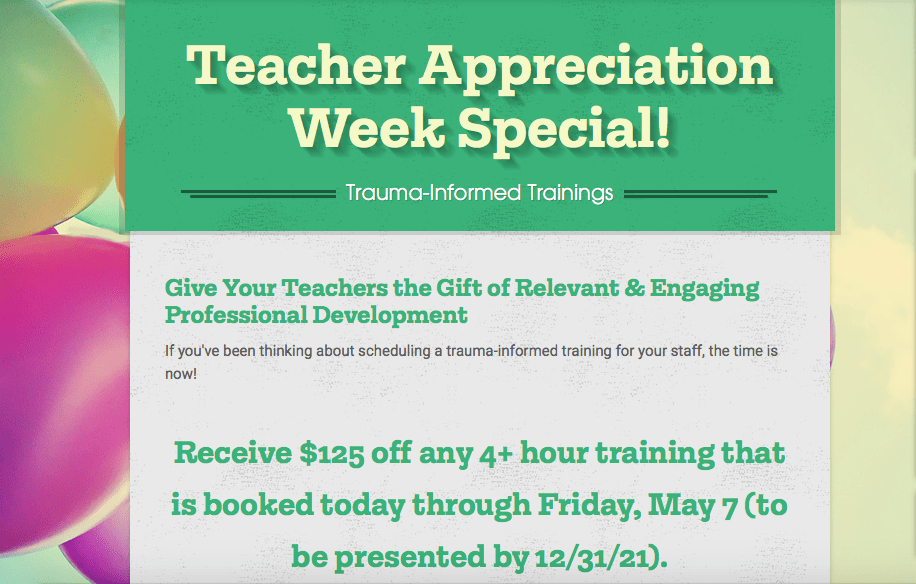
Teacher Appreciation Week Special!

Find out more here

Contact me today for more information on scheduling and pricing. All trainings can be done in-person or virtually and are customizable to fit your schools’ needs and budget. Don’t miss out on the opportunity to bring this critical professional development to your staff! Check out my Facebook page here! 

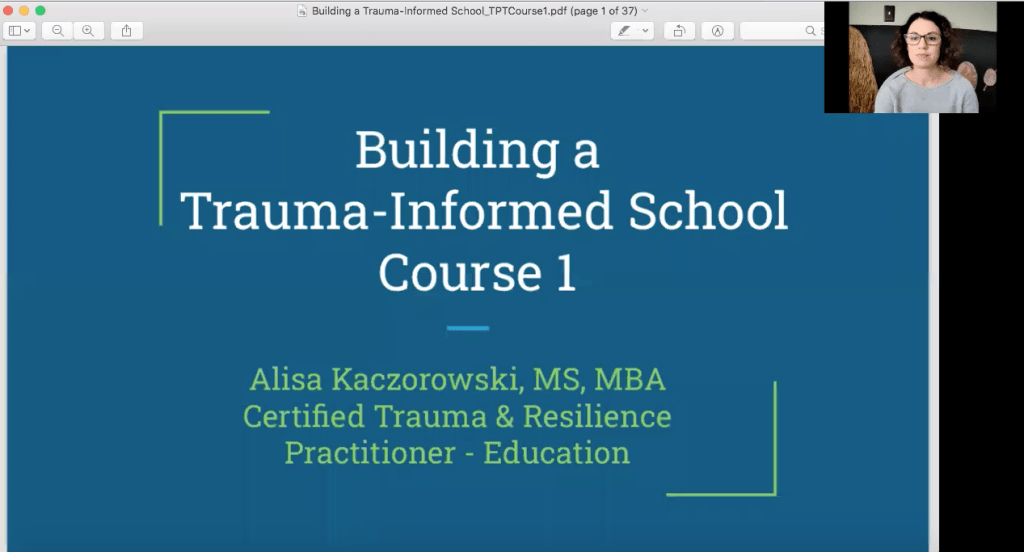
Building a Trauma-Informed School Video Series

Get Course 1 here!

Course 1 of my new video series on Building a Trauma-Informed School launches today on Teachers Pay Teachers! I’m excited to make the content I teach to schools all over the country accessible to educators at the click of a button and at an affordable price.

This series will break down the information I present in a full-day professional development into smaller, easy to watch chunks. Course 1 focuses on understanding the basics of trauma in our society, why schools should be trauma-informed and recognizing the characteristics of trauma in children of various age levels.

Course 2 will go live in the next two weeks. It will dive into understanding the neuroscience of trauma – how traumatic experiences impact, and cause changes to, the brain that affect students in a learning environment. It will cover the impact of trauma on learning, as well as a variety of mindfulness techniques that can be implemented in the classroom.

At least two more courses will follow and will focus on the impact of trauma on behavior, trauma-informed classroom management strategies and strategies for building a more trauma-informed culture in the classroom.

Head on over to Teachers Pay Teachers and grab Course 1 here!

Video #2: De-Escalation Strategies

The second video that I recorded in collaboration with Indy Direct Docs has dropped over on their website! You can view the entire video here.

Just a reminder that these strategies, as well as TONS of others, will be included in the new virtual parent workshop that is coming very soon! If you’re interested in more information about that, reach out to me at akedconsult@gmail.com.

New Workshop Coming Soon!

Virtual parent workshops will be coming soon!

During these 1 hour workshops, you can expect to learn more about:

  • The impacts of the pandemic on children’s social-emotional health
  • Strategies for helping kids cope with feelings of sadness, anxiety, anger, loneliness and more
  • Tips for teaching kids to recognize and name their emotions
  • Tools that kids can use to self-regulate
  • Tricks for making your home a calmer, more joyful place

Who doesn’t need a little extra help right now? Contact me today at akedconsult@gmail.com to find out how to get on the list.

Parenting in a Pandemic

Click here to view the entire video.

Last week, I had the opportunity to shoot a few videos with my new friends over at Indy Direct Docs on parenting in a pandemic. While I primarily train educators on trauma-informed practices, the strategies are just as useful and effective for parents, especially now when we’re all wearing so many different hats.

I was super excited to partner with Drs. Moore-Ostby and Holliday for a variety of reasons. First of all, their innovative take on healthcare puts the focus on the relationship between a doctor and patient, similar to the idea of relationship-building between a teacher and student. Second, they are invested in providing resources of all sorts to their patients through their blog. From nutrition and cooking tips to parenting strategies, they are in tune with the content their patients want. Lastly, I feel strongly about the trauma-informed strategies I teach, as both an educator and a mom, so why not share them with others? Parenting is hard. Parenting in a pandemic is nearly impossible. We’ve all felt it over the past 8 months. I know I need some help, and I’m guessing others do too.

There’s a really disappointing myth in our society that trauma-informed practices are only beneficial to kids living in poverty or kids who have experienced trauma. NO! Not true. Trauma-informed practices are beneficial to ALL kids. They nurture and repair relationships, encourage social-emotional health and well-being and help kids learn to be more in tune with their emotions. Isn’t that what we all want for our kids? I know I do!

Despite what we sometimes think, all kids have experienced some sort of trauma in their lives. From divorce and death to absentee parents and COVID-19, traumatic experiences are everywhere. It doesn’t have to be abuse or neglect to be considered trauma. Even if a child’s exposure to trauma is minimal at best, the strategies I teach are still useful. Have a child who struggles to control their anger, sadness, worry, etc.? I have strategies for that. What about kids who have difficulty resolving social conflicts? I have strategies for that too. Perhaps you just need some new ideas for surviving this trying time as a parent. I’m right there with you, and I can help.

Let’s give our kids the tools they need to grow into compassionate, empathetic human beings, living in a society where emotions are normalized and stigmas around mental illness and trauma are non-existent. If you’re interested in learning more about how trauma-informed practices can be useful to your kids, drop me an email or Facebook message!

***The first video can be viewed here.