MARCH 2024 SEL THEME – CONFLICT RESOLUTION & PROBLEM SOLVING – Strategies for Teachers & parents

As promised last week, today I’m sharing a few great conflict resolution/problem solving strategies for kids.

  1. ASWATA – This stands for ask the person to stop, walk away, talk to an adult. This strategy is one to teach kids to use when someone is bothering them or they are dealing with a minor annoyance. First, we politely ask the person to stop doing whatever it is they are doing. If they don’t stop, we walk away. If they continue or follow us, that’s when we talk to an adult. This is a simple strategy that can be used to solve all sorts of minor conflicts between kids in the classroom or at home and puts the focus on the child solving the problem, not the adult.
  2. “I feel…” Statements – I feel statements are a critical component of the conflict resolution process. Why? Because rather than pointing the finger at the other person (which often leads to more anger and hostility), they put the focus on how that person’s actions made you feel. For example, saying “You never listen to me” is just an invitation to escalate a conflict. The other person will go on the defensive, and before you know it, the conflict has grown beyond its initial problem. However, saying “I feel frustrated and hurt when it seems like you aren’t listening to me” is not nearly as defense-inducing and potentially hurtful. Additionally, it’s hard for the other person to argue how you feel and these statements open the possibility of an honest conversation versus an anger-filled fight.
  3. Rock, Paper, Scissors – As a teacher or parent, you probably already know that a large percentage of the conflicts our kids encounter are minor and don’t require extensive problem solving. In fact, some of them are so minor that a quick game of Rock, Paper, Scissors can get the problem solved and all parties moving on with life quickly. It’s a simple but effective strategy for things like who gets the front seat of the car or the line leader position. Don’t waste a bunch of time on these conflicts AND put the ball in the kid’s court! This is the perfect time for them to practice their problem solving skills!

These are just a few of the hundreds of problem solving strategies we can teach our kids, but they have served me well as a teacher and a mom! What are some of your go-to problem solving strategies?

MARCH 2024 SEL THEME – CONFLICT RESOLUTION & PROBLEM SOLVING – Recognizing, Identifying and Labeling Emotions

Today, rather than share any strategies with you (which I’ll do next week), let’s talk about the very first step in conflict resolution – being able to recognize, identify and name our own emotions, also known as having self-awareness.

Think about it. If we are unable to identify what we are feeling, as well as the cause of that feeling, it’s going to be nearly impossible to recognize in another person. This lack of self- and social awareness will make it very difficult to resolve any type of conflict that may arise.

Aside from being a critical component of conflict resolution, these emotional awareness skills are really important in so many other facets of life – from emotional regulation to advocating for ourselves.

So how do we help kids build these muscles? Here are a few things you can start doing with kids of any age (but the earlier, the better!)…

  1. Talk about feelings openly and honestly in your home or classroom. We shouldn’t hide them or be ashamed of how we’re feeling. A safe, loving environment is a must in encouraging kids to share their feelings.
  2. Model, model, model. Constantly talk through how YOU are feeling in different situations. Not only will you send the message that it’s ok to share their feelings, you will also be giving them the vocabulary to do so.
  3. Teach emotion vocabulary words. Kids need to know how to label their emotions, and they need more words than just sad, glad and mad! Dig deep with them to get to the root of what they’re feeling and provide them the words until they’re able to do it on their own.
  4. Help kids to understand that feelings are information. We have to pay attention to them to help us decipher the message. Then, we are able to begin the problem solving process.

What else is missing from this list? What do you do to build your kids’ emotional awareness muscles?

March 2024 SEL THEME – Conflict Resolution & Problem solving – AN INTRODUCTION

Welcome to March and our 3rd social-emotional learning theme of the month! This is a tricky one for many of us so buckle up for some great information and strategies!

In this first week of the month, we will define our theme, discuss why it’s an important SEL skill and talk real-world application. This will serve as a springboard for the resources and other ideas I will be sharing throughout the remainder of the month.

So, let’s dive in!

What are conflict resolution and problem solving exactly? Here’s a good starting point to use with kids of all ages. You can adjust this definition to best fit the needs of the age group you work with. I know many of these themes are pretty self-explanatory, but sometimes we just need someone else to sum it up for us!

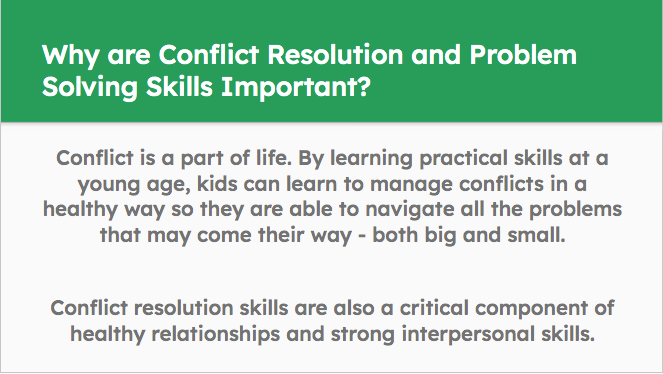
Now that kids know what conflict resolution means and what problem solving skills are, we need to help them understand why these skills are important and how they will be beneficial to them.

Next, we can begin connecting conflict resolution and problem solving with kids’ real lives by helping them recognize the many skills that are part of conflict resolution…and it’s a long list!

I know this is a tricky skill to learn, especially since many of our students are learning to resolve conflict in ways that seemingly go against everything we are trying to instill in them. How can you combat that and make these skills a priority this month (and beyond) for your kids or students?

Be sure to follow along all month right here on the blog, YouTubeFacebookInstagram and LinkedIn. I will be sharing all sorts of tips, strategies and resources throughout March.