
Looking for picture books to support a lesson or discussion on resilience or perseverance? Check out one of these great titles!


What other books about resilience and perseverance do you love?
Looking for picture books to support a lesson or discussion on resilience or perseverance? Check out one of these great titles!
What other books about resilience and perseverance do you love?
This week, I talked all about the importance of connecting, and building relationships, with kids over on YouTube. One of the strategies I discussed was relationship mapping. I found this excellent tool for use by any teacher/school looking to do a more formal relationship mapping of their students.
I realize that this might be a difficult task to undertake for educators working in larger schools, but if you’re in a smaller school or up to the challenge, this tool really is fantastic and well worth the time it would take to complete.
I’d love to hear from you, if your school has done any kind of relationship mapping! How did you do it? What were the take-aways?
Whenever I hear the word “resilience,” my mind immediately starts to think of certain sets of student siblings or family members that I’ve had over the years. I’ve always been intrigued by the question, “What causes one sibling to be on an uphill trajectory in life while another sibling makes worrisome choices?”
While we know that the answer is resilience, what does that mean really? How does one build resilience? What traits must they possess to become resilient?
These are just a few of the questions I will address over the course of this month, as we dive into our monthly SEL theme of resilience and perseverance.
First, we know that there are a plethora of traits associated with resilience building, including the following:
We also know that we can help people build resilience in a variety of ways.
The 7 Cs model of resilience building was first published by the American Academy of Pediatrics in 2006. This model provides us with a roadmap for building resilience. By identifying aligned activities and implementing them in our classrooms or homes, we can set our children up to have the ability to bounce back from challenges and roadblocks.

Over the next few weeks, I am going to spend time here and over on my YouTube channel, breaking down each of the 7 Cs. Additionally, I am going to give you actionable activities to help grow resilient learners. I hope you’ll join me!
Looking for a curated list of mentor texts to use during an empathy and compassion unit or lesson? Look no further!
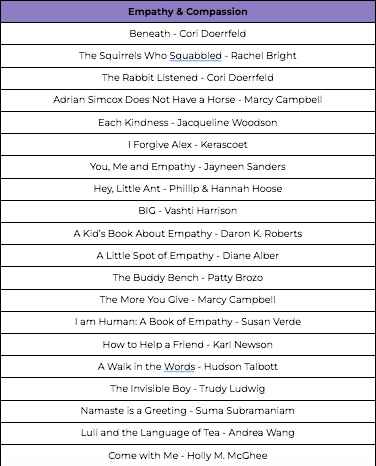
I also shared about one of my favorite (and new to me!) books on empathy and compassion on YouTube earlier this week. You can watch the video here.
What other books would you add to this list? I’m sure there are so many good ones out there that I don’t even know about!
As promised last week, today I’m sharing a few great conflict resolution/problem solving strategies for kids.
These are just a few of the hundreds of problem solving strategies we can teach our kids, but they have served me well as a teacher and a mom! What are some of your go-to problem solving strategies?
Looking for a curated list of mentor texts to use during a kindness unit or lesson? Look no further!


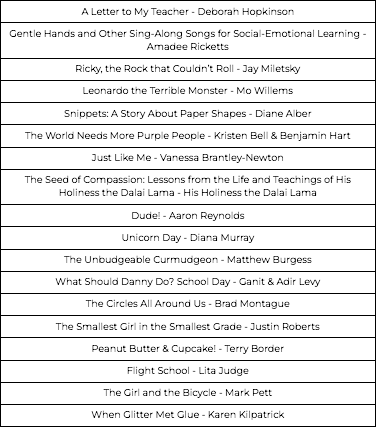
I also shared about a few of my absolute favorite books on kindness on YouTube earlier this week. You can watch the video here.
What other books would you add to this list? I’m sure there are so many good ones out there that I don’t even know about!
Over on YouTube, I’ve shared two really great strategies for educators to instill kindness in students.
The first is a “take what you need” board. The idea is that you fill a bulletin board with quotes or affirmations that students can take when they are feeling overwhelmed, lacking self-confidence, etc.
To create a “take what you need” board, you first want to brainstorm the emotional supports your students may need. For instance, do you notice many students struggling with low self-esteem? Do they seem to need a reminder that they can and will rock exam week?
Once you identify several categories of supports, go in search of inspirational quotes and affirmations that may be helpful to them. Print or write them out to attach to the board. You can even color code the categories to make it easier to replenish as they are taken.
This is a fantastic idea for middle and high school educators and you can definitely get your student council or other similar club involved in helping.
Be sure all the students know about the board, where to find it, how it works, etc. Make sure it is accessible to all. You may even consider adding in some resources for students who are struggling with mental health issues or crises.
The second idea I discussed over on YouTube was a student and/or staff shout-out board. For this, you need to create a form that students or staff members can use to recognize one another. You make these forms available in a central location and have a system for them to be turned in. The forms can be attached to a bulletin board for everyone to read or can be read during morning/afternoon announcements.
This is a great way to encourage your school community to recognize the kind acts/great things happening in the building. Plus, it just makes people feel good to know they have been seen!
If you want to learn more about these strategies, head over to the following links to listen…
What are some other ways you can instill kindness in your students?
Well, it’s time to wrap up our very first SEL theme of the month – goal setting. If you’ve been following along and setting goals for yourself or with your kids or students, you might be wondering how to keep the momentum going throughout the year.
Here are a few things you can do to ensure achievement of your goals:
Now that you are well on your way to achieving your goal for the year, you may be wondering where we are heading for February and our next SEL theme. Well, I’ll tell you…tomorrow!
As we begin to wrap up this first social-emotional learning theme of the year, I want to share a few resources that I have come across over this past month. These can be used by parents or teachers, at home or in the classroom.
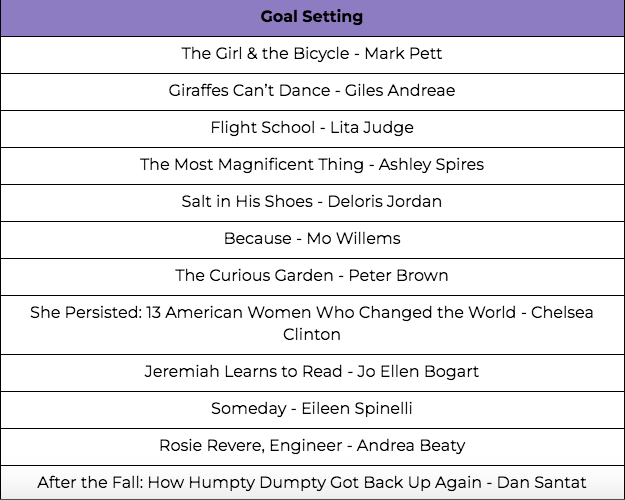
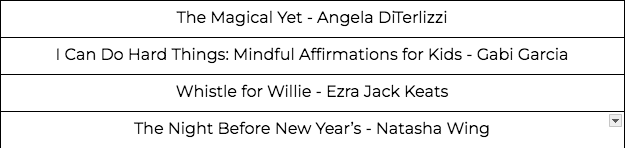
Be sure to check out my YouTube channel for so many other goal-setting activities and resources! I hope you’ve enjoyed this first SEL theme of 2024! I will be announcing February’s theme very soon!
In last week’s blog, I talked about setting goals with kids and what that looks like at my house. This week, we are going to dig deeper into the idea of goal setting and take a look at two strategies that are beneficial in helping us achieve our goals.
First, let’s talk about visualizing our goals. This is a strategy that many athletes, performers and businesspeople use regularly. The idea is that we visualize every small detail of our race, performance, goal, etc., from the very beginning to the very end. We focus on our five senses to help us really feel as though we are experiencing the achievement. We acknowledge any obstacles that we may face and work through how we might overcome them. We see ourselves celebrating the accomplishment of achieving our goal.
The second strategy is the use of affirmations to help us overcome challenges while working toward our goal and remind us that we can accomplish what we set out to do. An affirmation can be a statement or mantra that you write down, read and repeat regularly. It’s basically putting the power of positive thinking to work for you.
Examples include:
Of course, you can add more detail to make the affirmation more specific to your goal.
Affirmations are great to write down and post in an area where you can read them regularly. They can stay the same for as long as you want/need or you can change them up daily/weekly/monthly to fit your needs at the time.
Here’s your homework for today…think about a big goal you have for this year. How can you incorporate visualization and affirmations into your routine to help you achieve your goal?
Once you’ve had practice with each of these strategies, think about how you can introduce them to students. Help them make connections between visualization that we use while reading, visualization we use to calm down and this type of visualization. Similarly, make connections between using affirmations for a self-esteem or self-confidence boost and for goal setting.
There are so many great ways to use these strategies with kids, especially since they are both fairly multi-purpose strategies! How do you foresee these strategies working in your classroom or home environment?
 akeducationalconsulting.com