January 2024 SEL Theme – Goal Setting – Tips & Strategies for Parents

Every year in January, each of my kids and I set a goal for ourselves for the new year. It’s typically a new skill we want to learn or something big we are challenging ourselves to complete.

Two years ago, my oldest child’s goal was to learn to ski and my middle child’s goal was to learn to trot on a horse. In true youngest child fashion, for the life of me, I cannot remember what my littlest’s goal was…ha! My own goal was to complete a triathlon.
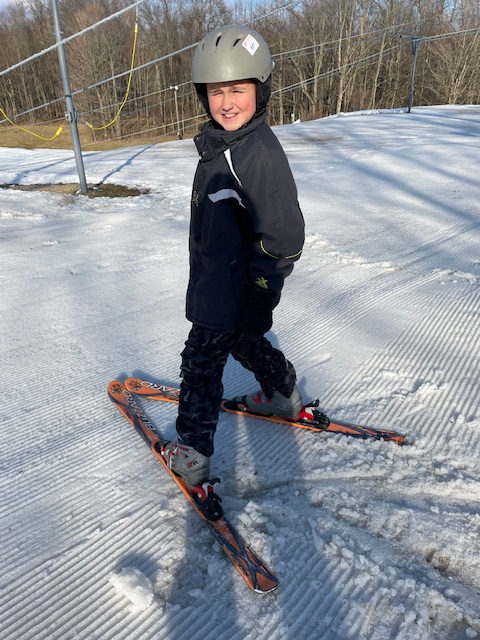
His first time hitting the slopes

After some time spent thinking and brainstorming, we write our goals on index cards and hang them up on the refrigerator where we can see them each and every day. We also discuss the steps we will need to take to accomplish our goal.

This is where we come in as parents because typically, our kids’ goals will involve us to some extent. In the case of the goals I talked about above, I had to commit to finding the time to take my kids skiing and horseback riding regularly so they could practice.

I find that it’s helpful to get dates on the calendar as early as possible so I don’t feel like we’re scrambling at the last minute. This also sends the message to kids that their goals are important to us and that we are invested in helping them succeed.
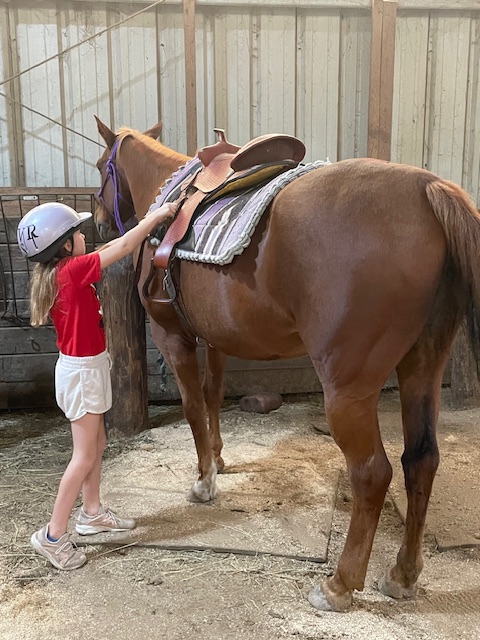
Grooming her favorite horse, Jake

Since beginning this goal setting project a few years ago, I have created this resource to help my kids in setting their goals and identifying their action steps. It’s a simple way to help guide their thinking.

As you begin thinking about setting goals with your kids, here are a few things to keep in mind and/or discuss with them:

  1. Goals can be big or small, but I encourage my kids to make this a BIG goal since they have all year to work on it.
  2. Encourage them to think outside the box. What is something they’ve always wanted to try? What is a new skill they’d like to learn?
  3. Have them help you plan out the action steps/get dates on the calendar. It’s their goal; they need to own it.
  4. Celebrate the small wins! As they inch closer to achieving their goal, get excited about the small steps they take along the way. This will help keep their momentum going as well!
  5. Discuss failure. What happens if they don’t achieve their goal? How might they feel? What might they be able to do differently in the future? Reassure them that failure is possible and OK! It happens to all of us!
  6. Celebrate the accomplishment! Make a big deal when they reach their goal! In our house, we write the date the goal was accomplished on the index card and take a picture of the person with their card to commemorate the achievement. We also keep all of their index card goals in their “box of memories” so they can look back on them later in life.
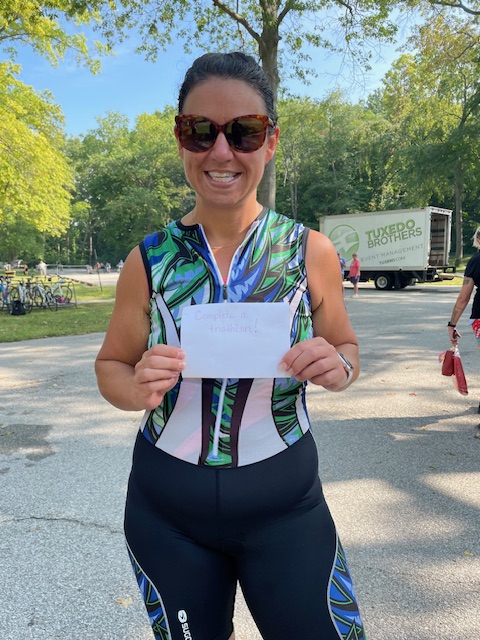
I even brought my index card goal with me to the triathlon so I could take a picture as soon as I finished!

If you try this strategy with your kids, I’d love to hear what some of their goals are for 2024! What are your own goals?
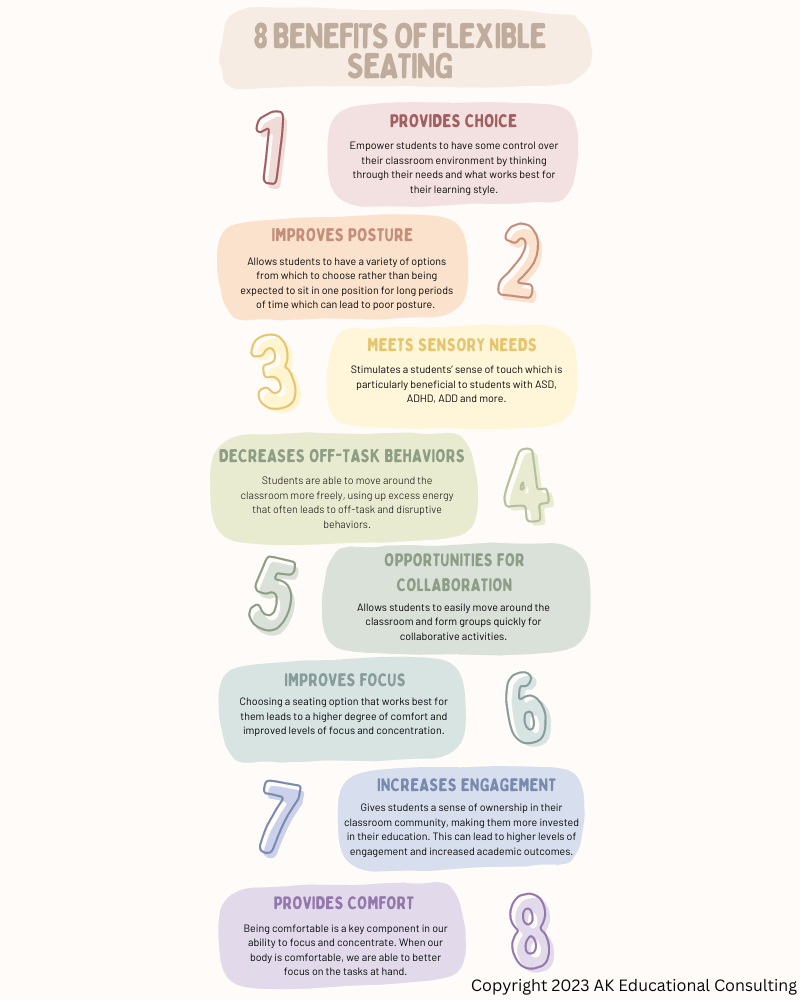
The benefits of flexible seating in the classroom

I shared this on my various social media channels this week but figured I’d jot a few thoughts here as well.

I really started thinking about this last week. After a long car ride at the end of Labor Day weekend, I was struggling to sit at my desk the following day and get work done. I couldn’t sit still. I couldn’t focus. I couldn’t get comfortable. It really hit me that some of our students struggle with these feelings on a daily basis.

Even thought I’m well aware of the inherent benefits of flexible seating, I had never truly thought about how this can be a total game changer for some kids. I know some of this information is common sense, but we can’t ignore the fact that providing flexible seating options is a shift in mindset for many educators.

If you are one of those educators, it’s OK! Take a minute to read over the infographic above. How could you implement small changes to your classroom seating to benefit your students? What baby steps can you take?

If you’re an educator who has fully bought in, what changes have you noticed in your students? What flexible seating options do you provide in your classroom? I’d love to hear!

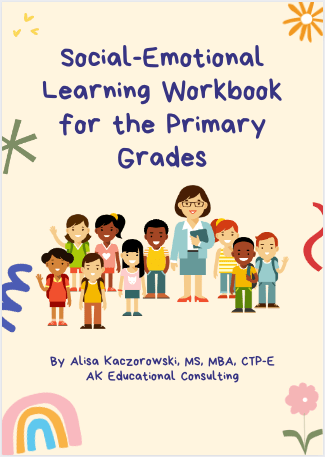
Social-Emotional Learning Workbook for the primary grades

I’m so excited to debut a project that I have been working on for almost two years – a 150+ page social-emotional learning workbook!

We all know that two things are true of teaching – one is that teachers wear many hats and the other is that there is never enough time during the school day to get everything done.

While I feel VERY strongly about explicit instruction of social-emotional learning skills in the classroom, I also know how hard this is. Most schools are not fortunate enough to have an SEL coach or a dedicated SEL block during the day so teachers have to get creative.

When I am working with schools, I always recommend that SEL instruction be embedded into the instruction that is already happening in the classroom. Reading a specific book during ELA? Think about the SEL themes that can be pulled out and discussed. Students need to write a narrative piece? Brainstorm ways that SEL can be tied in or assigned as the prompt. Having a specific problem in the classroom that needs to be addressed (i.e. friendship skills, conflict resolution, etc.)? Let’s address it through meaningful SEL instruction rather than another lecture that no one is paying attention to.

Of course, all of this is much easier said than done, right? That’s why I decided to create this workbook. I wanted to give teachers a set of pre-made lessons that take the research and guesswork out of explicit SEL instruction.

I spent countless hours researching the CASEL Framework for Social-Emotional Learning, as well as the Michigan Social-Emotional Learning Competencies and Indicators, the most comprehensive set of state standards I found, in order to identify the most critical skills students need to be exposed to.

I used those skills to create 34 week-long lessons that include all the things a teacher would need to carry out instruction – a lesson plan, graphic organizers, printables, picture book lists, cross-curricular activities and more. Plus, each lesson uses a fantastic picture book as the foundation for instruction.

I am so excited that this workbook is done and available for teachers at the beginning of a new school year, and I sincerely hope it is a valuable and time-saving resource for teachers. Find it, along with many other trauma-informed and SEL resources, right here in my TPT store!

Mind-Body Skills Part 1: Breathing

**This is Part 1 of a 7 part series on Mind-Body Skills. Check out the introductory post here or follow along on my YouTube channel.

Mindful breathing strategies are a great place to begin when teaching kids mind-body skills. Why? Because when we mindfully breathe, our brain sends a message to our heart, telling it to slow down. As a result, our heart rate slows and we can begin to calm down and better regulate. Additionally, breathing strategies are some of the easiest to learn, especially for young children.

Below you will find some of my favorite breathing techniques and other resources…

Five Finger Breathing (sometimes called Mountain Breathing): this is my all-time favorite breathing technique for kids because it’s simple, easily understandable and lends itself well to a simple visual reminder on the wall.

Box Breathing: another favorite for all the same reasons as above. Definitely, my own go-to breathing technique!

Other Deep Breathing Exercises: this post has SO MANY great breathing exercises that kids will find fun to do!

Sesame Street Belly Breathe Video: best for 1st grade and younger!

Alphabreaths and Alphabreaths Too: these are great picture books with lots of breathing techniques.

Breathing Makes It Better: another great book for connecting deep breathing and the emotions we feel. Best for younger kids.

Breathe Like a Bear: another picture book best suited to younger kids.

Breathing is My Superpower: great book of breathing techniques for elementary-aged kids.

Let me know what other breathing exercises you enjoy using with kids! I’d love to hear from you!

school safety drills are here to stay: empowering educators with best practice tools and strategies for lockdown and active shooter drills

For the past week, I have struggled with what to say about the school shooting in Nashville. Not because I don’t have any thoughts or feelings on it, but because I’m not sure I have anything worthwhile or new to add to the conversation.

As an educator and mom, it’s frightening how numb our society is becoming to these mass shootings. But I suppose, as is the case for many scary things, we learn to compartmentalize in order to go on living and sending our kids to school each day.

For the past week (and if I’m being honest, for many more months prior to that), I have mulled over a myriad of thoughts about this school shooting, as well as all the others. Because my passion is kid’s social-emotional health and well-being, most of my thoughts center around that topic, and I have found myself returning over and over again to the same question.

Do the benefits of active shooter and lockdown drills outweigh the risks to our students and teachers?

The answer seems to be that no one knows for sure.

As a school administrator, I remember announcing these drills and walking the building, jiggling classroom door handles to ensure they were locked, peering through classroom windows to ensure the kids weren’t visible from where I was standing and admonishing teachers whose class “failed the test.”

I cringe now to think of the psychological damage being done to the students and teachers I loved like my own family, and I wonder how many hundreds or thousands of other schools in our country are doing the same.

As a mom of three kids, I feel outrage when I hear about active shooter and lockdown drills being conducted, not from the school administrators, but from my kids when they return home in the afternoon.

While I certainly don’t have all the answers (and from my research, it appears no one does), I do know that we can do better. We MUST do better.

So, rather than focusing on all that’s wrong (because that list is too long to think about), I am choosing to focus on empowering educators with tools and resources to reflect upon, share with administrators and use with students.

Here we go.

  1. National Association of School Psychologist’s “Best Practice Considerations for Armed Assailant Drills in Schools” – this is a very comprehensive manual that should be used by school or district administrators as part of their emergency preparedness plan
  2. Your Local Epidemiologist’s “Active Shooter Drills: Do Risks Outweigh Benefits?” – a quick and easy read for anyone
  3. National Association of School Psychologist’s “Mitigating Psychological Effects of Lockdowns” – a great fact sheet of tips and to-dos for before, during and after a lockdown drill
  4. National Association of School Psychologist’s “Talking to Children About Violence: Tips for Parents and Teachers” – a fantastic infographic of tips for talking with children of all ages about violence, includes specific talking points and is available in Spanish
  5. National Education Association’s “Unannounced Active Shooter Drills Scaring Students Without Making Them Safer” – a great article on what NOT to do when conducting active shooter drills at school
  6. NPR’s “2 Big Teachers Unions Call for Rethinking Student Involvement in Lockdown Drills” – the case against lockdown drills
  7. Everytown’s “The Impact of Active Shooter Drills in Schools” – a whitepaper that includes loads of data and anecdotal evidence
  8. National Association of School Psychologist’s “School Safety Drills and Exercises for Students with Autism Spectrum Disorder (ASD): Tips and Resources for Educators” – best practices and specific strategies for a population of students often forgotten about during school safety drills

What other resources have you found helpful? Please share them in the comments.

My favorite series for teaching kids about social problem solving

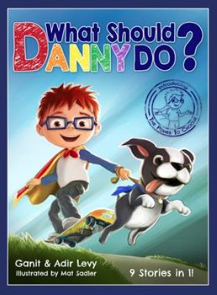
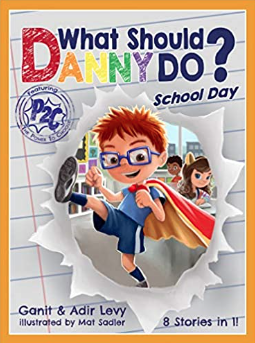
If you haven’t heard of, or read, the “What Should Danny Do?” series by Ganit and Adir Levy, you need to check them out!

Written in a “Build Your Own Adventure” kind of way, each book contains 8-9 separate stories. As children read the book, they are given choices about how Danny (or now, Darla!) should react or proceed. Based on the choices they make, the story leads them down a different path.

The scenarios in the book are all ones that are familiar to kids – fighting over toys with a sibling, breaking something that belongs to someone else, standing up for others. With each choice they make, kids will begin to see how Danny’s actions determine the consequences.

This series really is a must-have for any school or home library! There are so many different social-emotional learning skills that are reinforced throughout the books, and the format of the books really encourages conversation between grown-ups and kids!

my 5 favorite picture books for teaching kids about friendship

Friendship is a theme that you can find in a whole host of children’s books which is fortunate since it is a topic that often needs revisited with kids. Whether you have students finding it difficult to be a kind friend or your own children are experiencing friendship struggles at school, I’m sure you’ll find a book on the list below that could be helpful in talking to younger kids about the concept of friendship.

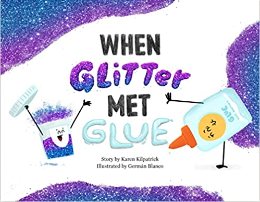
When Glitter Met Glue by Karen Kilpatrick

This wonderful picture book is all about what to do when one person in a friendship feels invisible. Find out how Glitter and Glue team up to help Glue shine like some of their other friends.

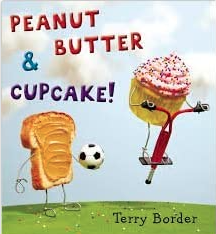
Peanut Butter and Cupcake by Terry Border

This witty picture book with awesome photo illustrations is a great one to turn to when kids are feeling lonely and struggling to find friends. Read to find out how Bread searches and searches for his perfect pairing.

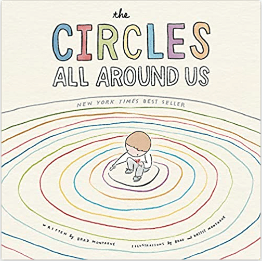
The Circles All Around Us by Brad Montague

This is one of my absolute favorite picture books for so many reasons. There are so many wonderful themes that can be extracted from this book. If you’re looking for a book about friendship, kindness or inclusivity, this is the one!

This book is all about how the circles of people around us (our relationships) grow as we get older to include, not only family, but also friends, neighbors and other people from our community with whom we connect and feel safe. This book serves as a great springboard for a conversation on how we grow those circles through kindness and by being a good friend.

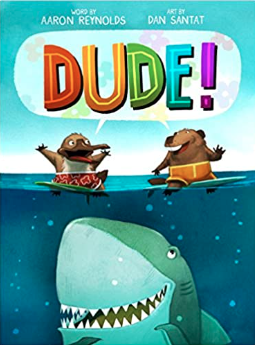
Dude! by Aaron Reynolds

If you have a child who feels excluded or students making snap judgments about another student, this book is for you!

This book is about platypus and beaver, friends who just want to go surfing. Unfortunately, they are afraid to surf because they share an ocean with shark. As he approaches and they get to know him, though, they find out that maybe there’s more to shark than what they originally thought.

You Will Be My Friend! by Peter Brown

This is the perfect book for those kiddos who just aren’t sure how to go about making friends.

In this story, we learn from Bear just how hard it is to make friends, how persistence is the key and how sometimes, we find the best friends in the most unlikely places.

I hope you have a chance to check out these wonderful books! In the comments, let me know what other books you like for the theme of friendship.

8 Steps to Building a Trauma-Informed School: A new youtube series

I’m excited to announce my brand new YouTube series – 8 Steps to Building a Trauma-Informed School. This series of 9 videos will begin with an overview of the 8 steps, and then subsequent videos will dive deeper into each step individually.

In each video, you can expect to learn more about each step and what it takes to accomplish it. This series is great for administrators, school counselors and educators who are interested in learning more about the steps needed to create cultural change in the school environment. Even if you aren’t prepared to tackle a huge, new initiative, I encourage you to check out the videos to gauge your own schools’ strengths and areas of need.

If you are ready to tackle a trauma-informed school initiative, send me an email at akedconsult@gmail.com. I will soon be opening up registration for 1 and 2 year partnerships that will kick off in August 2023 and spots will be limited!

My 5 favorite picture books for teaching kids about growth mindset

Growth mindset is something we’ve been hearing a lot about in recent years, but what is it really and how do we teach kids about it?

Simply stated, a growth mindset is the belief that you and your brain can grow and learn new things. In other words, you are not just born smart; you can BECOME smart.

The opposite of a growth mindset is a fixed mindset. This is where many people, including kids, get trapped. It’s the belief that, if you can’t do something right now, you will never be able to do it.

This simply isn’t true, though. We know that the human brain is malleable, or able to change and grow. It can become stronger through effort, trying new and different things and asking for help, when needed.

The research also shows that parent and teacher interactions play a big role in forming a child’s mindset. We have the ability to help kids become more resilient through our words and actions. We can do this by focusing our praise on the process versus a child’s ability, teaching kids the importance of trying new strategies when they aren’t successful and how asking for the assistance or opinions of others can be beneficial.

If all of this sounds great, but you still aren’t sure where to start, check out these 5 picture books that will serve as a springboard for discussion of this topic.

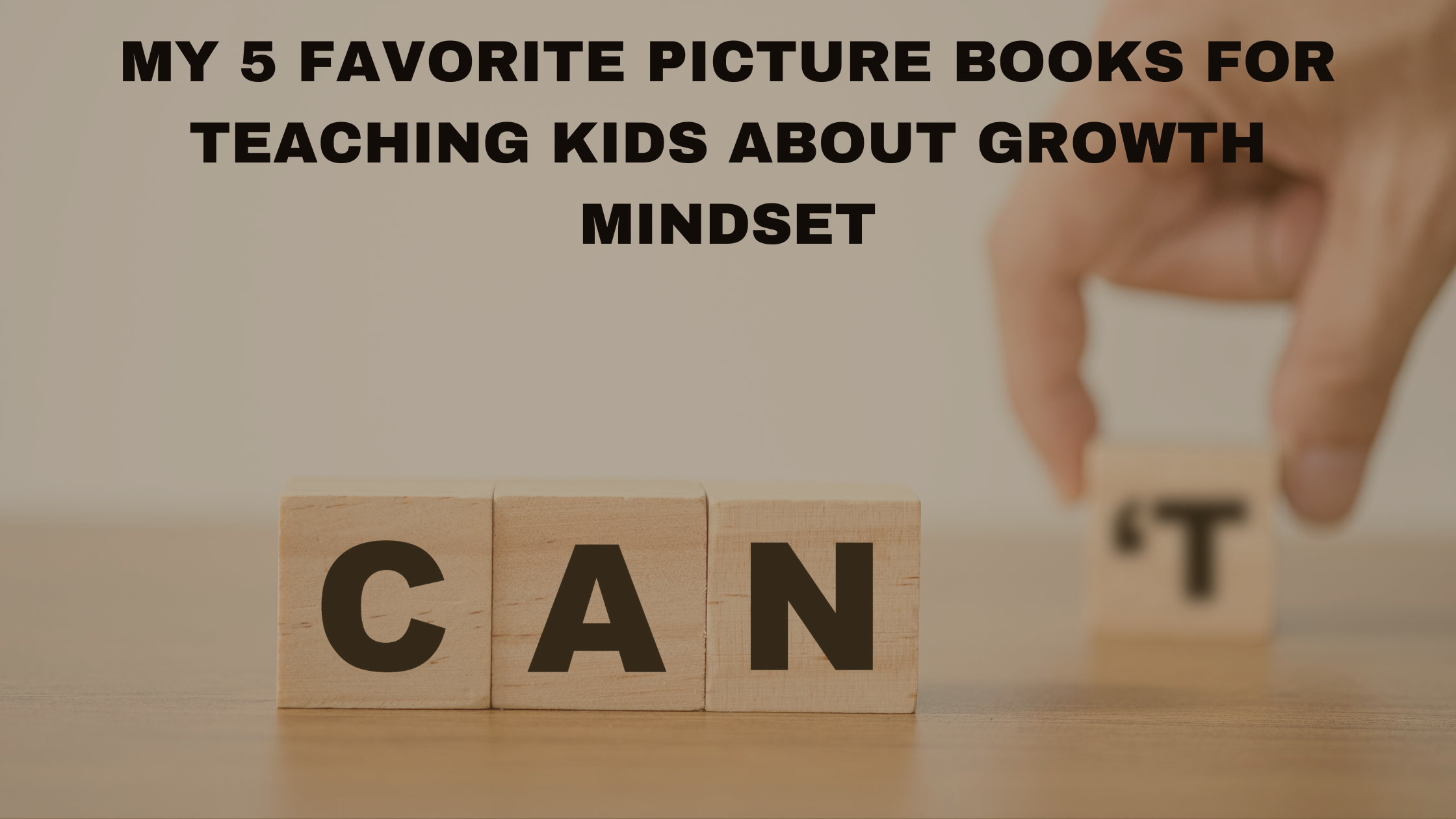
The Dot by Peter H. Reynolds

This is, of course, a fan favorite. It is about a little girl who dislikes art class because she doesn’t think she is a good artist. Her teacher encourages her to simply begin with a single dot and see where it takes her. This one interaction begins a journey of discovery for the little girl which is very relatable for many of our kids.

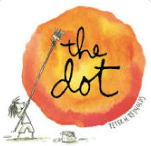
Emmanuel’s Dream: The True Story of Emmanuel Ofosu Yeboah by Laurie Ann Thompson

This is the true story of a little boy born in Ghana with a deformed leg. While most people dismiss Emmanuel because of his disability, his mother pushes him to dream big. He eventually becomes a cyclist who rides across Ghana, spreading his message of perseverance, courage and strength.

The Thing Lou Couldn’t Do by Ashley Spires

Lou really wants to be brave and climb a tree like all her friends, but she’s never done it before and is convinced she can’t. Despite brainstorming lots of methods for getting to the top of the tree, she isn’t able to make it. Her friends cheer her on and remind her that she can’t do it YET and she can always try again tomorrow. A great reminder for all our kids that they are on their way to accomplishing their goals, even if they haven’t succeeded yet.

I’m Not Just a Scribble by Diane Alber

Scribble realizes he’s different when he meets other drawings and gets made fun of. Eventually, the other drawings come to realize that Scribble is not bad just because he’s different. In fact, Scribble teaches them that he has a lot to add to their lives! A great message to accept others for who they are and what they have to offer the world.

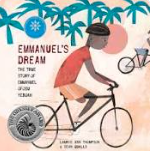
Mistakes that Worked: 40 Familiar Inventions and How They Came to Be by Charlotte Foltz Jones

A wonderful nonfiction book about mistakes that changed the world. Kids will learn how sandwiches, potato chips, Silly Putty and many other common items came to be…by accident!

There are so many wonderful books out there to help teach kids about growth mindset. What are some of your favorites?

Podcast Announcement!

I’ve been so excited to share this news for awhile, and finally, I can! Several months ago, I was honored to be asked to sit down for an interview for the “Inspiring School Counselors” podcast and the episode aired yesterday!

I’m so grateful to be able to share several practical tips on building a trauma-informed classroom or school. It doesn’t have to be complicated or a whole school effort! Even one person can make a dramatic difference to a struggling child.

I hope you’ll take a few minutes to listen to the episode (and check out some of the other awesome guests they’ve interviewed!). It really is a great podcast for any educator! Enjoy!