New Training Announcement! – Fostering family engagement within your school

I’m so excited to roll out my brand new training just in time for the beginning of the school year! This training is a critical component of building a trauma-informed school (see step #6 below).

There’s been a lot of chatter online lately about the difference between parent involvement and family engagement in schools (and yes, there is a huge difference!). Traditionally, schools have considered parents to be involved when they volunteer in the classroom, attend field trips or send in classroom donations. These things are great (and necessary!), but they do not necessarily equate to parents and caregivers being in true collaboration with the school. Additionally, this type of “involvement” is often exclusive to parents who have the time and financial means to participate in their child’s education in this way.

If your school is instead looking to partner with ALL families in a meaningful way by building strong relationships, engaging them in the curriculum and providing tools for helping children at home, this training is for you!

A few things you will learn during this training include:

  1. Specific strategies for engaging families as your partner in educating their child
  2. Tips to streamline family-school communication to reach more families
  3. Steps to establish a parent outreach coordinator or team
  4. How to host family workshops and interactive events that provide caregivers the tools and strategies to help their child academically, behaviorally and social-emotionally
  5. Strategies for building strong relationships between teachers, students and caregivers

This training is designed for teachers and other school staff. It can be done as a stand-alone 2, 4 or 6 hour professional development or as a partnership, in conjunction with a combination of my parent workshops (see informational flyer below).

If you’re ready to join the thousands of educators (and parents!) who have benefited from my trainings and expertise, send me an email at akedconsult@gmail.com. Let me help you build a trauma-informed school!

Coming soon!!! – Indiana School Counselor and Administrator Collaboration Institute (ISCACI)

Calling all school leaders (principals, assistant principals), school counselors, and graduate students/alumni in school counseling and educational leadership programs! You are cordially invited to join us at the inaugural Indiana School Counselor and Administrator Collaboration Institute (ISCACI). This conference focuses on school administrator-school counselor collaboration to better meet all PK-12 student needs. Three nationally and internationally known speakers will provide workshops and a keynote, and 34 local presenters will share knowledge and resources in breakout sessions during this exciting two-day event in June at Ball State University. We hope to see you there!  

Conference information

Dates: June 13-14, 2022

Location: Ball State Alumni Center, 2800 W. Bethel Ave., Muncie, IN  47304

Website: https://ncyionline.org/conferences/iscaci/

Cost: $20 (Graduate Student) and $95 (Early Bird Regular Registration)

Meals provided: Breakfast and Lunch for Two Days

Breakout session presenters are from a variety of organizations, such as the Indiana Department of Education, Standard for Success, local Indiana school districts, Indiana Online, and much more! Breakout session topics include:

  • Student Success
  • Community Engagement
  • College & Career Readiness
  • Educational Equity 
  • Principal/Counselor Relationships

Workshop: “Integrating MTSS Into Your Comprehensive School Counselor Program (CSCP)” with Dr. Carol Dahir from New York Institute of Technology

Workshop: “Working Together to Support Students” with Dr. Leigh Bagwell who recently served with the Tennessee Department of Education.

Keynote: “How Do You View the World? A Discussion of Diversity and Equity” with Robert Jamison from Virginia Beach City Public Schools.

Please contact Dr. Rachel Geesa (rlgeesa@bsu.edu) and Dr. Theresa Kruczek (tkruczek@bsu.edu) if you have questions about the conference.

My Thoughts on yesterday’s school shooting in uvalde, Texas

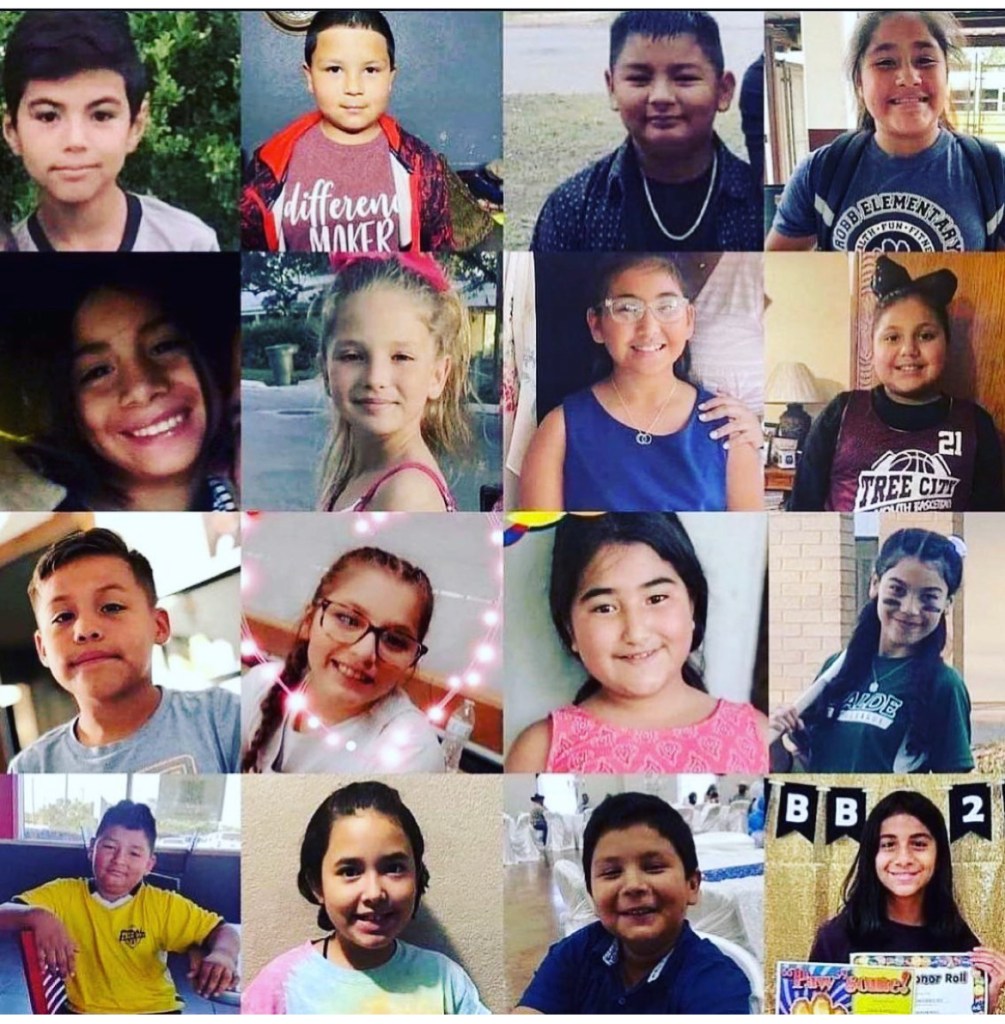
Photo courtesy of NBC News

I’m sitting here wondering how to express the thoughts going through my mind this morning, wondering what I could possibly say that is of any importance right now, wondering how our nation got to this place. I’m heartbroken for the people of Uvalde, Texas. As an educator and more importantly, as a mother, I’m feeling devastated, sad, helpless, scared and angry.

The shooting that occurred yesterday at Robb Elementary School killed 19 children and 2 adults, making it the 2nd deadliest school shooting on record behind Sandy Hook, and was the 27th school shooting of 2022. 27th. Let that sink in for a minute. In 2021, there were 34 school shootings and yesterday marked the 27th of this year. In May.

Between 1970 and 2021, 637 people were killed in school shootings. Obviously, this number has increased with the additional 27 shootings that have happened in 2022.

When does enough become enough? When do we stop being ok with children regularly practicing lockdown and active shooter drills during instructional time? When do we stop expecting school leaders to walk through their buildings several times a year, jiggling doorknobs and peeking through windows to ensure classrooms are locked and all children are out of sight?

I know that our country is full of “experts” this morning; people who think they know where we’ve gone wrong and how to fix it, people who will use this tragedy to push their own political platform and agenda. I am not one of those people. Why? Because, in my opinion, the number of ways we’ve gone wrong, as a country, is too many to count, particularly when it comes to our educational system. Because I don’t believe there is ONE solution to this problem. Because I don’t view the devastation that occurred in Uvalde yesterday as a political event. I view it as a human event; one where dozens of parents lost their babies and the community lost two beloved teachers.

Maybe, this morning, you’re wondering what can be done to stop this madness. Perhaps, like me, you’re not there yet and are still just full of grief and heartbreak for this community and our nation, as whole. I’m sure the coming days and weeks will be a barrage of “next steps,” but for me, for now, I am going to allow myself the time and space to feel sad, helpless and angry. Then, when I’m ready, I’m going to keep doing what I can to continue to bring awareness to the importance of trauma-informed practices, social-emotional learning and relationship building in schools. I’m not naive enough to believe that these things alone will even remotely impact the monumental mess we are facing in this country, but I know, for a fact, that they can and DO make a HUGE difference in the lives of individual children. And for now, that is good enough for me.

5 Ways to Address Mental Health Awareness Month with kids (Plus a freebie!)

Download and print this infographic, highlighting 5 ways you can address Mental Health Awareness month with kids in the classroom or at home!

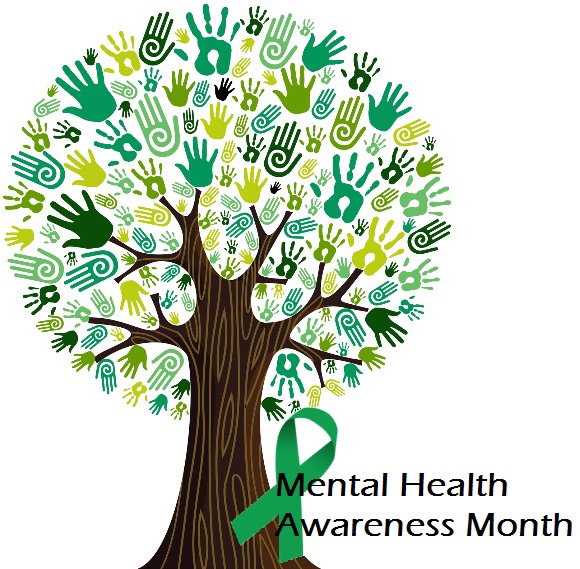
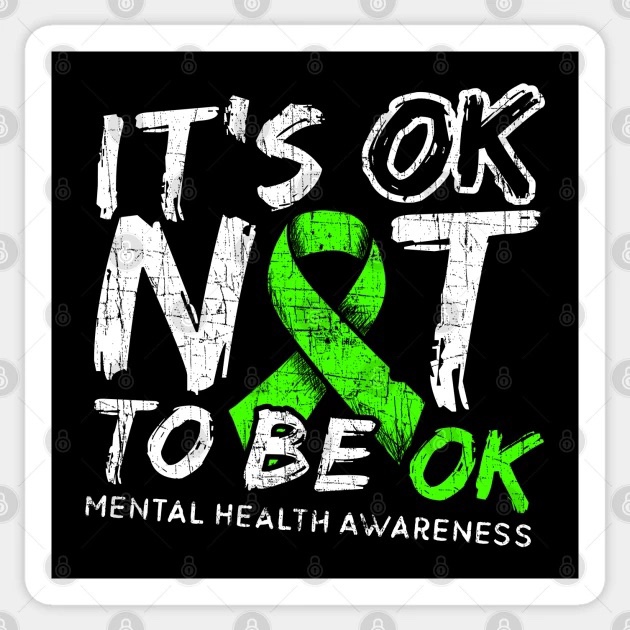
Mental Health Awareness Month

Did you know that May is Mental Health Awareness month? It’s time to start talking about the health of our brains, just like we do the health of our bodies. It’s time to BREAK THE STIGMA. That’s what this month is all about.

Not only do I feel passionately about this topic because it’s what I talk about for a living but also because my own family is impacted by mental illness just like so many of yours are. In fact, it’s one of the main reasons I focus my trainings and content on topics such as trauma, chronic stress and social-emotional learning.

The pandemic has certainly brought to light many of the challenges people with mental health issues face on a daily basis. It is also to blame for exacerbating these issues for tens of thousands of adults and children.

There has never been a better time to break the cycle of silence and gain a better understanding of mental illness. If not for your benefit, for the benefit of someone you love.

If you or someone you know is thinking about suicide, please call the Suicide Prevention Lifeline at 1-800-273-TALK. Trained crisis workers are available 24/7.

New Training Announcement! 6 Strategies for building strong connections with kids

I’m so excited to announce my newest training – 6 Strategies for Building Strong Connections with Kids. As I talk about in all my other trainings, building strong relationships is really the foundation for all trauma-informed care, particularly in schools.

We cannot expect to get anywhere with the students or kids we work with without first building a relationship based on mutual trust, respect and compassion. This relationship becomes the basis for digging deeper into a child’s past experiences to better understand their words, actions and behaviors. By doing this, we can then provide them with the supports they need most and set them up for success in their school and home environments.

This professional development will cover the benefits of strong relationships for both children and adults and 6 key strategies that can be used to build, strengthen and maintain strong relationships with kids. This training is applicable to just about anyone who works with kids, from teachers and social workers to school counselors and childcare workers.

The strategies that are covered (in much greater detail) are:

  1. Know Their Story
  2. Be Human
  3. We are Family
  4. Build Them Up
  5. Thoughtfully Interact
  6. Be an Advocate

Interested in learning more? Send me an email at akedconsult@gmail.com.

5 Strategies for Building decision making skills in kids

Over the past several blog posts, we’ve focused on each of the individual competencies within the CASEL social-emotional learning framework. So far, we have talked about the first four competencies – self-awareness, self-management, social awareness and relationship skills. Today, we will dig into the final competency – responsible decision making.

I think we can all agree that the skills within this competency are probably the ones that keep most parents awake at night. How do we teach our kids to not only make decisions but make RESPONSIBLE decisions?

This skill is critical to a child’s safety and really sets the tone for the kind of person they will become. Making responsible decisions really encompasses so many different facets of a child’s life – behavior, personal safety, social interactions, their well-being and the well-being of those around them. The list goes on and on.

While there are so many different skills within this competency, there are a few key strategies we can teach kids to set a strong foundation for responsible decision making all the way through adulthood.

Teach kids to identify bullying and know what to do about it

Kids need to know what bullying is – what it looks like, what it sounds like and what they can do about it. Talk about the different types of bullying (physical, verbal, social and cyber). Help them to understand that bullying means repetitive, unwanted, aggressive and one-sided behaviors that target a specific person or group. Empower kids with the tools to recognize bullying, stand up for the person being bullied and seek help from an adult.

There are so many amazing tools online to help teach kids about bullying. This website is a great place to start and includes a wealth of information and resources to support you.

Teach kids to advocate for themselves

If we are going to give kids the tools to stand up for other people, we should probably also give them the tools to stand up and advocate for themselves. This is something that I have really been working on with my 2nd and 5th graders for the past year or so.

Begin by talking through social situations your child encounters after the fact. My children often come home from school upset about something that was said or done to them. In those situations, I always review with them what is ok for them to say and/or do. For example, if my preschooler mentions that someone hit him because they wanted the toy he was playing with, the conversation may go something like this:

Me: Did you tell him not to hit you, that you don’t like that?

Preschooler: No, I told on him.

Me: If someone is hurting you, it’s ok to say, “Don’t hit me. I do not like that.” You can stand up for yourself. Then, if he doesn’t stop, you can find an adult to help you.

This takes time and practice, but it’s so worth it. Not only am I modeling what is ok to say and do, I’m helping my kids understand that they don’t always have to rely on an adult to solve their problems.

With older children, the situation may involve an adult such as a teacher. Those are important conversations to model as well because you’re helping your child understand how to handle a situation in which they are likely uncomfortable and unsure of themselves.

Introduce kids to the decision making process

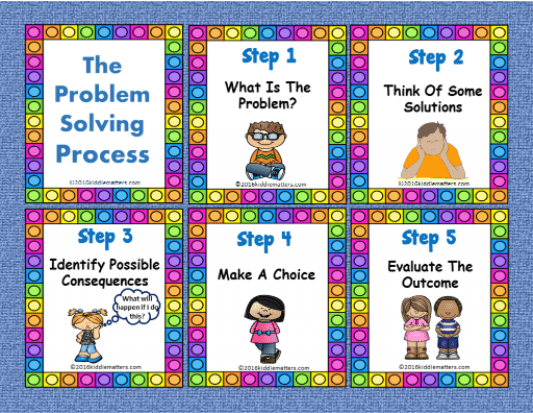
I really like this visual for teaching the decision making process from Kiddie Matters because it is simple to follow and fairly self-explanatory. Go over each step of the process, model what it might look like and practice by applying it to a variety of situations to give kids practice.

If we give kids the foundation for making responsible decisions when they are young, we can support them in applying it to more complex decisions as they get older.

Stop, Think, Act Strategy

This is a fantastic strategy for kids to have in their toolbox for a variety of situations. It can be used as a coping skill, a problem solving strategy or a way to make responsible decisions. The idea behind this strategy is that kids stop and take a moment to think through the situation, decision, problem, etc. before acting. This allows kids to be more reflective and proactive rather than impulsive and reactive. That’s never a bad thing!

Know the difference between above the line and below the line behaviors

You may remember this strategy from the post on relationship skills, and that’s ok! There is a lot of overlap within the competencies.

I don’t remember where I first heard that term, but it has stuck with me for years now. Above the line behaviors are positive and below the line behaviors are negative. Another way to think of it is above the line behaviors are characteristic of a healthy friendship or relationship while below the line behaviors are those reminiscent of an unhealthy relationship. Create an anchor chart of each type of behavior or the traits of a good friend. Read and discuss stories with examples of strong, healthy relationships, as well as ones where bullying or unhealthy relationships are happening. Help students understand that everyone is deserving of healthy relationships and, depending upon age, discuss ways to seek help if they are involved in an unhealthy relationship.

It’s helpful for kids to have a solid understanding of this, as it will (hopefully!) inform their own decision making regarding their behavior, personal safety, advocacy of others and relationships.

Have other ideas of great strategies for building decision making skills in kids? Share them with me!

Trauma-Informed School Partnership Opportunity

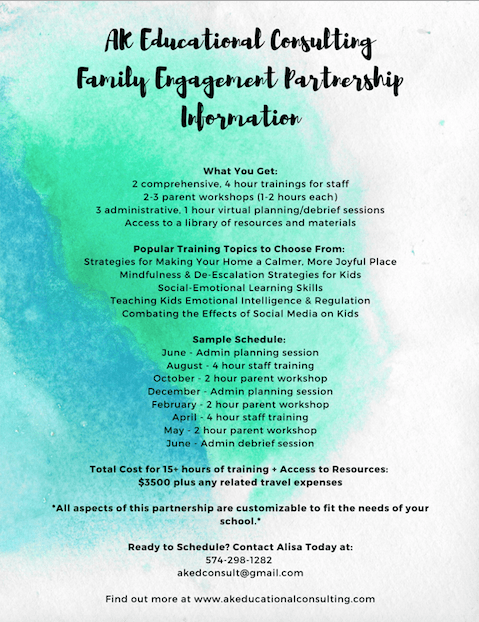
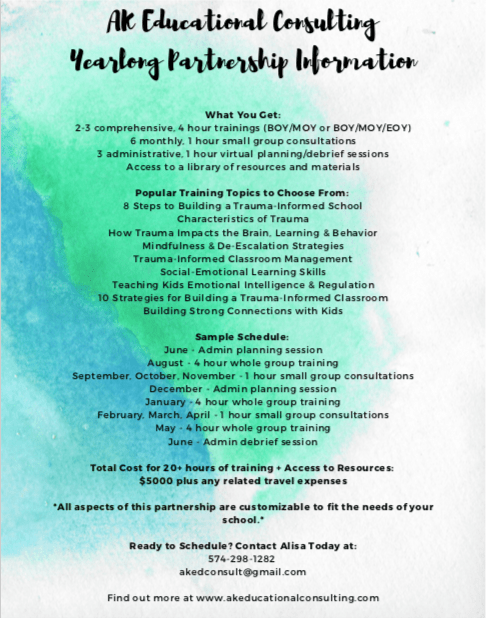
A few weeks ago, I rolled out a new training/consulting opportunity in my bi-weekly newsletter to schools. This is a fantastic opportunity for schools or districts to get a lot of bang for their buck and make tremendous headway toward building a trauma-informed culture in their building or district.

The informational flyer below outlines the details, but many aspects of this partnership are customizable to fit the needs of each particular school. I originally opened up 5 spots for the 2022-2023 school year, and I have 2 spots remaining.

Interested in learning more? Reach out to me at akedconsult@gmail.com.

5 Strategies for Building Self-Management Skills in kids

If you’ve been following along with the blog and my YouTube channel for the past several weeks, you’ve probably noticed that I’ve been spending a lot of time talking about social-emotional learning and its many components. A few weeks ago on the blog, I wrote an overview of the CASEL framework.

Last week, I began a deeper dive into each competency within the CASEL framework, beginning with self-awareness. Self-management is the second competency within the social-emotional learning framework, and it is also a critical component of building emotional intelligence, as it goes hand in hand with self-awareness. As a reminder, the Institute for Health and Human Potential states, emotional intelligence is “the ability to recognize, understand and manage our own emotions” and “recognize, understand and influence the emotions of others.” 

Self-awareness is all about knowing how you feel, understanding how your emotions impact the people around you, knowing your strengths and weaknesses and having humility. You can review even more characteristics of self-awareness by reading here.

Self-management is the ability to manage and express emotions in a constructive manner. Think of it this way – self-awareness is laying the groundwork and giving kids the tools while self-management is actually using and applying those tools in real life. Let’s look at 5 strategies that we can use to help foster self-management skills in kids.

  1. Teach and practice calm down techniques.
  2. Use “I feel…” statements.
  3. Set up a calm down space.
  4. Follow through on commitments.
  5. Set a short-term goal and create an action plan.

Teach and practice calm down techniques.

If our ultimate goal is to teach kids to self-regulate (and that IS the ultimate goal), we need to begin by explicitly teaching kids the strategies they can use to calm down. We do this by introducing a wide variety of strategies to kids so that they can begin to decide which ones feel right to them. It’s also important to help kids understand that not all strategies work for all people and that’s ok.

Think about your own go-to calm down strategies. Maybe you do yoga, listen to music or work on a puzzle. As an adult, you’ve probably figured out which activities help you the most. On the flip side, you can probably think of one or two strategies that would be stress-inducing for you rather than relaxing. Maybe dancing, running or being in nature aren’t your jam. That’s totally fine! We are all different, and thus respond in different ways to different strategies.

One thing to keep in mind when introducing calm down strategies to kids is that it takes practice, practice, practice. Kids need consistent reminders of the strategies they’ve learned and to actually use those strategies. Be patient with them; building self-regulation skills is a process.

Use “I feel…” statements.

“I feel…” statements are a great tool to teach kids to use. They are great during a disagreement and as a simple way for kids to verbalize their feelings.

Think about the last time you were in a disagreement with your partner, a friend or co-worker. Oftentimes, the words we use escalate the disagreement and put the other person on the defensive. For example, we may say something like, “You never listen to me!” This immediately makes the other person feel attacked and doesn’t really get to the root of the problem. Alternately, if we say, “I feel frustrated when you don’t look at me when I’m speaking,” the other person isn’t so quick to feel put down by the statement.

That’s the great thing about “I feel…” statements – they don’t place blame on any one person and it’s hard to argue with someone about how they feel. By using this type of statement, you are better able to keep the disagreement on track and get to the problem solving portion more quickly.

Set up a calm down space.

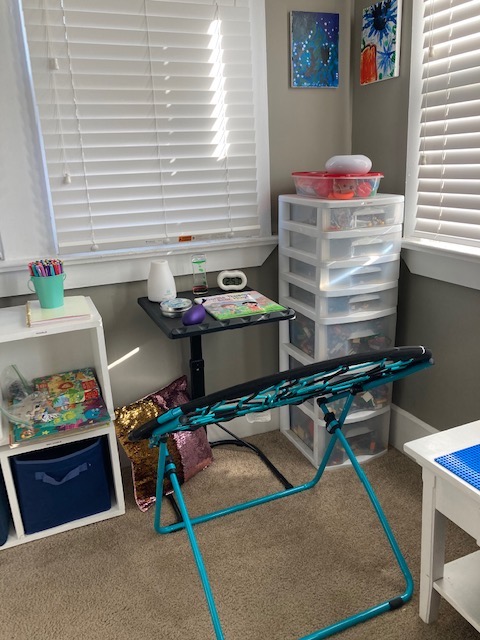
Remember how important it is to teach kids calm down strategies? It’s equally important to provide them with a space to practice those strategies. It might be in the library area of the classroom, an extra desk you have lying around or a corner of the dining room at home. It really doesn’t matter where you set it up, as long as there’s a dedicated space available with a few key tools.

The purpose of a calm down space is to provide kids with a quiet area to go to process through whatever it is they’re feeling. You can include comfortable seating options, low lighting, sensory tools, visual reminders of strategies they’ve been taught, music, drawing materials…the list goes on and on.

The most important thing here is that kids understand that this is not a “time-out” space in a punitive sense but a quiet, calming space with tools to help them self-regulate.

Our calm down space in my kid’s playroom

follow through on commitments.

Teaching kids to honor their commitments is a critical component of self-management. The concepts of perseverance and “stick-to-it-iveness” are ones that our kids are really struggling with, in light of the events of the past two years. However, that does not mean sending the message to kids that they should continue to do things that are unsafe or no longer serve them. This is more about teaching our kids to reflect upon whether or not they really want to join that team, club or activity. Will it fit into their schedule? Is it something they feel passionate about doing or trying? Do they understand what the commitment entails? Does it feel true to who they really are? These are the questions we want our kids to be able to reflect on to push them toward the higher-level goal of making responsible choices for themselves.

set a short-term goal and create an action plan.

If you remember, we’ve seen this strategy before! Goal setting is critical to building both self-awareness and self-management because it helps kids identify something they really want to accomplish and make and carry out a plan for doing it. Before diving into a large or long-term goal, encourage kids to start small. Help them to identify a smaller, short-term goal they would like to meet and teach them to create an action plan for how they will accomplish that goal. Don’t forget to celebrate the small wins along the way to reinforce the progress that is being made, build self-confidence and remind them that they are one step closer to their end goal.

Feel free to share other thoughts, ideas and strategies for building self-management in the comments!

Social-Emotional Learning: The CAsel 5

I’ve recently been working on a new project (details coming soon!) which has required me to really dive into the CASEL framework. If you’re not familiar, the framework is a set of five core social and emotional competencies that are the foundation of social-emotional learning. Additionally, the framework describes the four key settings in which kids spend most of their time and thus, should be learning social-emotional skills.

I thought it might be useful to give a brief synopsis of the CASEL wheel since I’ve spent so much time on social media, YouTube, etc. talking about social-emotional learning lately and not everyone lives and breathes it like I do.

The five core competencies that make up SEL are self-awareness, self-management, social awareness, relationship skills and responsible decision making. They are in that order specifically because the skills embedded into each competency build upon one another. In other words, you need to master the skills within self-awareness BEFORE you tackle the skills within self-management.

So what are the skills within each competency? I’ll briefly outline them below:

Self-Awareness: recognizing, labeling and describing our emotions, identifying our strengths/weaknesses and likes/dislikes, understanding the difference between static and dynamic traits, identifying safe adults and positive role models, understanding that there are positive and negative consequences for our actions, knowing how to care for our emotional selves

Self-Management: identifying and managing our emotions, managing frustration and addressing stress, moving to a calm down space, using strategies to calm ourselves, using self-monitoring strategies, expressing our emotions respectfully, accepting constructive feedback, demonstrating honesty and integrity, setting, monitoring and evaluating goals in life

Social Awareness: demonstrating awareness of other people’s emotions and perspectives, understanding how our own behavior affects the emotions of others, being considerate of others, positively contributing to our communities, demonstrating an awareness of, and respect for, different cultures, reading social cues and responding accordingly

Relationship Skills: effectively communicating with others, using attentive listening skills, working cooperatively with others, developing and maintaining positive relationships, understanding the difference between helpful and harmful behaviors in a relationship, using problem solving and conflict resolution skills

Responsible Decision Making: being positive and accepting of people from other cultures, showing empathy for others, being honest, respectful and compassionate, knowing the steps of effective decision making, having individual roles and responsibilities in a variety of settings

If you’ve been following along with my Social-Emotional Learning YouTube series, you may be wondering how the competencies I’m discussing over there fit into all of this. Each of those 11 skills (kindness, coping skills, social problem solving, etc.) align to one of the five competencies listed above. You can think of them as the subset of skills needed to successfully master each of the core competencies.

If you remember, I also mentioned that the CASEL Wheel identifies four key settings in which social-emotional learning skills are important. These are the classroom, school, home and community. It is important that any school-based social-emotional learning program take into account the external settings of home and community, in order to be as effective as possible.

Now that you (hopefully!) have a better understanding of the building blocks of social-emotional learning, you may be wondering where to even begin. That’s a very fair question since SEL is a term that encompasses a LOT of skills. Check out the list below of a few ideas of where to start:

-Read up on the CASEL Framework here

-Check out my SEL YouTube series here

-Do a little research on your state’s SEL standards (not every state has standards and some states have poor quality standards so you can check out the Michigan standards here to see what high quality SEL standards should look like)

-Follow me on Pinterest for loads of SEL ideas and strategies

-Check out all the resources in my TPT store

-Stay tuned for a BIG announcement that will be verrrryyyy helpful in getting social-emotional learning integrated into your classroom instruction!!!