New parent workshop announcement!

I’m thrilled to announce a brand new parent workshop that focuses on the impact of social media and technology on kids and families! There are two versions of this workshop – one geared toward Catholic schools and includes content related to Blessed Carlo Acutis and one geared toward public and other private schools that does not.

Are your families expressing concerns over their children’s use of technology and social media? Are they wondering how to encourage a more unplugged childhood? Do they want to build a community of other like-minded parents? If so, my newest parent workshop will address all this and more AND in an engaging, hands-on way!

What will you learn during this training?

  1. How social media and technology use impact the brain, learning and behavior
  2. How social media and technology use impact social-emotional and mental health
  3. How to set boundaries and limitations around screens at home
  4. Strategies for encouraging a more unplugged childhood
  5. Ways to build community and support with like-minded families

What else will you get from this training?

  1. Access to a Google folder full of aligned resources
  2. Ongoing support from me

Our children are growing up in a society that values technology and instant gratification over most everything else. This has resulted in less praying and playing and more staying on screens for many of our kids. If your families are looking to empower themselves and their children to take back their childhoods, this workshop will do just that!

This training is designed for parents and caregivers. It can be done as a stand-alone 1-3 hour workshop.

If you’re ready to join the thousands of educators (and parents!) who have benefited from my trainings and expertise, send me an email at alisa@akeducationalconsulting.com. Let me help you build a happier and healthier school community!

Being informed about trauma doesn’t make you trauma-informed

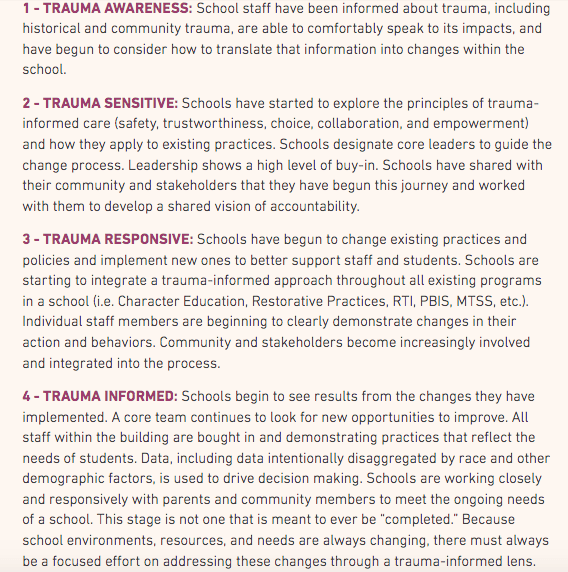
I’ve been reviewing the Missouri Model for Trauma-Informed Schools guidance document, and I LOVE this breakdown of stages to becoming trauma-informed.

I often say that I hate the term “trauma-informed” because it’s so overused and seldom actually understood.

This is such great insight into how most schools are actually only in stage 1 – trauma awareness. Until you begin to research and implement change at the building level, and see the results of those changes, you can’t leave the first stage.

Being informed about trauma does not make you TRAUMA-INFORMED.

Relationship mapping tool

This week, I talked all about the importance of connecting, and building relationships, with kids over on YouTube. One of the strategies I discussed was relationship mapping. I found this excellent tool for use by any teacher/school looking to do a more formal relationship mapping of their students.

I realize that this might be a difficult task to undertake for educators working in larger schools, but if you’re in a smaller school or up to the challenge, this tool really is fantastic and well worth the time it would take to complete.

I’d love to hear from you, if your school has done any kind of relationship mapping! How did you do it? What were the take-aways?

MAY 2024 SEL THEME – RESILIENCE & PERSEVERANCE – The 7 Cs

Whenever I hear the word “resilience,” my mind immediately starts to think of certain sets of student siblings or family members that I’ve had over the years. I’ve always been intrigued by the question, “What causes one sibling to be on an uphill trajectory in life while another sibling makes worrisome choices?”

While we know that the answer is resilience, what does that mean really? How does one build resilience? What traits must they possess to become resilient?

These are just a few of the questions I will address over the course of this month, as we dive into our monthly SEL theme of resilience and perseverance.

First, we know that there are a plethora of traits associated with resilience building, including the following:

  1. Optimism
  2. Gratitude
  3. Strong moral compass
  4. Desire to help others
  5. Sense of purpose
  6. Humor
  7. Positive role models
  8. Social connection
  9. Supportive family relationships
  10. Willingness to confront and grow from fears

We also know that we can help people build resilience in a variety of ways.

The 7 Cs model of resilience building was first published by the American Academy of Pediatrics in 2006. This model provides us with a roadmap for building resilience. By identifying aligned activities and implementing them in our classrooms or homes, we can set our children up to have the ability to bounce back from challenges and roadblocks.

Over the next few weeks, I am going to spend time here and over on my YouTube channel, breaking down each of the 7 Cs. Additionally, I am going to give you actionable activities to help grow resilient learners. I hope you’ll join me!

May 2024 SEL THEME – Resilience & Perseverance – AN INTRODUCTION

Welcome to May and our 5th social-emotional learning theme of the month! This is, arguably, one of the most important skills we can help our kids develop so get ready for some great information and strategies!

In this first week of the month, we will define our theme, discuss why it’s an important SEL skill and talk real-world application. This will serve as a springboard for the resources and other ideas I will be sharing throughout the remainder of the month.

So, let’s dive in!

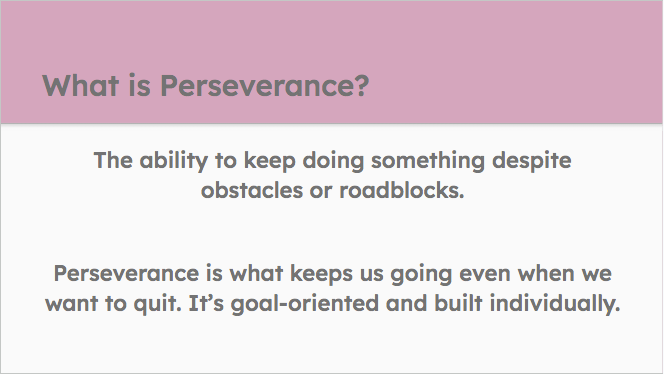
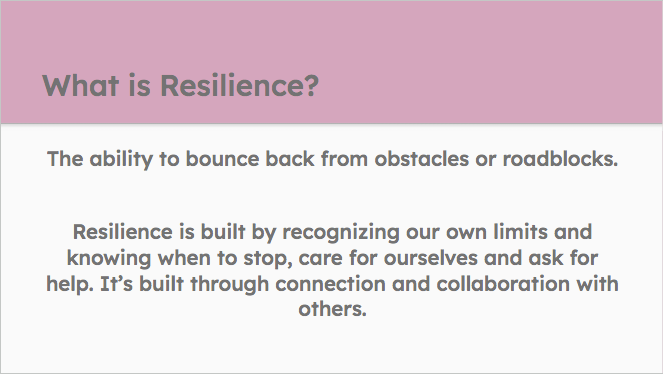
What are resilience and perseverance exactly? You may not know there is a difference between them, but there is! Here’s a good starting point to use with kids of all ages. You can adjust this definition to best fit the needs of the age group you work with. I know many of these themes are pretty self-explanatory, but sometimes we just need someone else to sum it up for us!

Now that kids know what resilience and perseverance are, we need to help them understand why these skills are important and how they will be beneficial to them.

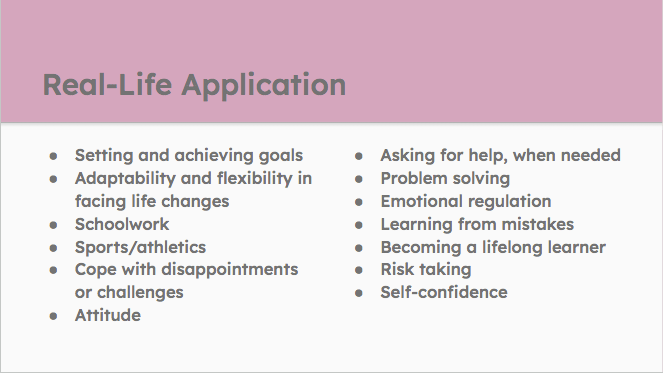
Next, we can begin connecting resilience and perseverance with kids’ real lives by helping them recognize what these skills actually look like and when they may come in handy!

Resilience is a skill that takes some time and support to fully develop. How can you aid your kids or students in resilience building this month and beyond?

Be sure to follow along all month right here on the blog, YouTubeFacebookInstagram and LinkedIn. I will be sharing all sorts of tips, strategies and resources throughout May.

APRIIL 2024 SEL THEME – EMPATHY & COMPASSION – Strategies for parents and educators

Empathy can be a very tricky skill to build in kids. Heck, lots of adults struggle to be empathetic!

Photo by Hiep Nguyen on Pexels.com

Starting early with very young kids is key. Here are three activities/strategies that can be used with kids of all ages but are particularly beneficial to younger kiddos.

  1. Caring for Plants, Animals and Babies – Involving young children in caring for plants, animals and babies is a very effective and “entry-level” way to begin building empathy. Model and assign specific tasks to them and discuss how they are helping that living thing to survive and thrive. Have conversations around how we are all responsible for caring for other living things in the world and encourage them to think of ways they can do so. Eventually, you can take a more global perspective with this strategy by moving from them caring for siblings, houseplants and family pets to caring for these things in their classroom or school community, neighborhood or city and beyond.
  2. Story Talk – This strategy is exactly what it sounds like – talking about the characters in a story. By discussing their lives, their problems and hardships, and how they might be similar or different from us, we can begin to open our children’s eyes to all the different types of people who share our world. Beginning to understand the concept of diversity is a critical first step toward building empathy. If the book calls for it, ask your kids or students to brainstorm ways they could help the character through compassionate acts. This is a great way to, not only build empathy, but encourage kids to take their empathy one step further by acting on it.
  3. Walk the Line – While this activity from Big Life Journal is geared toward older children, you can certainly adjust to make it work for younger kids. The idea is to help a group of kids begin to see how others have similar experiences as them and begin to build empathy for people who seemingly “don’t have problems” or “have it easier than they do.” With younger children, simply focus on identifying the things that kids in the group have in common. This is a great first step. You can also extend this activity through a variety of writing activities that are mentioned at the article link.

What other activities do you use to build empathy in your kids or students? I’d love to hear about them so please share!

MARCH 2024 SEL THEME – CONFLICT RESOLUTION & PROBLEM SOLVING – Recognizing, Identifying and Labeling Emotions

Today, rather than share any strategies with you (which I’ll do next week), let’s talk about the very first step in conflict resolution – being able to recognize, identify and name our own emotions, also known as having self-awareness.

Think about it. If we are unable to identify what we are feeling, as well as the cause of that feeling, it’s going to be nearly impossible to recognize in another person. This lack of self- and social awareness will make it very difficult to resolve any type of conflict that may arise.

Aside from being a critical component of conflict resolution, these emotional awareness skills are really important in so many other facets of life – from emotional regulation to advocating for ourselves.

So how do we help kids build these muscles? Here are a few things you can start doing with kids of any age (but the earlier, the better!)…

  1. Talk about feelings openly and honestly in your home or classroom. We shouldn’t hide them or be ashamed of how we’re feeling. A safe, loving environment is a must in encouraging kids to share their feelings.
  2. Model, model, model. Constantly talk through how YOU are feeling in different situations. Not only will you send the message that it’s ok to share their feelings, you will also be giving them the vocabulary to do so.
  3. Teach emotion vocabulary words. Kids need to know how to label their emotions, and they need more words than just sad, glad and mad! Dig deep with them to get to the root of what they’re feeling and provide them the words until they’re able to do it on their own.
  4. Help kids to understand that feelings are information. We have to pay attention to them to help us decipher the message. Then, we are able to begin the problem solving process.

What else is missing from this list? What do you do to build your kids’ emotional awareness muscles?

FEBRUARY 2024 SEL THEME – KINDNESS – TIPS & STRATEGIES FOR Teachers

Over on YouTube, I’ve shared two really great strategies for educators to instill kindness in students.

The first is a “take what you need” board. The idea is that you fill a bulletin board with quotes or affirmations that students can take when they are feeling overwhelmed, lacking self-confidence, etc.

To create a “take what you need” board, you first want to brainstorm the emotional supports your students may need. For instance, do you notice many students struggling with low self-esteem? Do they seem to need a reminder that they can and will rock exam week?

Once you identify several categories of supports, go in search of inspirational quotes and affirmations that may be helpful to them. Print or write them out to attach to the board. You can even color code the categories to make it easier to replenish as they are taken.

This is a fantastic idea for middle and high school educators and you can definitely get your student council or other similar club involved in helping.

Be sure all the students know about the board, where to find it, how it works, etc. Make sure it is accessible to all. You may even consider adding in some resources for students who are struggling with mental health issues or crises.

The second idea I discussed over on YouTube was a student and/or staff shout-out board. For this, you need to create a form that students or staff members can use to recognize one another. You make these forms available in a central location and have a system for them to be turned in. The forms can be attached to a bulletin board for everyone to read or can be read during morning/afternoon announcements.

This is a great way to encourage your school community to recognize the kind acts/great things happening in the building. Plus, it just makes people feel good to know they have been seen!

If you want to learn more about these strategies, head over to the following links to listen…

Take What You Need Board

Student/Staff Shout Out Board

What are some other ways you can instill kindness in your students?

Mind-Body Skills Part 7: Visualization

**This is Part 7 of a 7 part series on Mind-Body Skills. Check out the introductory post here or follow along on my YouTube channel.

Photo by 100 files on Pexels.com

We’ve come to the final mind-body skill in this series – visualization, the process of creating mental images using our imagination. This might seem like a childish technique, but the benefits of visualization are aplenty.

Studies have shown that visualization can help us achieve goals, reduce stress, increase self-confidence and enhance our creativity and problem solving skills.

Additionally, visualization is a technique that can be employed in a variety of areas in life, including sports training, academics, goal setting, relaxation and more.

There are lots of different visualization strategies. Here are a few:

  1. Guided Imagery – In this strategy, you listen to or read a script that describes a relaxing scene or inspiring scenario to promote relaxation and stress reduction. You can also do this on your own by simply imagining yourself in a relaxing setting or a place that brings you comfort and joy.
  2. Positive Affirmations – This strategy uses positive self-talk, combined with visualization, to reinforce certain beliefs about yourself or goals you are working toward. You, simultaneously, repeat a statement such as “I am loved by many” while imagining yourself surrounded by those who love and care for you.
  3. Mental Rehearsal – This strategy is a way to rehearse events or situations that you will be in that you find difficult, challenging or frightening. For instance, if you have to give a speech in front of a large audience and are terrified of public speaking, mental rehearsal can be used to imagine yourself, from the very beginning to the very end, successfully giving the speech to an engaged and supportive group of people. In this strategy, it’s important to focus on the feelings of confidence and success.

The key to deepening the visualization experience in any of these strategies is employing as many of the five senses as you can. Imagine the sights, sounds and smells around you, the things you can reach out and touch, what something would taste like (if this applies to your visualization journey).

Another important thing to remember about visualization is that it is not just a strategy for adults. Kids can be taught to effectively use visualization strategies in a variety of ways. Visualizing while reading a book is already something we teach in our classrooms; this is a great introduction for teaching kids to use the same strategy in different ways.

You can find a multitude of guided imagery practices online or on different apps like Headspace and Calm. Many of these are even geared specifically toward kids.

How do you use visualization in your life? What benefits have you enjoyed?

Mind-Body Skills Part 6: Writing & journaling

**This is Part 6 of a 7 part series on Mind-Body Skills. Check out the introductory post here or follow along on my YouTube channel.

Photo by olia danilevich on Pexels.com

Whenever I ask a group of educators what they do to calm down or ease stress and anxiety, very few of them say they write or journal. These seem to be activities that people either love or hate.

For the people out there who love them, here are some great ways to incorporate writing into your de-escalation/stress relief/calm down routine. All of these activities can easily be used with kids at home or in the classroom as well.

  1. Ten Favorite… – Pick a category, any category, and write your 10 favorites. For instance, jot down your 10 favorite meals, your 10 favorite things about fall or your 10 favorite ways to spend a lazy day. This writing strategy serves as a great activity for distracting our brain from the stress/anxiety/anger/etc. we are feeling.
  2. Today, I Feel… – At the beginning or end of each day, write 1-2 sentences describing how you feel. How do you feel about the day ahead? How do you feel now that the day is behind you?
  3. Brain Dump – Are there any others out there who struggle to fall asleep at night because of all the thoughts jumbled up in your brain…the things you need to remember or do the next day? Put a little notebook next to your bed, and the next time those thoughts are keeping you awake, get them all out on paper. It doesn’t have to look pretty (sometimes I even do this in the dark!)…you just need to get all those thoughts out of your head. Once you’ve done so, give your brain permission to rest and go to sleep!
  4. Gratitude Journaling – Did you know that speaking your gratitude aloud actually makes you happier? Yep, it’s true! So write it down! Make a list, write it in paragraph form, whatever…just take a few minutes each day to focus on what you’re grateful for.

Are you a journal-er? What writing activities do you enjoy doing to de-stress?