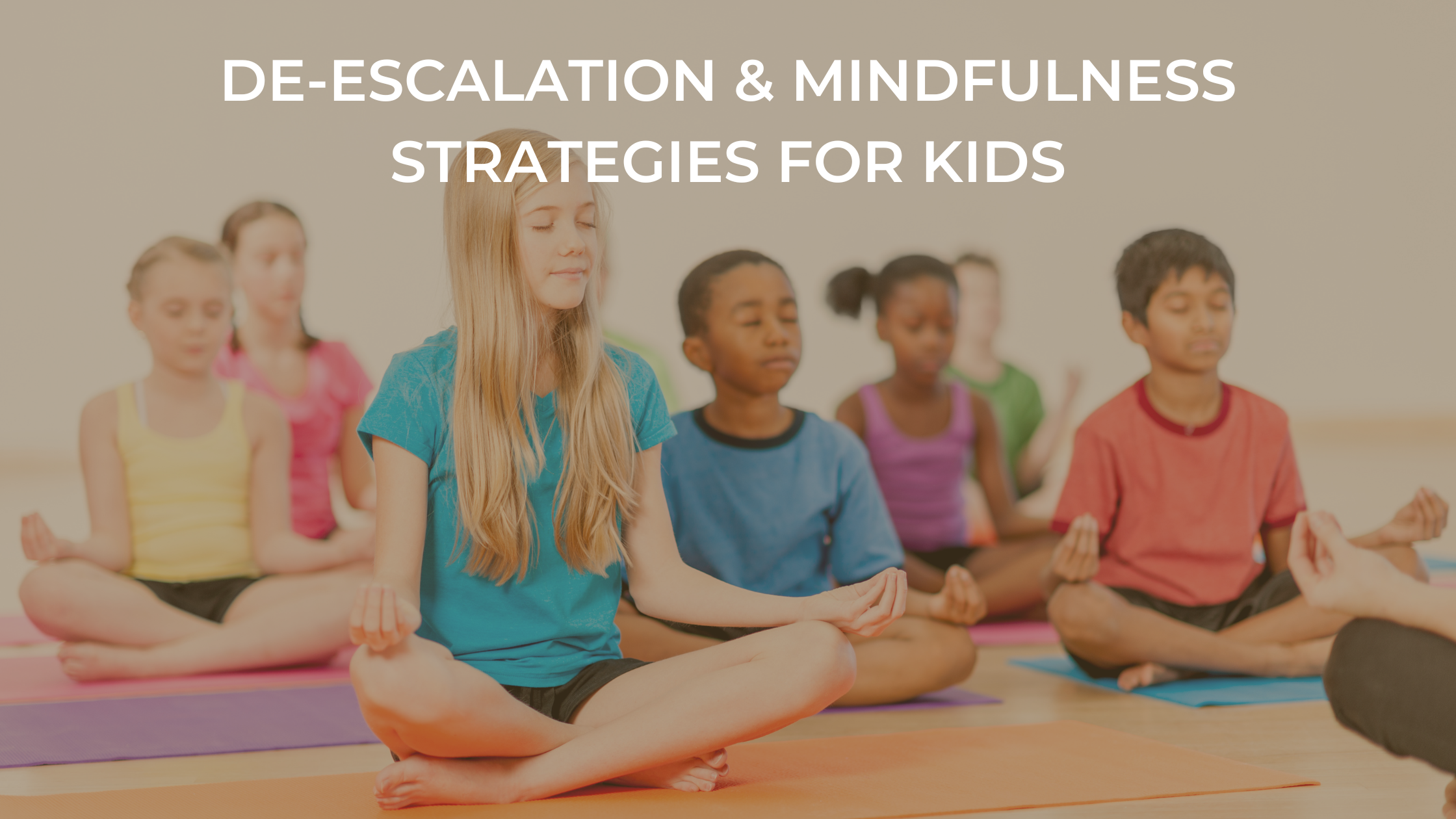
De-Escalation and Mindfulness Strategies for Kids

One of the most popular trainings I do is all about teaching kids strategies for calming down. Why? Because one of the most widespread effects of the pandemic on our children was stress and anxiety which has lead to them having the inability to regulate their emotions. For many kids, this was difficult prior to the pandemic, but now it is the chief concern for most teachers and administrators I talk to.

In light of what our kids have experienced over the past couple of years, it is critical that we give them the tools to understand what they are feeling, why they are feeling it and what to do about those feelings. They need to be explicitly taught strategies for calming down when they are escalated, as well as strategies for helping to keep their brain and body calm.

Fortunately, this training covers exactly how to do that, in addition to:

  1. What is happening in the brain when we become escalated
  2. How to strengthen the neural pathways in the brain to be more reflective
  3. The similarities and differences between de-escalation and mindfulness strategies
  4. How to recognize, identify and label emotions
  5. Dozens of simple strategies kids (and grown-ups!) can use to calm down

If you want to give your students a toolbox full of strategies to self-regulate, as well as better understand what is happening in their brain when they become escalated, this is the perfect training for you. Reach out to me at akedconsult@gmail.com to get more details.

4 Ways to get parent buy-in for sel programming

In the time since the COVID-19 pandemic began in 2020, we have seen a sharp increase in the number of schools putting an intentional focus on social-emotional learning. For many administrators, the goal is to give students and teachers the tools to deal with the multitude of challenges that have resulted from the pandemic.

Since 2020, we have seen more and more children struggle with time management, learning stamina, effective communication and self-regulation skills, to name just a few of these challenges. Many children have had difficulty re-acclimating to the in-person school environment. Others seem to have mysteriously forgotten how to communicate with their peers while many more struggle to express their emotions appropriately.

As these challenges have piled up over recent years, coupled with the many professional and personal difficulties teachers are facing, administrators have scrambled to find ways to help both teachers and students.

Enter social-emotional learning or SEL.

The thing is, SEL is not a new idea, born of the challenges of the pandemic. Schools have been incorporating social-emotional learning strategies for decades. According to the Social Emotional Learning Alliance for the United States (SEL4US), social-emotional learning is a practice that helps kids and adults learn and apply the skills necessary to develop healthy identities, manage emotions, set and achieve goals, feel and show empathy, establish strong relationship skills and make responsible decisions.

If you think back to your own schooling, depending on the type of school you attended, you will likely remember something along the lines of character education or virtues training. In other words…social-emotional learning.

So, if SEL has been around for so long and includes critical skills like the ones listed above, why are we just now beginning to see so many parents seemingly against it? Well, there are many answers to that question, but oftentimes, the true answer comes down to just one thing…misunderstanding.

As a whole, we have not done a great job of helping parents to understand what SEL really is, why it is important and how it is being incorporated into the classroom experience. Thus, we have a large number of parents who simply don’t understand what we mean when we say our school focuses on social-emotional learning.

So how do we fix this? There are 4 simple things we can do to help parents and caregivers better understand social-emotional learning and how it is being used in the school.

  1. Use Less Jargon

Educators are good at jargon…too good, and we often use it when communicating with parents who are likely unfamiliar with our terms. Instead, use simple language. Rather than using terms like “social-emotional learning” or “whole child development,” use words like kindness, empathy and being sensitive to other cultures.

At the end of the day, most parents want to know how their child is doing at school, aside from academics and most parents want their child to grow up to be a good human. That’s the goal of SEL, but we can use other language to communicate that.

  1. Be Clear About What SEL Is

Many parents have pre-conceived notions about what SEL actually is, and oftentimes, those notions are incorrect. Clearly communicate to your families what SEL is in YOUR school or district. Perhaps you have a list of traits or virtues that are being taught. Maybe you have adopted a specific curriculum. Share these, along with resources, with families so they clearly understand what SEL means for their child.

  1. Clearly Communicate How and When SEL is Integrated into the Classroom

Once you have communicated what SEL means in your school or district, it’s just as important that you share how and when it is being integrated into learning. If you’re using a specific curriculum, communicate how many minutes or days per week children will be engaging with it. If you are focusing on key traits, will these be introduced each week during a school-wide community meeting, taught once a month by the school counselor or integrated into a variety of classroom activities each week? Clearly communicating these parameters will often help ease parents’ ill feelings.

  1. Engage Parents

After communicating what SEL is and how and when it will be used, it’s critical to continue to engage parents in your school’s programming. Sending resources home to better educate them is a great start, but be sure to continue sharing with them as the school year progresses. Share some of the strategies or language being used at school and encourage them to use these at home as well. Help them understand how the programming is beneficial to their child AND their family, how strategies can be used at home to make life just a little bit easier. Let’s face it…we are all facing challenges in this post-pandemic world and can use all the help we can get…even parents.

I’d love to hear what you are doing (or have done!) to get buy-in from your parents for SEL programming. Comment on this post or shoot me an email at akedconsult@gmail.com.

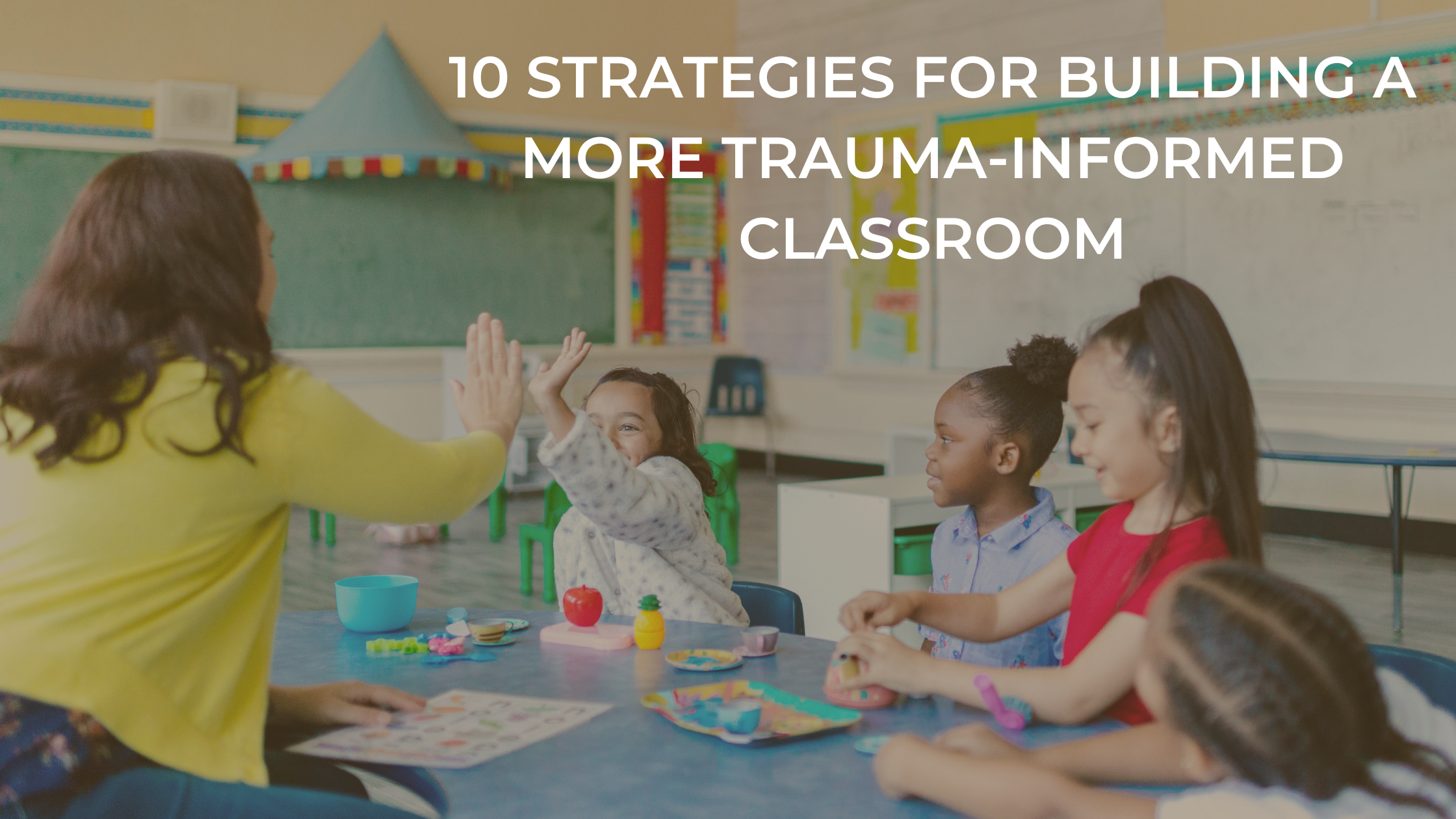
10 Strategies for Building a More Trauma-Informed Classroom

My flagship, and most popular, training is 10 Strategies for Building a More Trauma-Informed Classroom. This training covers a LOT of material and is a great introduction for teachers and school staff who do not have a lot of experience with trauma-informed practices in the school environment. Not only will teachers get a solid foundation in what trauma-informed care looks like in a classroom and why it is critical to the success of their students, but they will also walk away with a toolbox full of strategies that they can begin using immediately. These strategies don’t cost a lot of money or take a lot of time to implement. They are simple, common sense strategies that are just best practice for ALL kids.

Additionally, this training will cover:

  1. The 3 Types of Trauma
  2. Adverse Childhood Experiences (or ACEs)
  3. Characteristics of Trauma
  4. How Trauma Impacts the Brain, Learning and Behavior
  5. Trauma-Informed Discipline
  6. Mindfulness and De-Escalation Strategies
  7. 10 Strategies for Building a More Trauma-Informed Classroom
  8. How to Get Started

If you are looking to give your teachers a toolbox full of strategies to help them have a successful year with students, particularly struggling students, this training is a great place to begin. It is typically a 6 hour training but topics can be added or subtracted, as necessary. This training is also great done in smaller 1-2 chunks during monthly staff meetings. Contact me today for more information or to schedule your next professional development.

New Training Announcement! – Fostering family engagement within your school

I’m so excited to roll out my brand new training just in time for the beginning of the school year! This training is a critical component of building a trauma-informed school (see step #6 below).

There’s been a lot of chatter online lately about the difference between parent involvement and family engagement in schools (and yes, there is a huge difference!). Traditionally, schools have considered parents to be involved when they volunteer in the classroom, attend field trips or send in classroom donations. These things are great (and necessary!), but they do not necessarily equate to parents and caregivers being in true collaboration with the school. Additionally, this type of “involvement” is often exclusive to parents who have the time and financial means to participate in their child’s education in this way.

If your school is instead looking to partner with ALL families in a meaningful way by building strong relationships, engaging them in the curriculum and providing tools for helping children at home, this training is for you!

A few things you will learn during this training include:

  1. Specific strategies for engaging families as your partner in educating their child
  2. Tips to streamline family-school communication to reach more families
  3. Steps to establish a parent outreach coordinator or team
  4. How to host family workshops and interactive events that provide caregivers the tools and strategies to help their child academically, behaviorally and social-emotionally
  5. Strategies for building strong relationships between teachers, students and caregivers

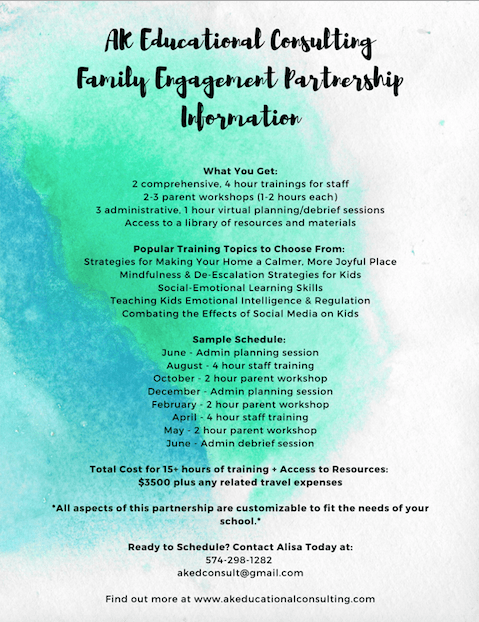
This training is designed for teachers and other school staff. It can be done as a stand-alone 2, 4 or 6 hour professional development or as a partnership, in conjunction with a combination of my parent workshops (see informational flyer below).

If you’re ready to join the thousands of educators (and parents!) who have benefited from my trainings and expertise, send me an email at akedconsult@gmail.com. Let me help you build a trauma-informed school!

Coming soon!!! – Indiana School Counselor and Administrator Collaboration Institute (ISCACI)

Calling all school leaders (principals, assistant principals), school counselors, and graduate students/alumni in school counseling and educational leadership programs! You are cordially invited to join us at the inaugural Indiana School Counselor and Administrator Collaboration Institute (ISCACI). This conference focuses on school administrator-school counselor collaboration to better meet all PK-12 student needs. Three nationally and internationally known speakers will provide workshops and a keynote, and 34 local presenters will share knowledge and resources in breakout sessions during this exciting two-day event in June at Ball State University. We hope to see you there!  

Conference information

Dates: June 13-14, 2022

Location: Ball State Alumni Center, 2800 W. Bethel Ave., Muncie, IN  47304

Website: https://ncyionline.org/conferences/iscaci/

Cost: $20 (Graduate Student) and $95 (Early Bird Regular Registration)

Meals provided: Breakfast and Lunch for Two Days

Breakout session presenters are from a variety of organizations, such as the Indiana Department of Education, Standard for Success, local Indiana school districts, Indiana Online, and much more! Breakout session topics include:

  • Student Success
  • Community Engagement
  • College & Career Readiness
  • Educational Equity 
  • Principal/Counselor Relationships

Workshop: “Integrating MTSS Into Your Comprehensive School Counselor Program (CSCP)” with Dr. Carol Dahir from New York Institute of Technology

Workshop: “Working Together to Support Students” with Dr. Leigh Bagwell who recently served with the Tennessee Department of Education.

Keynote: “How Do You View the World? A Discussion of Diversity and Equity” with Robert Jamison from Virginia Beach City Public Schools.

Please contact Dr. Rachel Geesa (rlgeesa@bsu.edu) and Dr. Theresa Kruczek (tkruczek@bsu.edu) if you have questions about the conference.

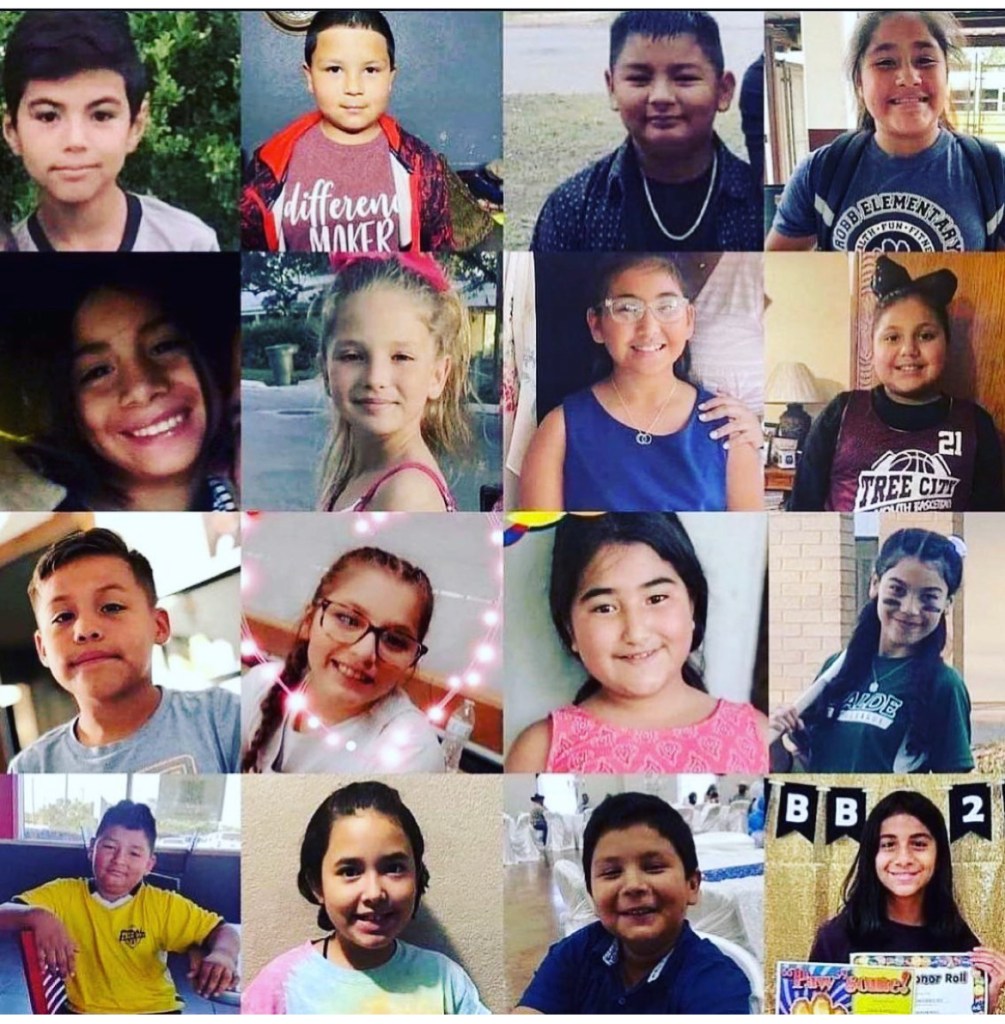
My Thoughts on yesterday’s school shooting in uvalde, Texas

Photo courtesy of NBC News

I’m sitting here wondering how to express the thoughts going through my mind this morning, wondering what I could possibly say that is of any importance right now, wondering how our nation got to this place. I’m heartbroken for the people of Uvalde, Texas. As an educator and more importantly, as a mother, I’m feeling devastated, sad, helpless, scared and angry.

The shooting that occurred yesterday at Robb Elementary School killed 19 children and 2 adults, making it the 2nd deadliest school shooting on record behind Sandy Hook, and was the 27th school shooting of 2022. 27th. Let that sink in for a minute. In 2021, there were 34 school shootings and yesterday marked the 27th of this year. In May.

Between 1970 and 2021, 637 people were killed in school shootings. Obviously, this number has increased with the additional 27 shootings that have happened in 2022.

When does enough become enough? When do we stop being ok with children regularly practicing lockdown and active shooter drills during instructional time? When do we stop expecting school leaders to walk through their buildings several times a year, jiggling doorknobs and peeking through windows to ensure classrooms are locked and all children are out of sight?

I know that our country is full of “experts” this morning; people who think they know where we’ve gone wrong and how to fix it, people who will use this tragedy to push their own political platform and agenda. I am not one of those people. Why? Because, in my opinion, the number of ways we’ve gone wrong, as a country, is too many to count, particularly when it comes to our educational system. Because I don’t believe there is ONE solution to this problem. Because I don’t view the devastation that occurred in Uvalde yesterday as a political event. I view it as a human event; one where dozens of parents lost their babies and the community lost two beloved teachers.

Maybe, this morning, you’re wondering what can be done to stop this madness. Perhaps, like me, you’re not there yet and are still just full of grief and heartbreak for this community and our nation, as whole. I’m sure the coming days and weeks will be a barrage of “next steps,” but for me, for now, I am going to allow myself the time and space to feel sad, helpless and angry. Then, when I’m ready, I’m going to keep doing what I can to continue to bring awareness to the importance of trauma-informed practices, social-emotional learning and relationship building in schools. I’m not naive enough to believe that these things alone will even remotely impact the monumental mess we are facing in this country, but I know, for a fact, that they can and DO make a HUGE difference in the lives of individual children. And for now, that is good enough for me.

5 Ways to Address Mental Health Awareness Month with kids (Plus a freebie!)

Download and print this infographic, highlighting 5 ways you can address Mental Health Awareness month with kids in the classroom or at home!

New Training Announcement! 6 Strategies for building strong connections with kids

I’m so excited to announce my newest training – 6 Strategies for Building Strong Connections with Kids. As I talk about in all my other trainings, building strong relationships is really the foundation for all trauma-informed care, particularly in schools.

We cannot expect to get anywhere with the students or kids we work with without first building a relationship based on mutual trust, respect and compassion. This relationship becomes the basis for digging deeper into a child’s past experiences to better understand their words, actions and behaviors. By doing this, we can then provide them with the supports they need most and set them up for success in their school and home environments.

This professional development will cover the benefits of strong relationships for both children and adults and 6 key strategies that can be used to build, strengthen and maintain strong relationships with kids. This training is applicable to just about anyone who works with kids, from teachers and social workers to school counselors and childcare workers.

The strategies that are covered (in much greater detail) are:

  1. Know Their Story
  2. Be Human
  3. We are Family
  4. Build Them Up
  5. Thoughtfully Interact
  6. Be an Advocate

Interested in learning more? Send me an email at akedconsult@gmail.com.

5 Strategies for Building decision making skills in kids

Over the past several blog posts, we’ve focused on each of the individual competencies within the CASEL social-emotional learning framework. So far, we have talked about the first four competencies – self-awareness, self-management, social awareness and relationship skills. Today, we will dig into the final competency – responsible decision making.

I think we can all agree that the skills within this competency are probably the ones that keep most parents awake at night. How do we teach our kids to not only make decisions but make RESPONSIBLE decisions?

This skill is critical to a child’s safety and really sets the tone for the kind of person they will become. Making responsible decisions really encompasses so many different facets of a child’s life – behavior, personal safety, social interactions, their well-being and the well-being of those around them. The list goes on and on.

While there are so many different skills within this competency, there are a few key strategies we can teach kids to set a strong foundation for responsible decision making all the way through adulthood.

Teach kids to identify bullying and know what to do about it

Kids need to know what bullying is – what it looks like, what it sounds like and what they can do about it. Talk about the different types of bullying (physical, verbal, social and cyber). Help them to understand that bullying means repetitive, unwanted, aggressive and one-sided behaviors that target a specific person or group. Empower kids with the tools to recognize bullying, stand up for the person being bullied and seek help from an adult.

There are so many amazing tools online to help teach kids about bullying. This website is a great place to start and includes a wealth of information and resources to support you.

Teach kids to advocate for themselves

If we are going to give kids the tools to stand up for other people, we should probably also give them the tools to stand up and advocate for themselves. This is something that I have really been working on with my 2nd and 5th graders for the past year or so.

Begin by talking through social situations your child encounters after the fact. My children often come home from school upset about something that was said or done to them. In those situations, I always review with them what is ok for them to say and/or do. For example, if my preschooler mentions that someone hit him because they wanted the toy he was playing with, the conversation may go something like this:

Me: Did you tell him not to hit you, that you don’t like that?

Preschooler: No, I told on him.

Me: If someone is hurting you, it’s ok to say, “Don’t hit me. I do not like that.” You can stand up for yourself. Then, if he doesn’t stop, you can find an adult to help you.

This takes time and practice, but it’s so worth it. Not only am I modeling what is ok to say and do, I’m helping my kids understand that they don’t always have to rely on an adult to solve their problems.

With older children, the situation may involve an adult such as a teacher. Those are important conversations to model as well because you’re helping your child understand how to handle a situation in which they are likely uncomfortable and unsure of themselves.

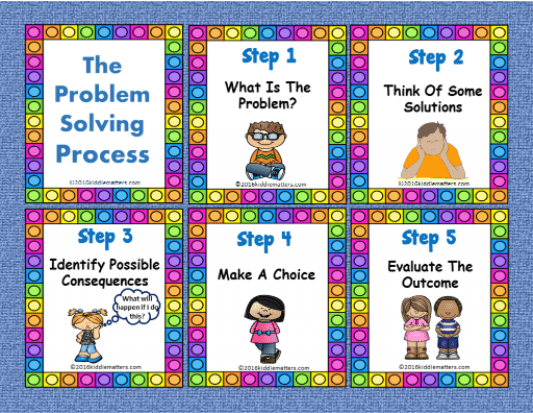
Introduce kids to the decision making process

I really like this visual for teaching the decision making process from Kiddie Matters because it is simple to follow and fairly self-explanatory. Go over each step of the process, model what it might look like and practice by applying it to a variety of situations to give kids practice.

If we give kids the foundation for making responsible decisions when they are young, we can support them in applying it to more complex decisions as they get older.

Stop, Think, Act Strategy

This is a fantastic strategy for kids to have in their toolbox for a variety of situations. It can be used as a coping skill, a problem solving strategy or a way to make responsible decisions. The idea behind this strategy is that kids stop and take a moment to think through the situation, decision, problem, etc. before acting. This allows kids to be more reflective and proactive rather than impulsive and reactive. That’s never a bad thing!

Know the difference between above the line and below the line behaviors

You may remember this strategy from the post on relationship skills, and that’s ok! There is a lot of overlap within the competencies.

I don’t remember where I first heard that term, but it has stuck with me for years now. Above the line behaviors are positive and below the line behaviors are negative. Another way to think of it is above the line behaviors are characteristic of a healthy friendship or relationship while below the line behaviors are those reminiscent of an unhealthy relationship. Create an anchor chart of each type of behavior or the traits of a good friend. Read and discuss stories with examples of strong, healthy relationships, as well as ones where bullying or unhealthy relationships are happening. Help students understand that everyone is deserving of healthy relationships and, depending upon age, discuss ways to seek help if they are involved in an unhealthy relationship.

It’s helpful for kids to have a solid understanding of this, as it will (hopefully!) inform their own decision making regarding their behavior, personal safety, advocacy of others and relationships.

Have other ideas of great strategies for building decision making skills in kids? Share them with me!

5 Strategies for building relationship skills in Kids

Over the past month or so, we’ve been focusing on the individual competencies within the CASEL social-emotional learning framework. So far, we’ve talked in depth about self-awareness, self-management and social awareness. Today, we will dive into the next competency – relationship skills.

There’s certainly no denying the fact that our kids’ relationship and communication skills took a hit because of the pandemic. Think about it – kids were isolated from their peers, communicating primarily with the people they live with or via a screen, missing out on critical conflict resolution opportunities (i.e. recess, playdates, etc.). It’s no wonder so many teachers consider the lack of relationship and communication skills to be one of their biggest battles now that in-person school has resumed.

To further illustrate this point, let me tell a personal story. Toward the end of the initial COVID lockdown, my daughter and I were invited over to her best friend’s house for a “porch playdate.” The girls (1st graders at the time) were going to play together on the porch while the moms chatted. This was the first time the girls were going to be together in person in several months. They were both so excited!

That morning, we walked over to their house. Her best friend had pulled out a wide variety of toys they could play with. They sat down on the ground, and her mom and I got to chatting. After several minutes, I realized that neither of the girls were talking to one another. They were both quietly playing with the flip sequins on my daughter’s backpack. I made a joke about how they were allowed to talk to one another and returned to chatting with her mom.

A few more minutes passed, and suddenly her dad popped his head out the front door. He seemed surprised to find us on the porch. He said it seemed so quiet outside, he thought we had gone for a walk. I laughed and said that I had just made a similar comment.

As time went on, the girls seemed to warm up and began to play. As my daughter and I were walking home, I asked her why she seemed so hesitant to talk and play with her best friend, but she didn’t really have an answer.

For the rest of the day, I kept thinking about the playdate, and it finally hit me! The girls had (in a sense) forgotten how to communicate! They had spent so many months in isolation, with just their parents and siblings, they were unsure of how to go about resuming “normal” play.

While it took me awhile to come to this conclusion, it’s since become clear that this is a widespread problem. As I travel to schools all over the country, I’ve had teacher after teacher verbalize this very same issue…even 2 years into the pandemic!

Our kids spent a long time being isolated from their peers and missing out on learning and practicing some pretty critical communication skills. It’s really no wonder this has become such a problem. The question becomes…What can we do about it?

Read on for 5 strategies to help our kids rebuild or strengthen their relationship and communication skills.

practice cooperative learning skills.

With students spending so much time doing virtual learning, hundreds of opportunities to build cooperative learning skills were missed. We need to provide those opportunities now. Allow students to work in partners, trios or larger groups as often as possible. Review, model and practice the skills necessary for successful cooperative learning – listening, encouraging, compromising, coming to a consensus, etc. Give kids the time and space to flex those muscles once again, and it will eventually all come back to them.

Teach kids how to communicate their wants and needs.

A huge component of building healthy relationships is having the ability to advocate for yourself when necessary. This is a skill that most kids are not well versed in. We can help them with this, though, by discussing the difference between needs and wants, listing out possible needs and wants and helping them to understand why it’s so important to be able to communicate these to others. Talk about this concept within the context of different types of relationships – friendships, student/teacher, parent/child, etc.

Know the difference between above the line and below the line behaviors.

I don’t remember where I first heard that term, but it has stuck with me for years now. Above the line behaviors are positive and below the line behaviors are negative. Another way to think of it is above the line behaviors are characteristic of a healthy friendship or relationship while below the line behaviors are those reminiscent of an unhealthy relationship. Create an anchor chart of each type of behavior or the traits of a good friend. Read and discuss stories with examples of strong, healthy relationships, as well as ones where bullying or unhealthy relationships are happening. Help students understand that everyone is deserving of healthy relationships and, depending upon age, discuss ways to seek help if they are involved in an unhealthy relationship.

Teach respectful disagreement strategies.

I know, I know…this same strategy was included in the social awareness post. I feel so strongly about this one, though, I’m including it again. You can read about it more here.

Arm kids with conflict resolution strategies.

Conflict is going to happen. We can’t avoid it, but we can provide kids with a wide variety of conflict resolution strategies so they are ready when it happens. Kids will not learn how to solve conflicts through osmosis. We have to explicitly teach the strategies and model, model, model. Then, we have to walk them through the conflict resolution process over and over again until they feel ready to independently tackle the problem. This is not a quick strategy, but it will pay off in the long run when we have kids who can independently resolve their conflicts and not rely on us to solve every little problem they run into. That’s worth it, in my opinion!

What other strategies would you include on this list?